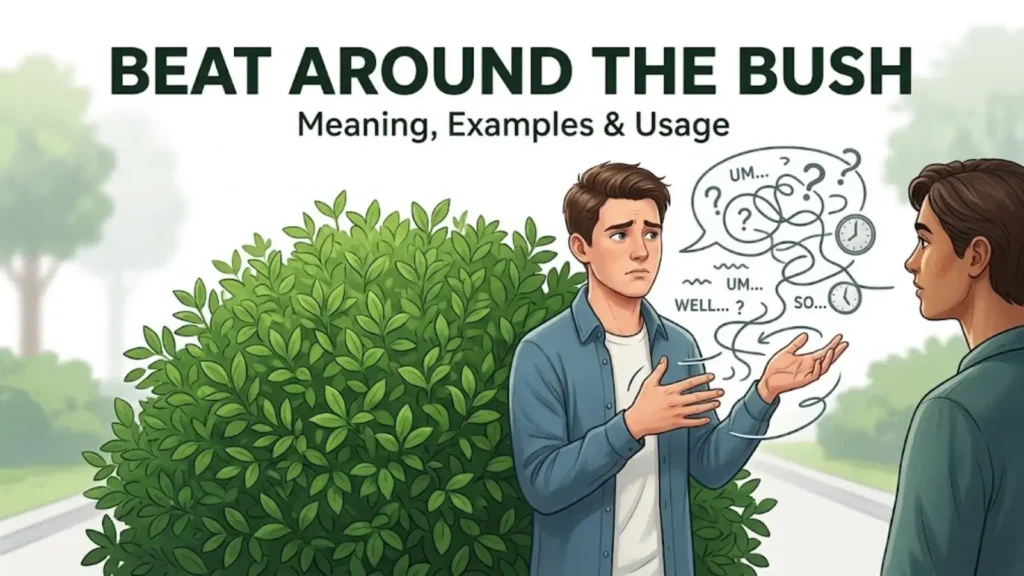
Have you ever asked someone a simple question, only to receive a long answer that never gets to the point? Perhaps a friend avoids discussing an uncomfortable subject, or a coworker keeps talking without explaining the real problem. In English, there is a popular expression for this behavior: beat around the bush.
The idiom beat around the bush means to avoid talking about something directly. Instead of giving a clear answer, someone may use unnecessary words, change the subject, or delay sharing important information. The expression is common in everyday conversations, workplace discussions, books, and informal writing.
English learners sometimes find this phrase confusing because its meaning is not obvious from the individual words. After all, beating a bush sounds like a physical action rather than a way of speaking. However, like many English idioms, its figurative meaning is different from its literal meaning.
Beat Around the Bush – Quick Answer
Beat around the bush is an English idiom meaning to avoid discussing a subject directly or to delay getting to the main point.
- ✅ Correct expression: Beat around the bush
- ✅ Meaning: Avoid speaking directly about something.
- ✅ Similar expression: Get to the point.
- ❌ Incorrect variation: Beat around bushes, when you intend to use the established idiom without a specific reason.
Examples
- Stop beating around the bush and tell me what happened.
- The manager beat around the bush instead of explaining the decision.
- I know you have something important to say, so please do not beat around the bush.
- She was beating around the bush because she felt uncomfortable discussing the problem.
In each example, someone avoids speaking clearly or directly.
| Expression | Meaning | Usage |
|---|---|---|
| Beat around the bush | Avoid the main point | Common idiom |
| Get to the point | Speak directly | Common alternative |
| Be straightforward | Communicate clearly | Neutral or professional |
| Talk in circles | Repeat ideas without reaching a conclusion | Informal expression |
| Come straight to the point | Address the main issue directly | Conversational and professional |
Meaning and Definition of Beat Around the Bush
The expression beat around the bush is an idiom. An idiom is a phrase whose established meaning cannot always be understood from its individual words.
In this case, the phrase describes indirect communication. A person might avoid answering a question, delay delivering important news, or discuss minor details instead of addressing the real issue.
What Does Beat Around the Bush Mean?
To beat around the bush means to avoid saying something directly, especially when a person feels nervous, embarrassed, uncertain, or unwilling to discuss a subject.
The phrase usually suggests that someone should communicate more clearly. However, it does not always mean the person is deliberately dishonest. Sometimes, people simply struggle to find the right words.
Examples:
1. Please stop beating around the bush and explain why you called.
- The speaker wants a direct explanation rather than unnecessary discussion.
2. He beat around the bush before admitting his mistake.
- He delayed acknowledging what he had done.
3. Instead of beating around the bush, Maya explained the problem honestly.
- Maya addressed the issue directly.
How Is the Expression Used Grammatically?
The expression contains the base verb beat, the preposition around, and the noun phrase the bush. It changes tense according to the subject and time being discussed.
| Grammatical Form | Example |
|---|---|
| Present simple | He beats around the bush. |
| Present continuous | He is beating around the bush. |
| Past simple | He beat around the bush. |
| Present perfect | He has beaten around the bush. |
| Future | He will beat around the bush. |
| Negative | Do not beat around the bush. |
Notice that the past tense of beat is also beat, but its past participle is beaten. Therefore, both he beat around the bush yesterday and he has beaten around the bush before are grammatically correct.
The Origin and History of Beat Around the Bush
The expression beat around the bush has a long history in English. Its precise origin is not completely certain, so it is important to distinguish a traditional explanation from a proven historical fact.
One commonly cited explanation connects the phrase with hunting practices. Hunters or helpers might beat vegetation to disturb birds or other game, encouraging the animals to move into the open. The person doing the beating would work around the bushes rather than directly confronting the animal.
Over time, the image became associated with approaching a subject indirectly instead of addressing it directly. This explanation makes sense as an image, but it should not be treated as definitive proof of the idiom’s origin.
The expression was established in English centuries ago. An early related form, beat about the bush, appears in older English usage. The word about in this expression serves a similar function to around.
Today, the phrase has a figurative meaning. People rarely use it to describe physically striking bushes. Instead, they use it when someone avoids the main subject or takes too long to communicate an important point.
For example, a person who spends ten minutes discussing minor details before answering a simple question may be described as beating around the bush.
Main Differences Between Beat Around the Bush and Similar Expressions
Although several English expressions describe indirect communication, they do not always carry exactly the same tone.
Beat around the bush emphasizes avoiding the main issue. Other expressions may focus on unnecessary repetition, vague language, or the need for a direct answer.
| Feature | Beat Around the Bush | Get to the Point |
|---|---|---|
| Meaning | Avoid the main issue | Address the main issue directly |
| Purpose | Describes indirect communication | Requests direct communication |
| Tone | Often critical or impatient | Direct and practical |
| Grammar | Idiomatic verb phrase | Verb phrase |
| Example | Stop beating around the bush. | Please get to the point. |
Beat Around the Bush vs Talk in Circles
Talk in circles means to repeat ideas or speak without making meaningful progress toward a conclusion. A person can talk in circles without intentionally avoiding a particular subject.
Example:
- ✅ We talked in circles for an hour without reaching an agreement.
- ✅ He beat around the bush instead of answering my question.
Both expressions describe unproductive communication, but their emphasis differs.
Beat Around the Bush vs Sugarcoat
To sugarcoat something means to make unpleasant information sound less harsh or negative than it really is.
Example:
- ✅ Do not sugarcoat the results; explain what went wrong.
- ✅ Do not beat around the bush; tell me what went wrong.
The first expression concerns softening unpleasant information. The second concerns avoiding a direct answer or the main issue.
British English vs American English
The expression beat around the bush is used in both British and American English. There is no major difference in its basic meaning or grammatical function.
However, you may encounter the alternative spelling beat about the bush, particularly in British English. Both versions express the idea of avoiding a direct discussion.
| Variety | Common Expression | Meaning |
|---|---|---|
| American English | Beat around the bush | Avoid the main point |
| British English | Beat around the bush | Avoid the main point |
| British English | Beat about the bush | Avoid the main point |
| International English | Beat around the bush | Widely understood idiom |
These are variations of the same idiomatic expression, not completely different idioms. When writing for a particular audience, choose the form that fits your usual English variety and maintain consistency.
Which Form Should You Use?
The expression works in many situations, but its tone matters. Because it can suggest impatience or criticism, consider your audience before using it.
School and University Assignments
You can use the idiom in dialogue, creative writing, and explanations of figurative language. In formal academic analysis, however, a direct explanation such as avoiding the main issue may be more suitable.
Example:
– ✅ The character beats around the bush because she fears revealing the truth.
This sentence works well when discussing a character’s behavior.
Professional and Academic Writing
In workplace conversations, the expression can encourage someone to communicate clearly. Nevertheless, it may sound impatient if directed at a colleague or manager.
Instead of saying, “Stop beating around the bush,” you could say, “Could we focus on the main issue?” This alternative sounds more diplomatic in formal settings.
Blogging and Website Content
Bloggers can use the idiom naturally in articles about communication, relationships, workplace behavior, and English vocabulary.
For example:
- Stop beating around the bush and explain the problem clearly.
- Effective communication means addressing difficult subjects without beating around the bush.
These examples use the expression naturally while showing its intended meaning.
Everyday Conversation
The idiom is especially useful in informal conversations with friends and family.
Example:
- “You look worried. What’s wrong?”
- “Please stop beating around the bush and tell me.”
Social Media and Informal Writing
The phrase also works in messages, comments, and posts when someone wants a direct answer.
Example:
“Life is easier when people stop beating around the bush and communicate honestly.”
Because the expression is familiar and conversational, it can make informal writing feel natural.
Common Mistakes to Avoid
1. Taking the Expression Literally
❌ He beat around the bush, so he must have physically hit a plant.
✅ He beat around the bush instead of explaining his decision.
Why? The expression usually has a figurative meaning. It describes indirect communication, not physical activity.
2. Using the Wrong Past Participle
❌ She has beat around the bush several times.
✅ She has beaten around the bush several times.
Why? The past participle of beat is beaten. Use it with auxiliary verbs such as has, have, and had.
3. Confusing It With Being Dishonest
❌ Anyone who beats around the bush is definitely lying.
✅ He beat around the bush because he felt nervous about discussing the problem.
Why? Avoiding a direct answer does not automatically mean someone is lying. The person may feel uncomfortable, embarrassed, or unsure how to respond.
4. Using the Idiom in Every Formal Situation
❌ Dear Professor, you are beating around the bush in your explanation.
✅ Dear Professor, could you clarify the main point of your explanation?
Why? The idiom can sound accusatory. A polite, direct alternative is usually better when addressing someone in a formal setting.
5. Confusing the Idiom With Its Opposite
❌ She beat around the bush by answering the question immediately and clearly.
✅ She avoided answering the question and beat around the bush.
Why? The idiom describes avoiding the main point. Answering a question clearly is the opposite behavior.
Beat Around the Bush in Everyday English
Here are additional examples showing how the idiom works in different situations.
Everyday Conversation
- “You seem upset. Stop beating around the bush and tell me what’s wrong.”
- “He beat around the bush when I asked whether he wanted to come.”
Both examples describe someone avoiding a direct conversation.
School and Education
- The student beat around the bush instead of explaining why the assignment was late.
- The teacher asked the class to stop beating around the bush and answer the question.
In both cases, the expression highlights the need for a clear response.
Blogging and Content Writing
- Do not beat around the bush when explaining the benefits of your product.
- Readers appreciate articles that address their questions without beating around the bush.
These examples show how the idiom can describe clear and effective writing.
Business and Professional Communication
- The manager stopped beating around the bush and explained the company’s decision.
- During the meeting, everyone wanted the director to stop beating around the bush and discuss the budget.
The idiom is useful in business conversations, although a more diplomatic alternative may suit sensitive situations.
News and Public Discussions
- The interviewer asked the politician to stop beating around the bush and answer the question.
- The spokesperson beat around the bush instead of addressing public concerns directly.
These examples illustrate how the expression describes indirect answers during public discussions.
Quick Tips to Remember the Meaning
- Remember the main idea: The idiom means avoiding the main point rather than speaking directly.
- Think about a difficult question: If someone keeps changing the subject instead of answering, they may be beating around the bush.
- Learn the opposite: Get to the point means to address the main issue directly.
- Practise the verb forms: Beat, beats, beating, and beaten appear in different grammatical constructions.
- Consider the tone: The phrase can sound critical, so use a more polite alternative when necessary.
A simple example to remember is: “Stop beating around the bush and tell me the truth.”
Frequently Asked Questions (FAQs)
1. What does beat around the bush mean?
Beat around the bush means to avoid discussing something directly. Instead of addressing the main point, a person may delay, change the subject, or use unnecessary words.
2. Is beat around the bush an idiom?
Yes, it is a common English idiom. Its figurative meaning is different from the literal meaning of hitting or moving around a bush.
3. Is beat around the bush positive or negative?
The expression is usually critical or mildly negative because it suggests that someone is avoiding a direct answer. However, its tone depends on the context and how the speaker uses it.
4. What is another word for beat around the bush?
Possible alternatives include avoid the main issue, be indirect, and talk in circles. The best choice depends on whether you want to describe vague communication, repetition, or deliberate avoidance.
5. Is beat around the bush used in British and American English?
Yes, both British and American speakers use beat around the bush. The alternative beat about the bush is also established, especially in British English.
6. What is the past tense of beat around the bush?
The simple past is beat around the bush. For example, “He beat around the bush yesterday.” The past participle is beaten, as in “He has beaten around the bush before.”
7. Can I use beat around the bush in formal writing?
You can use it when an idiom suits the context, particularly in articles, dialogue, or discussions of communication. In highly formal reports, avoid the main issue or provide a direct answer may be more appropriate.
8. What is the opposite of beat around the bush?
The opposite is to speak directly or get straight to the point. Expressions such as be straightforward and come straight to the point communicate this idea.
9. Why do people beat around the bush?
People may avoid direct communication because they feel nervous, embarrassed, uncertain, or afraid of upsetting someone. The expression describes their communication style, but it does not prove that they are dishonest.
10. How do I use beat around the bush in a sentence?
Use the expression when someone avoids addressing the main subject. For example, “Instead of beating around the bush, she explained exactly what had happened.”
Conclusion
The idiom beat around the bush means to avoid discussing something directly instead of addressing the main point. It is commonly used in everyday conversations, workplace discussions, storytelling, and informal writing. Although it can express frustration, it does not necessarily mean someone is lying; a person may simply feel uncomfortable discussing a difficult subject.
Remember that the expression changes tense according to the sentence: beat around the bush, beating around the bush, and has beaten around the bush are all useful forms. The phrase is widely understood in both British and American English, although beat about the bush is another established variation.
When you want someone to communicate clearly, you can ask them to stop beating around the bush. In professional situations, however, a polite request to address the main issue may work better.

Hi, I’m Victoria Lane, the voice behind Wordspry!
I’m passionate about helping students and readers master English grammar, vocabulary, and writing through simple, friendly, and easy-to-follow content.