Quick Answer:
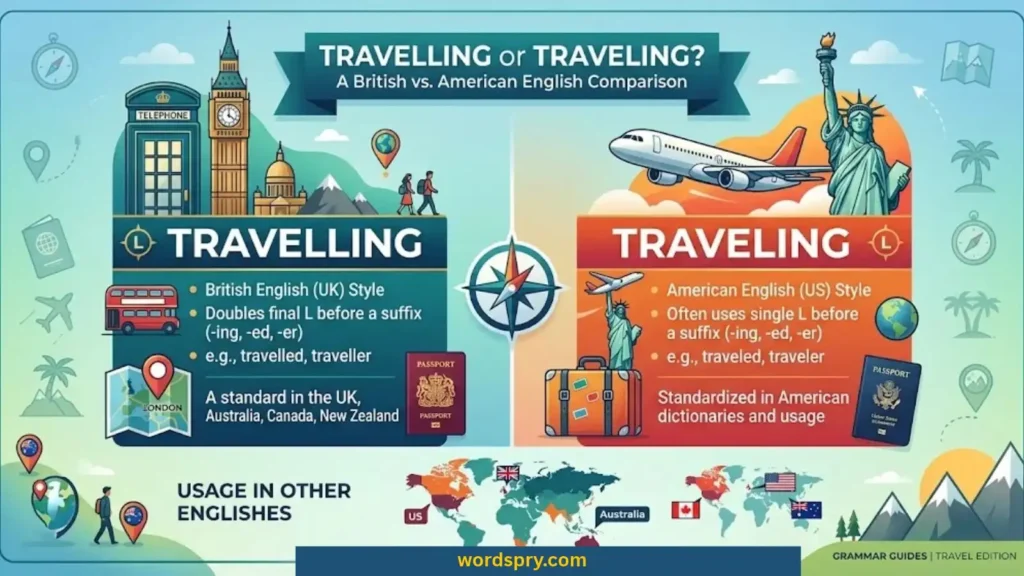
✅ Both travelling and traveling are correct. Use traveling in American English and travelling in British English.
Have you ever written a school essay or an email and wondered whether to use travelling or traveling? You are not alone. Many English learners face this problem because both spellings look right and have the same meaning.
The word means going from one place to another. You might travel to another city, visit a new country, or take a short trip with your family. However, the spelling changes depending on the type of English you use.
In American English, people usually write traveling with one l. In British English, writers usually prefer travelling with two ls. Neither spelling is wrong. The main difference comes from regional spelling rules.
RELATED: Pricy or Pricey: Which Spelling Is Correct in Modern English?
Pronunciation of Travelling and Traveling
Both spellings have the same pronunciation. The extra l in travelling does not change how you say the word.
- American English: /ˈtrævəlɪŋ/
- British English: /ˈtrævəlɪŋ/
The stress falls on the first syllable. The word has three syllables.
Difference Between Travelling and Traveling
There is no difference in meaning between these two spellings. The main difference is regional spelling. Here are 10 useful points to help you understand them.
1. American English Spelling
American English usually uses traveling with one l.
- ✅ I am traveling to New York.
- ✅ She enjoys traveling with her family.
- ❌ I am travveling to New York.
2. British English Spelling
British English usually uses travelling with two ls.
- ✅ We are travelling to London.
- ✅ He is travelling by train.
- ❌ We are travalling to London.
3. Meaning
Both words mean going from one place to another. Their meanings are exactly the same.
- ✅ I love traveling around the world.
- ✅ I love travelling around the world.
- ❌ Neither spelling is wrong because of its meaning.
4. Verb Form
Both spellings are the -ing form of the verb travel.
- ✅ They are traveling across the country.
- ✅ They are travelling across the country.
- ❌ They are travaling across the country.
5. Use in School Assignments
Students should follow the spelling rules required by their school or teacher.
- ✅ Traveling is common in an American English essay.
- ✅ Travelling is common in a British English essay.
- ❌ Mixing both spellings without a reason can make an essay inconsistent.
6. Use in Professional Writing
Businesses should follow one spelling style across their documents.
- ✅ Our American office is traveling to Chicago.
- ✅ Our British office is travelling to Manchester.
- ❌ Using different spelling styles randomly in one document is poor editing.
7. Use on Websites
Website owners should choose spelling based on their target audience.
- ✅ A US travel website may use traveling.
- ✅ A UK travel website may use travelling.
- ❌ Assuming one spelling is universally correct is a mistake.
8. Use on Social Media
Both forms are correct in social media posts.
- ✅ I am traveling this weekend!
- ✅ I am travelling this weekend!
- ❌ Marking either standard spelling as wrong is incorrect.
9. Related Word Forms
The same spelling pattern appears in several related forms.
- ✅ American English: traveling, traveled, traveler.
- ✅ British English: travelling, travelled, traveller.
- ❌ Writing travelling but changing randomly to traveled in British-style writing can create inconsistency.
10. Choosing the Right Form
Your audience and writing style should guide your choice.
- ✅ Use traveling when following American English.
- ✅ Use travelling when following British English.
- ❌ Do not change between the two styles without a clear reason.
Nature and Behaviour of Travelling and Traveling
Travelling
Travelling is the British English spelling of the present participle and gerund of travel. It can describe an action in progress or an activity.
Examples:
- ✅ We are travelling to Scotland.
- ✅ Travelling helps me explore new places.
Traveling
Traveling is the usual American English spelling of the same word. It has the same grammatical uses.
Examples:
- ✅ She is traveling to California.
- ✅ Traveling is one of his favorite hobbies.
Both forms can appear after helping verbs, act as nouns, and describe ongoing actions. The difference is spelling, not grammar.
Why People Get Confused About Travelling and Traveling
English spelling can change between countries. Some words keep one consonant in American English but double it in British English.
The verb travel follows this pattern when adding -ing.
- American English: travel → traveling
- British English: travel → travelling
People also get confused because spell-checkers may use a different regional dictionary. A British spell-checker may flag traveling, while an American spell-checker may flag travelling.
⚠️ Remember:
A spelling checker does not always show that a word is wrong. It may simply use a different English variety.
Travelling vs. Traveling: Comparison Table
| Feature | Traveling | Travelling |
|---|---|---|
| Standard spelling | American English | British English |
| Meaning | Going from place to place | Going from place to place |
| Number of ls before -ing | One | Two |
| Pronunciation | Same basic pronunciation | Same basic pronunciation |
| Grammar | Verb form and gerund | Verb form and gerund |
| Common audience | US readers | UK readers |
| Correct spelling? | ✅ Yes | ✅ Yes |
| Best practice | Follow US style | Follow UK style |
The Origin of Travelling and Traveling
Both spellings come from the verb travel. The word entered English through Anglo-French and Old French forms related to labor, trouble, or effort. Over time, its meaning developed to include making a journey.
The difference between traveling and travelling grew from regional spelling practices. American English often uses a single consonant in forms such as traveling and traveled. British English commonly doubles the consonant in travelling and travelled.
The spelling difference does not give either word a different history or meaning. Both forms belong to the same English verb.
British vs. American English
American and British English share most vocabulary and grammar rules, but some spellings differ.
| American English | British English |
|---|---|
| traveling | travelling |
| traveled | travelled |
| traveler | traveller |
| canceled | cancelled |
| labeling | labelling |
Examples:
- 🇺🇸 ✅ We are traveling to Boston.
- 🇬🇧 ✅ We are travelling to Bristol.
- 🇺🇸 ✅ He traveled last summer.
- 🇬🇧 ✅ He travelled last summer.
These are regional differences, not mistakes. Other words may follow different patterns, so it is best to check a trusted dictionary or style guide when unsure.
Which One Should You Use?
Choose the spelling that matches your audience.
- 🇺🇸 For American readers: Use traveling, traveled, and traveler.
- 🇬🇧 For British readers: Use travelling, travelled, and traveller.
- 🌍 For international readers: Either spelling is acceptable. Choose one style and use it consistently.
For an English grammar blog aimed at US readers, traveling is a suitable default. If your article targets UK readers, use travelling instead.
Common Mistakes
| Incorrect or inconsistent usage | Better choice |
|---|---|
| ❌ Travveling | ✅ Traveling or travelling |
| ❌ Travaling | ✅ Traveling or travelling |
| ❌ Travelinng | ✅ Traveling or travelling |
| ⚠️ Traveling in a UK-style article | 🟢 Prefer travelling for consistency |
| ⚠️ Travelling in a US-style article | 🟢 Prefer traveling for consistency |
The last two examples are not inherently incorrect. They are style mismatches when a document follows a specific regional standard.
Everyday Usage Examples
In Emails
- 🇺🇸 ✅ I will be traveling for work next week.
- 🇬🇧 ✅ I will be travelling for work next week.
On Social Media
- ✅ Traveling with friends makes great memories.
- ✅ Travelling with friends makes great memories.
News Articles
- 🇺🇸 ✅ The team is traveling to Texas for the final.
- 🇬🇧 ✅ The team is travelling to Wales for the final.
Formal Writing
- 🇺🇸 ✅ The employee is traveling on behalf of the company.
- 🇬🇧 ✅ The employee is travelling on behalf of the company.
In each pair, both sentences are grammatically correct. The spelling depends on the regional style.
Usage Trends
Traveling is the standard form in American English, while travelling is widely used in British English and other regions that follow British spelling conventions.
The same pattern appears in Canada, Australia, and other English-speaking countries, although local usage and style guides can vary. Online articles may also use one form because of their intended audience.
There is no need to treat one spelling as better English. The important thing is to use the form that fits your readers and keep it consistent.
Metaphors and Similes
Neither spelling has a special metaphorical meaning of its own. However, the verb travel can appear in figurative language.
Metaphor: “Her mind was traveling through the past.”
This means she was thinking about earlier events.
Simile: “The news traveled like wildfire.”
This means the news spread very quickly.
Both British and American writers can use these expressions. Changing the spelling does not change the figurative meaning.
Connotative Meaning
Travelling and traveling have the same basic associations. Their connotations depend on the sentence.
- Positive: “Traveling opened her eyes to new cultures.” This suggests learning and discovery.
- Negative: “Traveling during the storm was stressful.” This suggests worry or difficulty.
- Neutral: “He is traveling to work.” This simply describes an action.
The extra l does not make one spelling more positive, negative, or formal than the other.
Idioms and Proverbs
The two spellings do not have separate idioms. However, English has many expressions related to journeys and travel.
– Safe travels: A wish for a safe journey. Example: “Have a wonderful holiday. Safe travels!”
– Hit the road: To begin a journey. Example: “We should hit the road before sunrise.”
– Travel broadens the mind: Traveling can help people understand other cultures and ideas. Example: “She believes that travel broadens the mind.”
These expressions work with either spelling.
Literature and Movies
Travel is a common theme in books and films. Writers often use journeys to explore discovery, change, and personal growth.
Literature
- Around the World in Eighty Days — Jules Verne, adventure novel, first published in 1872. It follows a journey around the world.
- The Hobbit — J. R. R. Tolkien, fantasy novel, first published in 1937. Its story centers on an unexpected journey.
Movies
- The Motorcycle Diaries (2004, international production) follows a journey through South America.
- Into the Wild (2007, United States) explores travel, independence, and life away from society.
These works illustrate travel as a theme. They do not establish one spelling as more correct than the other.
Why This Difference Matters
Knowing the difference between travelling and traveling helps you write clearly and professionally. It is especially useful for students, bloggers, editors, and business writers.
A consistent spelling style makes an article look polished. It also helps readers recognize that you understand their regional English conventions.
Simple Rule: American English usually doubles fewer consonants in these forms, while British English often uses the doubled consonant.
🟢 Easy tip: The United States usually uses traveling. The United Kingdom usually uses travelling.
Usefulness in Daily Life
You may need this spelling when writing a school assignment, booking a trip, sending a work email, or publishing a blog post.
Example:
- 🇺🇸 ✅ “I am traveling to New York next month.”
- 🇬🇧 ✅ “I am travelling to London next month.”
If you use a word processor, set its proofing language to the English variety you need. This helps your spelling checker suggest the correct regional forms.
Remember that spelling consistency matters more than choosing one form for every situation.
Situational Preference
For American school assignments, business reports, and websites, choose traveling. For British schoolwork, UK publications, and documents that follow British style, choose travelling. On social media, either form is fine because both are widely understood. For international writing, consider your main audience before choosing a style. If you are unsure, use one trusted dictionary or style guide throughout the document. Do not switch between the spellings without a reason. Both forms are correct, and neither changes the meaning of the sentence.
FAQs
1. Is travelling or traveling correct?
✅ Both are correct. Traveling is standard in American English, while travelling is standard in British English.
2. Is travelling British or American?
Travelling is the usual British English spelling. It is also used in other places that follow British spelling conventions.
3. Is traveling American or British?
Traveling is the usual American English spelling. British readers can understand it, too.
4. Why does travelling have two Ls?
British English commonly doubles the l when adding -ing to travel. American English usually keeps one l.
5. Do travelling and traveling mean the same thing?
✅ Yes. Both mean going from one place to another. The difference is regional spelling.
6. Is travelling wrong in the United States?
It is not inherently wrong, but traveling is the standard American spelling. Use traveling when following American English style.
7. Which spelling should I use for SEO articles?
Choose the spelling that suits your target readers. Use traveling for a mainly American audience and travelling for a mainly British audience. Keep your spelling consistent.
Conclusion
Both travelling and traveling are correct English spellings. They have the same meaning, pronunciation, and grammatical use. The only main difference is the regional spelling style.
American English usually uses traveling, with one l. British English usually uses travelling, with two ls. The same pattern appears in related words, such as traveled and travelled.
When writing an article, school assignment, email, or business report, think about your readers. If you are writing for an American audience, choose traveling. If your readers use British English, choose travelling. For international writing, either form can work.
Remember these simple examples:
- 🇺🇸 ✅ I enjoy traveling around the world.
- 🇬🇧 ✅ I enjoy travelling around the world.
- ❌ Travelling is always wrong.
- ❌ Traveling is always wrong.
Both claims marked with a red cross are false because both spellings are accepted.
The easiest rule to remember is this: American English prefers traveling, while British English prefers travelling. Choose one style, use it consistently, and write with confidence.

Hi, I’m William Parker, the creator behind Wordspry.com
I enjoy breaking down complex grammar rules into clear and practical lessons that help learners write and speak English more effectively.