If you often wonder whether to write affect or effect, you are not alone. These two words look and sound similar, but they usually have different jobs in a sentence. This makes them one of the most common word-choice problems in English.
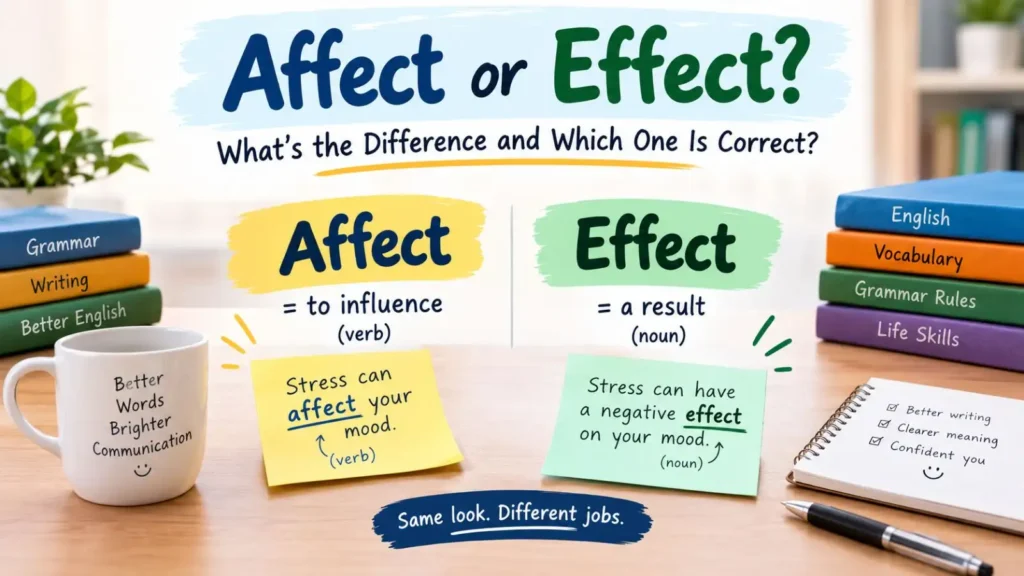
The main difference is simple: affect is usually a verb, while effect is usually a noun. For example, “Lack of sleep can affect your mood.” Here, affect means to influence. In contrast, “Lack of sleep can have a negative effect on your mood.” Here, effect means a result.
People search for affect or effect because both words are common in everyday English. They also appear in emails, school assignments, news articles, business writing, and social media posts.
In this guide, you will learn the meaning, origin, correct usage, common mistakes, and easy ways to remember the difference. You will also see clear examples that make choosing the right word much easier.
Affect or Effect – Quick Answer
The easiest rule is:
- Affect = usually a verb meaning “to influence.”
- Effect = usually a noun meaning “a result.”
Examples
Affect as a verb:
Loud noise can affect your ability to sleep.
Effect as a noun:
Loud noise can have a negative effect on your sleep.
Another easy example:
The weather affected our travel plans.
The weather had a major effect on our travel plans.
Quick Memory Trick
Think:
Affect = Action
Effect = End result
This is not a rule for every possible use, but it works well in most everyday sentences.
The Origin of Affect or Effect
The words affect and effect have different histories, even though they look very similar.
Affect comes from Latin roots connected with the idea of influencing, acting on, or having an impact on something. Over time, it entered English as a verb meaning “to influence” or “to have an effect on.”
Effect also comes from Latin. Its roots are connected with the idea of bringing something about or producing a result. In English, it commonly developed as a noun meaning “a result” or “outcome.”
The spelling difference is important because the two words perform different grammatical jobs.
For example:
- The heat affected the crops.
- The heat had a serious effect on the crops.
Although both sentences discuss the same idea, the words have different roles.
The words are also pronounced differently in many uses. Affect as a verb usually begins with an unstressed “uh” sound, while effect commonly begins with a stronger “ee” sound.
British English vs American English Spelling
Unlike many British and American spelling differences, affect or effect does not usually change between British and American English.
Both varieties normally use:
- affect
- effect
- affected
- affecting
- effective
- effectively
The main issue is therefore not spelling. It is correct word choice.
| Meaning | American English | British English |
|---|---|---|
| Influence | affect | affect |
| Result | effect | effect |
| Influenced | affected | affected |
| Producing a result | effective | effective |
| In a successful way | effectively | effectively |
Example
American English:
The new rule may affect small businesses.
British English:
The new rule may affect small businesses.
The spelling stays the same.
Therefore, when learning affect or effect, focus more on grammar and meaning than on regional spelling.
Which Spelling Should You Use?
You do not normally need to choose between British and American spelling for affect or effect. Both forms are standard in major varieties of English.
Instead, choose the word based on its role in your sentence.
Use Affect When You Mean “Influence”
Affect when one thing changes or influences another.
Stress can affect your health.
The news affected her decision.
Lack of sleep may affect your concentration.
Use Effect When You Mean “Result”
Effect when you are talking about the result of an action or event.
The medicine had a positive effect.
The new policy had little effect.
We noticed the effects of the storm.
For US Writers
Use the same standard forms:
affect and effect.
For UK and Commonwealth Writers
The same forms are correct:
affect and effect.
For Global English
If you write for an international audience, use affect for influence and effect for result. This rule is clear and widely understood.
Common Mistakes with Affect or Effect
Because the words look alike, writers often use them incorrectly.
Mistake 1: Using Effect as a Verb for “Influence”
❌ The weather effected our plans.
If you mean “influenced,” use affected.
✓ The weather affected our plans.
However, effect can be a verb in a different sense. As a verb, effect can mean “to bring about” or “to cause something to happen.”
The company hopes to effect major changes.
This use is more formal.
Mistake 2: Using Affect for a Result
❌ The new law had a major affect on business.
✓ The new law had a major effect on business.
Here, you need a noun because you are talking about a result.
Mistake 3: Confusing “Affected” and “Effected”
These words have different meanings.
Affected usually means influenced.
The storm affected thousands of people.
Effected usually means caused or brought about.
The manager effected several important changes.
Mistake 4: Choosing by Sound Alone
Some writers choose the word that sounds right. This can lead to errors because affect and effect sound similar.
Instead, ask:
Am I describing an action or influence?
Use affect.
Am I naming a result?
Use effect.
Affect or Effect in Everyday Examples
Understanding real-life examples can make the difference much easier to remember.
In Emails
Affect:
The delay may affect our delivery schedule.
Effect:
The delay may have an effect on our delivery schedule.
Both can be correct, but the sentence structure changes.
In News Writing
The new tax could affect thousands of families.
Or:
The new tax could have a significant effect on household spending.
News writers use both words frequently.
In Social Media
Lack of sleep really affects my mood.
This update had a huge effect on the app.
The first sentence uses a verb. The second uses a noun.
In Formal Writing
Climate change can affect agricultural production.
Climate change may have a long-term effect on agricultural production.
Both forms are useful in academic and professional writing.
Affect or Effect – Comparison Table
| Word | Common Part of Speech | Basic Meaning | Example |
|---|---|---|---|
| Affect | Verb | Influence | Stress can affect your sleep. |
| Effect | Noun | Result | Stress can have an effect on sleep. |
| Affected | Verb form | Influenced | The storm affected the city. |
| Effected | Verb | Brought about | The policy effected major changes. |
| Effective | Adjective | Successful | The treatment was effective. |
| Effectively | Adverb | Successfully | The team worked effectively. |
Simple Rule
| If you mean… | Choose |
|---|---|
| Influence | Affect |
| Result | Effect |
| Influenced | Affected |
| Brought about | Effected |
| Successful | Effective |
Affect or Effect – Google Trends & Usage Data
Search interest for affect or effect remains strong because both words are common in everyday English and formal writing.
People search for this phrase when they are unsure about grammar, spelling, or sentence structure. Students, teachers, professionals, bloggers, and English learners often need help choosing between the two.
Interest can also vary by country and audience. English-speaking countries such as the United States, United Kingdom, Canada, and Australia regularly use both words. Global English learners also search for explanations because the words have similar forms but different grammatical functions.
Google Trends can show changes in search interest over time and differences between countries. However, search popularity does not mean that one word is more correct than the other.
The important point is that affect and effect are both standard English words. The correct choice depends on meaning and grammar.
FAQs About Affect or Effect
1. What is the main difference between affect and effect?
Affect is usually a verb meaning “to influence.” Effect is usually a noun meaning “a result.”
2. Is it “affect” or “effect” someone?
Use affect when you mean influence.
The experience affected him deeply.
3. Is it “affect” or “effect” on something?
Usually use effect after phrases such as “an effect on.”
The decision had an effect on sales.
4. Can effect be a verb?
Yes. Effect can be a verb meaning “to bring about” or “to cause.”
The new manager effected several changes.
This use is more formal.
5. Can affect be a noun?
Yes, but this is a specialized use, especially in psychology and medicine. In everyday English, affect is much more commonly used as a verb.
6. Is “affected by” correct?
Yes.
Many people were affected by the storm.
Here, affected means influenced or impacted.
7. What is the easiest way to remember affect and effect?
Remember:
Affect = influence
Effect = result
If you can replace the word with “influence,” affect is usually correct. If you can replace it with “result,” effect is usually correct.
Conclusion
Knowing the difference between affect or effect can make your English clearer and more professional. Although the two words look and sound similar, they usually have different grammatical roles.
Use affect when you mean to influence or change something. For example, “Stress can affect your sleep.” Use effect when you mean a result or outcome. For example, “Stress can have an effect on your sleep.”
Remember that this difference is the same in both American and British English. The main challenge is not spelling but choosing the correct word for the sentence.
You should also remember that effect can sometimes work as a verb meaning “to bring about,” while affect can be a noun in specialized contexts. These uses are less common in everyday writing.
For most situations, the simple rule works well: affect = influence, effect = result. Keep this rule in mind, and you will avoid one of the most common English word-choice mistakes.

Hi, I’m Liam Harper, the voice behind Wordspry!
I’m here to make English grammar simple, clear, and easy to understand for learners of all levels. Through practical lessons and helpful guides, I aim to help you improve your writing and communication skills with confidence.