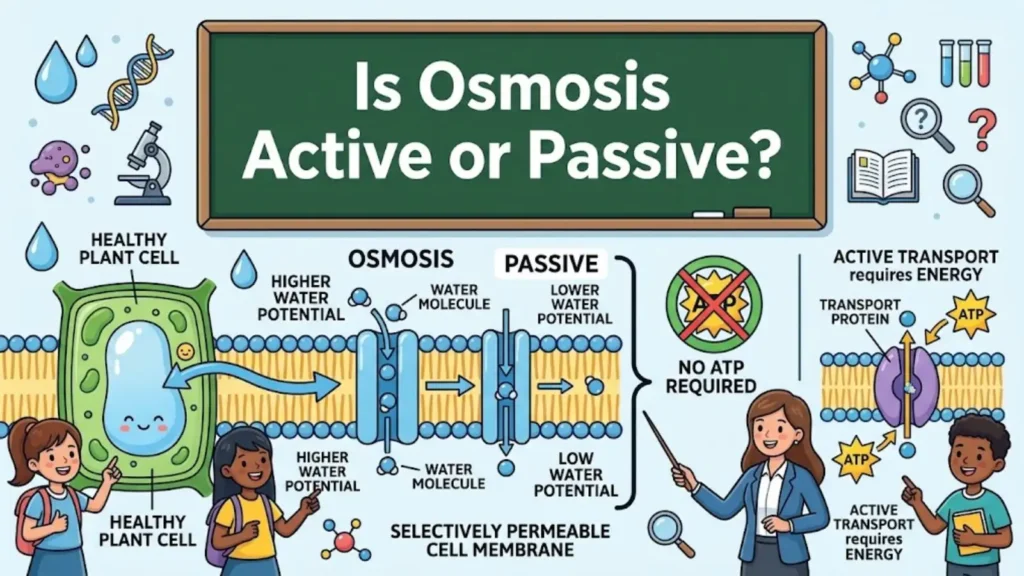
If you have ever wondered “is osmosis active or passive?”, the short answer is simple: osmosis is a passive transport process. It does not require the cell to spend energy in the form of ATP.
Think about what happens when a plant sits in water. Water naturally moves into its cells through a selectively permeable membrane. The cell does not have to pump the water inward. Instead, water moves down its water potential gradient.
This question often causes confusion because osmosis involves movement across a cell membrane, and some other forms of membrane transport require energy. However, the key difference is whether the cell uses metabolic energy.
RELATED: No Cuts No Buts No Coconuts: Meaning, Origin and Examples
Table of Contents
- Is Osmosis Active or Passive? Quick Answer
- What Is Osmosis?
- Why Is Osmosis Passive Transport?
- How Osmosis Works
- Osmosis vs Active Transport
- Real-Life Examples of Osmosis
- Common Mistakes About Osmosis
- Important Factors Affecting Osmosis
- Comparison Table
- FAQs
- Conclusion
Is Osmosis Active or Passive? Quick Answer
Osmosis is passive transport.
It describes the movement of water molecules through a selectively permeable membrane. Water moves from an area with higher water potential toward an area with lower water potential.
Most importantly, the cell does not use ATP energy to make osmosis happen.
See also: Casi Algo Meaning: Full Guide to Love, Feelings, and Relationships
Quick facts
- Osmosis is passive transport.
- It involves the movement of water.
- Water crosses a selectively permeable membrane.
- It moves down a water potential gradient.
- It does not directly require ATP.
- Osmosis can occur naturally without cellular energy expenditure.
What Is Osmosis?
Osmosis is the passive movement of water across a selectively permeable membrane.
The membrane allows some substances to cross while restricting others. Water can move through the membrane toward the side with lower water potential.
In simple terms, water moves toward the side where there is a greater concentration of dissolved substances.
For example, imagine a cell surrounded by salty water. The solution outside the cell contains more dissolved salt than the cell’s interior. Water may move out of the cell toward the saltier solution.
This movement can cause the cell to lose water and shrink.
A simple example
Imagine placing a raisin in plain water.
At first, the raisin contains many dissolved substances. Water from the surrounding solution moves into the raisin through its membranes.
As water enters, the raisin becomes larger and softer.
That process demonstrates the basic idea behind osmosis.
Why Is Osmosis Passive Transport?
Osmosis belongs to passive transport because it does not require the cell to spend metabolic energy.
Cells commonly use ATP when they need to move substances against a concentration gradient. Osmosis works differently.
Water moves naturally because of differences in water potential or solute concentration.
Therefore, the cell does not need to use ATP to push water from one side to another.
Passive transport vs active transport
Passive transport moves substances down their gradient without direct energy use.
Active transport uses cellular energy to move substances against their gradient.
Example:
- Osmosis → passive
- Simple diffusion → passive
- Facilitated diffusion → passive
- Sodium-potassium pump → active transport
- Proton pump → active transport
So, if an exam asks “Is osmosis active or passive?”, the correct answer is passive.
How Osmosis Works
Osmosis becomes easier to understand when you focus on three important ideas.
1. Water must be involved
Osmosis specifically concerns the movement of water molecules.
The movement of glucose, oxygen, or sodium is not called osmosis.
2. A selectively permeable membrane is involved
Water moves across a membrane that allows water to pass more easily than certain dissolved substances.
Cell membranes perform this important role.
3. Water moves along its water potential gradient
Water tends to move from an area of higher water potential to lower water potential.
A solution with fewer dissolved particles generally has higher water potential. A solution with more dissolved particles generally has lower water potential.
This creates the driving force for water movement.
In plant biology, water potential depends mainly on solute potential and pressure potential.
Osmosis vs Active Transport
Although both processes involve cell membranes, they work in different ways.
Osmosis moves water passively. Active transport moves substances using cellular energy.
For example, a plant root can absorb mineral ions through active transport when those ions must move against their concentration gradient.
Water may then move through the root because of differences in water potential.
So, these processes can work together without being the same thing.
Simple comparison
Osmosis:
Water moves passively across a selectively permeable membrane.
Active transport:
Cells use energy to move substances against their concentration gradient.
This distinction is especially useful in biology exams.
Real-Life Examples of Osmosis
Osmosis happens constantly in living organisms. You can also observe its effects in everyday situations.
1. Plant roots
Plant roots absorb water from the soil. Water can move into root cells through osmosis when suitable water potential differences exist.
This helps plants maintain hydration.
2. Raisins in water
A dry raisin placed in water can absorb water and swell.
The movement of water into the raisin demonstrates osmosis.
3. Salt on vegetables
Sprinkling salt on vegetables can draw water out of their cells.
The surrounding salty environment has a lower water potential, encouraging water to move outward.
4. Red blood cells
Red blood cells are surrounded by a membrane that allows water to move across it.
If placed in a very dilute solution, water can enter the cells. The cells may swell and eventually burst.
In contrast, a concentrated surrounding solution can cause water to leave the cells, making them shrink.
5. Plant cells in different solutions
A plant cell placed in a dilute solution may gain water.
Its vacuole expands, increasing pressure against the cell wall. This helps the plant remain firm.
Common Mistakes About Osmosis
Students often make a few predictable mistakes when learning this topic.
Mistake 1: Calling osmosis active transport
Incorrect: Osmosis is a type of active transport.
Correct: Osmosis is a type of passive transport.
Mistake 2: Saying osmosis moves solutes
Incorrect: Osmosis is the movement of salt across a membrane.
Correct: Osmosis describes the movement of water across a selectively permeable membrane.
Mistake 3: Saying osmosis requires ATP
Incorrect: Cells must use ATP for osmosis.
Correct: Osmosis does not directly require ATP.
Mistake 4: Confusing osmosis with diffusion
Osmosis is related to diffusion, but the terms are not completely interchangeable.
Diffusion generally describes the movement of particles from higher concentration to lower concentration.
Osmosis specifically describes water movement across a selectively permeable membrane.
Important Factors Affecting Osmosis
Several factors can influence how water moves across a membrane.
Solute concentration
A difference in solute concentration can create a water potential difference.
A solution with more dissolved particles generally has lower water potential.
Membrane permeability
Water must be able to cross the membrane for osmosis to occur.
Some membranes allow water to cross easily, while others restrict its movement.
Temperature
Temperature affects molecular movement. Higher temperatures generally increase molecular motion, although biological systems have practical limits.
Pressure
Pressure can influence water potential, especially in plant cells.
For example, pressure inside a plant cell contributes to its overall water potential.
Osmosis vs Active Transport: Comparison Table
| Feature | Osmosis | Active Transport |
|---|---|---|
| Type of transport | Passive | Active |
| Main substance | Water | Solutes or ions |
| Uses ATP directly? | No | Yes |
| Membrane involved? | Yes | Usually yes |
| Movement | Down water potential gradient | Often against concentration gradient |
| Energy required | No direct cellular energy | Requires cellular energy |
| Example | Water entering a plant cell | Mineral ion uptake by root cells |
Special Rules to Remember
When studying osmosis, remember this simple rule:
Osmosis = water + selectively permeable membrane + passive movement.
You can also remember these three questions:
- Is water moving?
- Is a selectively permeable membrane involved?
- Does the movement occur without direct ATP use?
If the answer to all three is yes, you are probably looking at osmosis.
Is osmosis always from low solute concentration to high solute concentration?
In basic biology, this is a useful way to remember osmosis. Water generally moves from the side with lower solute concentration toward higher solute concentration, provided other factors do not alter the water potential.
However, more advanced biology uses water potential rather than solute concentration alone.
Frequently Asked Questions
Q1.Is osmosis active or passive?
Osmosis is passive transport. Water moves across a selectively permeable membrane without the direct use of cellular ATP.
Q2.Does osmosis require energy?
No. Osmosis does not directly require ATP. Water moves naturally because of differences in water potential.
Q3.Is osmosis a type of diffusion?
Yes. Osmosis is a specialized form of passive movement involving water across a selectively permeable membrane.
Q4.Does osmosis move water or solutes?
Osmosis refers specifically to the movement of water. Solute movement involves other transport processes.
Q5.Is osmosis active or passive transport in plant cells?
Osmosis is passive transport in plant cells. Water can move into or out of plant cells without the plant directly using ATP to drive that water movement.
Q6.What is the difference between osmosis and active transport?
Osmosis moves water passively across a selectively permeable membrane. Active transport uses cellular energy to move substances, often against their concentration gradient.
Q7.Why does water move during osmosis?
Water moves because differences in water potential create a driving force. In simple terms, water tends to move toward the area with greater effective solute concentration.
Conclusion
So, is osmosis active or passive? Osmosis is passive transport.
It involves water moving across a selectively permeable membrane without the direct use of ATP. Water generally moves from higher water potential toward lower water potential.
The easiest way to remember it is:
Osmosis is passive because the cell does not spend energy to move water.
Once you understand that basic rule, you can more easily distinguish osmosis from diffusion and active transport. This simple distinction also makes many cell biology questions much easier to solve.

Hi, I’m Liam Harper, the voice behind Wordspry!
I’m here to make English grammar simple, clear, and easy to understand for learners of all levels. Through practical lessons and helpful guides, I aim to help you improve your writing and communication skills with confidence.