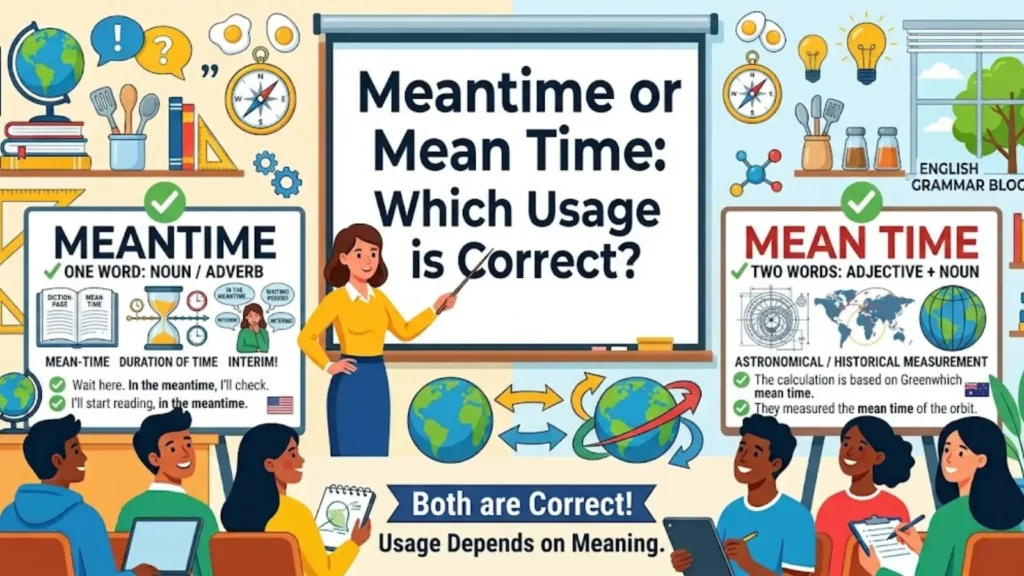
Quick Answer: Meantime or Mean Time?
Meantime is usually correct when you mean “during the time before something happens.” The most common expression is in the meantime.
✓ In the meantime, I will finish my work.
✓ The doctor will arrive soon. In the meantime, please wait here.
Mean time is used when mean means “average,” especially in scientific or mathematical contexts.
✓ The mean time required to complete the test was 20 minutes.
Simple rule:
👉 Waiting period = meantime
👉 Average time = mean time
Learn More: Hierarchical vs Hierarchal: Which Word Should You Use?
What Does Meantime Mean?
Meantime is a noun that refers to the period between two events. It is most commonly used in the expression in the meantime.
The phrase means “during the time before something happens” or “while waiting for another event.”
Example:
- The doctor will see you soon. In the meantime, please take a seat.
- The food is cooking. In the meantime, we can prepare the table.
- Sarah is finishing her homework. In the meantime, her brother is watching television.
In each example, something is happening while another person waits for the next event.
Moreover, meantime can sometimes appear without “in,” although this is less common in everyday English.
Example:
“The repairs will take several days. Meantime, we need to find another solution.”
However, in the meantime is the more familiar and natural expression for most readers.
What Does Mean Time Mean?
Mean time consists of two separate words. Here, mean and time keep their individual meanings.
The word mean can refer to an average value. For example:
The mean time for completing the test was 45 minutes.
Here, “mean time” means the average amount of time.
Similarly:
“Researchers calculated the mean time between the two events.”
In this sentence, “mean” describes an average, while “time” is the thing being measured.
Therefore, mean time is not simply another spelling of meantime.
Meantime or Mean Time: The Core Difference
The easiest way to understand meantime or mean time is to look at the meaning of the complete phrase.
Meantime is generally connected with a waiting period or an interval between events. It commonly appears in in the meantime.
Mean time, however, usually describes an average or calculated time.
Compare these sentences:
The bus will arrive soon. In the meantime, we can wait inside.
Here, “in the meantime” means while we are waiting.
Now consider:
The mean time required to complete the experiment was 20 minutes.
Here, “mean time” means average time.
Thus, the two forms have different grammatical functions and meanings.
Quick Comparison
| Form | Meaning | Common Use | Example |
|---|---|---|---|
| Meantime | The period between events | Usually “in the meantime” | In the meantime, I will read. |
| Mean time | Average or calculated time | Scientific, mathematical, or technical contexts | The mean time was 15 minutes. |
As you can see, context determines which form you need.
Why Is Meantime Usually Written as One Word?
English contains many words that developed from phrases over time. Meantime is one of them.
When speakers use in the meantime, they are referring to an interval or period between events. The word has become established as a standard English noun.
Example:
The manager is unavailable. In the meantime, please contact the assistant.
Here, meantime functions as part of a fixed expression.
It would be incorrect to write:
❌ The manager is unavailable. In the mean time, please contact the assistant.
The standard form is:
✓ The manager is unavailable. In the meantime, please contact the assistant.
However, this does not mean that mean time is always wrong. It is correct when mean is being used separately to describe an average or another specific type of time.
For instance:
✓ The mean time for each runner was calculated.
So, the rule depends on meaning rather than appearance.
When Should You Use Meantime?
Use meantime when you are talking about a period during which something else is happening or before another event takes place.
The most common construction is:
in the meantime
Examples
- The train is delayed. In the meantime, passengers can wait in the lounge.
- I am waiting for your reply. In the meantime, I will continue working.
- The website is being updated. In the meantime, you can use the mobile app.
- Dinner will be ready soon. In the meantime, please relax.
- The students are waiting for the teacher. In the meantime, they are reviewing their notes.
Moreover, this phrase works well in both formal and informal writing.
Meantime in Formal Writing
You can use in the meantime in:
- Business emails
- Academic writing
- News articles
- Blog posts
- Reports
- Instructions
- General communication
For example:
We are reviewing your application. In the meantime, please keep your contact information updated.
This sounds professional and natural.
When Should You Use Mean Time?
Use mean time when mean describes an average, usually in mathematics, statistics, science, research, or technical writing.
For example:
The mean time required to finish the task was 30 minutes.
Here, the researchers are talking about an average.
Another example is:
The mean time between system failures was six months.
In this sentence, the phrase refers to an average period calculated from multiple observations.
Therefore, mean time is appropriate when the context involves measurement, calculation, or averages.
More Examples
- The mean time for the experiment was recorded.
- Scientists calculated the mean time between events.
- The mean time for completing the survey was ten minutes.
- The researchers compared the mean time for each group.
- The mean time between machine failures decreased last year.
These examples are very different from sentences using in the meantime.
Usage in Real Life
Understanding meantime or mean time becomes easier when you see how each form appears in practical situations.
1. Blogging Examples
Bloggers frequently use in the meantime when explaining what readers can do while waiting.
For example:
Our complete guide will be published next week. In the meantime, you can read our beginner’s guide.
Another example:
The new feature is still being developed. In the meantime, users can access the existing tool.
Therefore, the phrase is especially useful when discussing temporary situations.
2. Education Examples
Teachers and students may also use in the meantime in everyday communication.
The teacher is preparing the next activity. In the meantime, students should review the previous lesson.
However, mean time may appear in mathematics or science:
The mean time taken by the students to complete the experiment was 18 minutes.
The first sentence describes a waiting period, while the second describes an average measurement.
Common Mistakes to Avoid
1. Writing “In the mean time”
This is one of the most common mistakes.
❌ In the mean time, we can wait here.
✓ In the meantime, we can wait here.
When you mean “during the waiting period,” use the one-word form.
2. Assuming Mean Time Is Always Wrong
Although meantime is common, mean time is not automatically incorrect.
❌ The phrase “mean time” is always wrong.
✓ The mean time for completing the experiment was 25 minutes.
In this example, “mean” means average.
3. Confusing Meaning With Spelling
The choice is not simply about spelling. It depends on what you want to say.
If you mean during the period before something happens, use in the meantime.
If you mean average time, use mean time.
4. Using “Meantime” Without the Right Context
Although meantime can appear alone, beginners should generally use the familiar expression in the meantime.
Example:
✓ The repair will take two hours. In the meantime, you can have lunch.
This construction is clear and natural.
5. Using “Mean Time” in Everyday Waiting Situations
Avoid using mean time when you simply mean “while waiting.”
❌ The doctor is coming. In the mean time, please sit down.
✓ The doctor is coming. In the meantime, please sit down.
The second sentence follows standard usage.
Meantime or Mean Time: Easy Rule to Remember
Here is a simple memory trick:
Waiting period = meantime
Average measurement = mean time
For example:
The train is late. In the meantime, I will read a book.
Think: What can I do while I wait?
Now:
The mean time for the journey was 40 minutes.
Think: What was the average time?
This simple distinction will help you choose the correct form in most situations.
FAQs About Meantime or Mean Time
Is “meantime” one word?
Yes. Meantime is a standard English word. It commonly appears in the phrase in the meantime.
Is “in the mean time” correct?
Usually, no. When you mean “during the time before something happens,” the standard expression is in the meantime.
What does “in the meantime” mean?
In the meantime means “during the period before another event happens” or “while waiting for something else.”
Is “mean time” ever correct?
Yes. Mean time is correct when “mean” describes an average or calculated time.
What is an example of “in the meantime”?
The technician will arrive tomorrow. In the meantime, please restart the computer.
What is an example of “mean time”?
The mean time required to complete the test was 12 minutes.
Can I use “meantime” in formal writing?
Yes. In the meantime is perfectly acceptable in formal, academic, business, and professional writing.
Is “meantime” the same as “meanwhile”?
They are closely related, especially in phrases such as in the meantime and meanwhile. Both can describe something happening during a period while another event is pending.
Which form should beginners remember?
Beginners should remember in the meantime for situations involving waiting or an interval between events. Use mean time when you specifically mean an average or calculated time.
Conclusion
The difference between meantime or mean time becomes simple once you focus on meaning. Use meantime, especially in in the meantime, when you are talking about a period between events or something happening while you wait. For example, “The report is not ready yet. In the meantime, we can review the data.”
Use mean time when mean has its separate meaning of average or calculated value. This form is more common in scientific, mathematical, and technical contexts.
Therefore, do not choose the spelling based only on how the words look. Instead, ask what you actually mean. If you are describing a waiting period, in the meantime is usually the correct choice. If you are describing an average measurement, mean time can be correct.

Hi, I’m Henry Collins, the educator behind Wordspry.com
I’m dedicated to helping English learners build confidence through easy grammar explanations, writing tips, and everyday language learning resources.