Have you ever typed a sentence like “He is a lier” and suddenly wondered whether something looks wrong? This small spelling choice can cause a surprisingly big amount of confusion. After all, both lier and liar look like they could come from the verb lie.
So, is lier or liar the correct spelling when you mean someone who tells untruths? Why does English use liar instead of the more expected-looking lier? And does lier have a meaning of its own?
The answer becomes much clearer once you separate the two words. Liar is the normal English noun for a person who tells lies. Lier is a much rarer word with a different use, usually referring to someone or something that lies in a particular position or waits in concealment.
Read: Casi Algo Meaning: Full Guide to Love, Feelings, and Relationships
Quick Answer
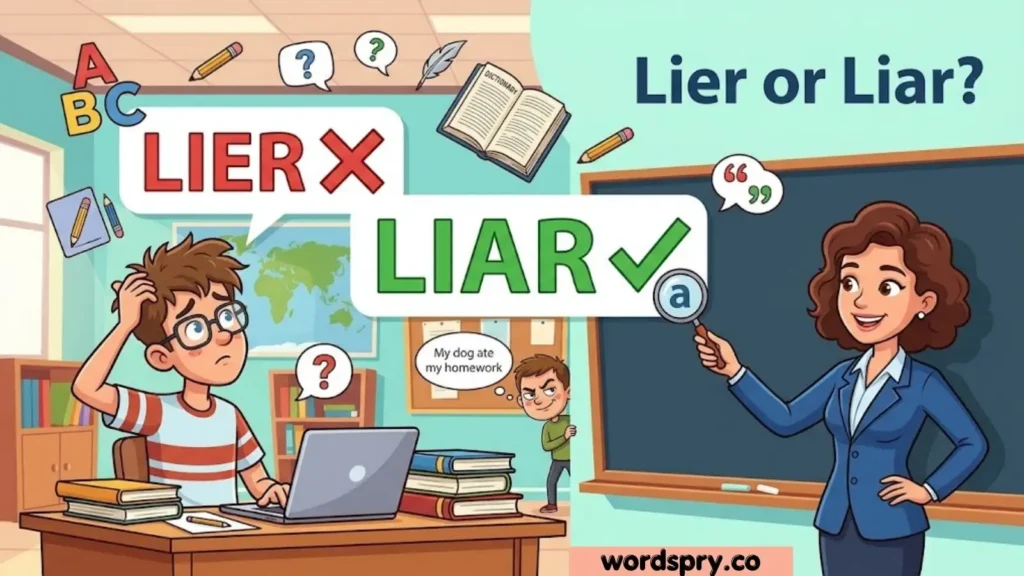
Liar is the correct and standard word for a person who tells lies. Lier is a rare word that can refer to someone who lies down or lies in wait. In ordinary writing, conversations, books, and social media, use liar when describing someone who is dishonest.
Table of Contents
- Meaning at a Glance
- What Does Lier or Liar Mean?
- Why Do People Search for Lier or Liar?
- The Deeper Meaning of Lier or Liar
- Background and Origin
- Contexts Where Lier or Liar Is Used
- Usage Across Different Platforms
- Examples in Everyday Life
- When Should You Use Liar?
- When Should You Avoid Lier or Liar?
- Common Misconceptions
- Common Mistakes
- Similar Words and Alternatives
- How to Use Liar in a Sentence
- Lier or Liar in Different Languages and Cultures
- Lier or Liar in Online Conversations
- Popularity and Trends Over Time
- Featured Snippet Summary
- Trusted References
- Frequently Asked Questions
- Conclusion
Meaning at a Glance
| Aspect | Liar | Lier |
|---|---|---|
| Literal Meaning | A person who tells lies | A rare noun for one who lies or lies in wait |
| Standard English | Yes | Rare |
| Common Usage | Very common | Uncommon |
| Pronunciation | /ˈlaɪər/ | Usually /ˈlaɪər/ |
| Main Context | Dishonesty and false statements | Specialized or historical contexts |
| Symbolic Meaning | Deception, dishonesty, lack of trust | Concealment or physical positioning in rare contexts |
| Best Choice | Use this for a dishonest person | Avoid unless the specialized meaning is intended |
The distinction matters because liar has a well-established everyday meaning. Cambridge defines a liar as “someone who tells lies,” while Oxford gives the same basic meaning.
What Does Lier or Liar Mean?
What Does Liar Mean?
A liar is a person who tells lies.
A lie is an untrue statement made with the intention of deceiving someone. Therefore, liar describes the person who makes that false statement.
For example:
Everyone knew he was a liar because he kept changing his story.
The word can describe someone who lies occasionally or someone who has developed a reputation for frequent dishonesty.
Merriam-Webster defines liar as “a person who tells lies.”
What Does Lier Mean?
Lier does exist, but it is extremely uncommon in modern everyday English.
Merriam-Webster lists lier as a noun meaning “one that lies,” especially someone who lies in concealment or ambush. It records the word as dating back to the late 16th century.
That specialized meaning explains why you may occasionally encounter lier in older, technical, literary, or unusual writing.
A Simple Example
- Correct for dishonesty: “He is a liar.”
- Rare specialized word: “The hunter was a lier in wait.”
For normal English, liar is almost certainly the word you need.
Why Do People Search for Lier or Liar?
The confusion comes from English spelling patterns.
People naturally connect lie with words such as:
- lie
- lied
- lying
- liar
- lier
The problem is that English does not always form nouns in perfectly predictable ways.
If someone knows that lie becomes lying, they may assume that “a person who lies” should be spelled lier. That logic looks reasonable, but standard English uses liar.
The issue also appears frequently in:
- Social media posts
- School assignments
- Text messages
- Comments
- Online discussions
- Grammar searches
- Creative writing
- Quotes and captions
A quick spelling check often leads people to search “lier or liar?”
The Deeper Meaning of Lier or Liar
The common word liar carries more than a simple dictionary definition.
Calling someone a liar usually suggests a problem with trust. The word can imply deception, dishonesty, manipulation, or a deliberate attempt to hide the truth.
In literature and visual culture, a liar can also represent larger ideas such as:
- Deception
- Identity
- Fear
- Betrayal
- Hidden motives
- False appearances
- Emotional conflict
- Social pressure
Artists and writers often explore these themes because truth and deception create natural dramatic tension.
A character who lies may hide an important part of their identity. A photograph may contrast appearance with reality. A novel may slowly reveal that an apparently trustworthy character has deceived everyone.
That is where language connects with storytelling, symbolism, creativity, and artistic expression.
Background and Origin
The word liar has a long history in English.
Oxford traces liar to Old English lēogere, formed from a verb meaning “to lie” with an agent-forming ending.
Merriam-Webster similarly traces the word to Middle English and Old English forms related to the verb to lie. Its dictionary records the first known use of liar before the 12th century.
The word lier has a different history as a rare noun. Merriam-Webster records its first known use in 1583 and gives the specialized meaning of someone who lies in concealment.
So, while both spellings connect to lie, they developed into different words.
Why Does Liar Have an “A”?
This is the part that confuses many learners.
English uses -ar in several nouns that describe people who perform an action. The spelling does not always follow a simple modern verb-plus-suffix formula.
Therefore:
lie → liar
not:
lie → lier
English spelling sometimes behaves like that one friend who refuses to follow the group plan.
Contexts Where Lier or Liar Is Used
Art & Painting
Artists can explore dishonesty through portraits, symbolism, and narrative scenes.
A painting might show a character hiding something while another person remains unaware. In an art discussion, a critic might describe the character as a liar.
Example:
“The painting presents the merchant as a charming liar who hides his greed behind a smile.”
Photography
Photography often explores the gap between appearance and reality.
A carefully staged photograph may raise questions about whether an image tells the whole truth.
Example:
“The photographer challenges viewers to question whether appearances can make us all liars.”
Literature
Literature frequently uses liars as major characters.
Mystery novels, thrillers, dramas, and psychological fiction often depend on deception.
Example:
“The narrator slowly discovers that the person she trusted was a liar.”
Movies & Documentaries
Film uses deception to create suspense and emotional conflict.
A character may lie to protect someone, gain power, hide a crime, or escape responsibility.
Example:
“The documentary examines how repeated false claims can damage a person’s credibility.”
Personal Development
Self-improvement writing sometimes discusses honesty and self-deception.
People may use expressions such as “stop lying to yourself” when encouraging personal growth.
Business & Branding
Businesses should generally avoid calling someone a liar unless they are making a deliberate and supportable claim.
Professional communication usually favors neutral expressions such as:
- inaccurate
- misleading
- unsupported
- incorrect
- inconsistent
Education
Teachers may explain liar when teaching vocabulary, spelling, or word formation.
Example:
“Remember that the standard noun for someone who tells lies is liar.”
Social Media
The word appears frequently in online arguments, memes, captions, and debates.
Because online conversations move quickly, people often use liar emotionally rather than carefully.
Usage Across Different Platforms
| Platform | Typical Usage | Example |
|---|---|---|
| Captions and quotes | “Trust actions, not a liar’s promises.” | |
| TikTok | Short videos and commentary | “How to spot a liar.” |
| Quotes and graphics | “A liar eventually reveals the truth.” | |
| Discussions and reactions | “I knew he was a liar.” | |
| Usually avoided | “The report contains misleading claims.” | |
| YouTube | Titles and commentary | “How to recognize a liar.” |
| Blogs | Grammar and vocabulary | “Lier or liar: which spelling is correct?” |
Examples in Everyday Life
Here are some natural examples:
Daily conversation:
“Don’t call him a liar without knowing the facts.”
Artwork:
“The artist portrays the character as a liar hiding behind an elegant mask.”
Classroom discussion:
“Why do writers sometimes make the narrator a liar?”
Business presentation:
“The speaker made several claims that the evidence does not support.”
Social media caption:
“Trust is hard to rebuild after someone proves to be a liar.”
Speech:
“Honesty matters because one lie can destroy years of trust.”
Blog title:
“Lier or Liar: Which Spelling Is Correct?”
When Should You Use Liar?
Use liar when you mean a person who tells lies.
It works naturally in:
- Everyday conversations
- Fiction
- Essays
- Grammar lessons
- Social media
- Journalism
- Reviews
- Storytelling
- Informal discussions
Examples
- “He is a liar.”
- “Nobody believed the liar.”
- “The novel’s main character is an unreliable liar.”
- “She accused him of being a liar.”
- “The film explores the psychology of a compulsive liar.”
When Should You Avoid Using Lier or Liar?
You should avoid liar when you need highly neutral, evidence-based language.
For example, legal, scientific, and professional writing may require more precise wording.
Instead of:
“The company spokesperson is a liar.”
A formal report might say:
“The spokesperson provided information that conflicts with the available evidence.”
This approach separates facts from personal accusations.
You should also avoid lier unless you specifically intend its rare dictionary meaning.
Common Misconceptions About Lier or Liar
Misconception 1: Lier Is Always Wrong
Not exactly.
Lier is a real but rare English word. Merriam-Webster recognizes it as a noun connected with someone who lies in concealment.
However, it is not the normal spelling for a dishonest person.
Misconception 2: Liar Is a Misspelling of Lier
No.
Liar is the standard word for someone who tells lies. Major dictionaries, including Cambridge, Oxford, and Merriam-Webster, recognize it.
Misconception 3: Both Words Mean Exactly the Same Thing
They can overlap historically, but modern usage separates them.
Liar has a clear everyday meaning connected with dishonesty. Lier has a much rarer and more specialized meaning.
Misconception 4: Liar Always Means a Habitual Liar
Not necessarily.
Someone can be called a liar because of one lie or because they regularly lie. Context determines the intended meaning.
Common Mistakes When Using Lier or Liar
Mistake 1: Writing “Lier” for a Dishonest Person
Incorrect:
“He is a lier.”
Standard:
“He is a liar.”
Mistake 2: Assuming English Spelling Must Follow the Verb
English word formation contains many historical patterns. You cannot always create a noun by simply adding a familiar suffix.
Mistake 3: Using Liar Without Evidence
Calling someone a liar makes a strong accusation.
In professional or sensitive writing, describe the specific false claim instead.
Mistake 4: Confusing Lie and Lay
The verbs lie and lay create another common spelling problem.
- Lie means to recline or tell an untruth.
- Lay means to put something somewhere.
For the meaning involving dishonesty, the verb is lie, with the past tense lied. Oxford confirms this distinction in its entry for lie.
Similar Words and Alternatives
| Word or Phrase | Meaning | Best Used When |
|---|---|---|
| Liar | Person who tells lies | Everyday English |
| Deceiver | Person who deliberately misleads others | Formal or serious contexts |
| Fibber | Person who tells small or harmless lies | Informal situations |
| Dishonest person | Someone who lacks honesty | Neutral descriptions |
| Fabricator | Person who invents false information | Formal contexts |
| Fabulist | Person who invents stories or false claims | Literary or formal contexts |
| Fraud | Person who deceives for gain | Financial or legal contexts |
| Falsifier | Person who makes something false or alters information | Technical or formal contexts |
The best alternative depends on what the person actually did.
How to Use Liar in a Sentence
Professional Writing
“The investigation found that the witness provided several false statements.”
Creative Writing
“The charming stranger was a liar with a talent for making every story sound believable.”
Social Media Caption
“A liar can fool people, but actions eventually reveal the truth.”
Inspirational Quote
“Honesty may feel difficult today, but lies create heavier burdens tomorrow.”
Everyday Conversation
“Don’t call her a liar unless you know what really happened.”
Lier or Liar in Different Languages and Cultures
The exact English spelling does not transfer directly into other languages. However, most languages have a specific word for a person who tells lies.
| Language | Common Interpretation |
|---|---|
| Spanish | mentiroso / mentirosa |
| French | menteur / menteuse |
| Arabic | كاذب (kādhib) |
| Hindi | झूठा (jhootha) |
| Urdu | جھوٹا (jhoota) |
| Tamil | பொய்யர் (poyyar) |
| Malayalam | നുണയൻ (nunayan) |
| Marathi | खोटारडा (khoṭāraḍā) |
The cultural meaning can vary depending on context.
In many cultures, calling someone a liar carries a strong social judgment because honesty plays an important role in relationships, family, business, and community life.
Lier or Liar in Online Conversations and Social Media
Online platforms have made the word liar extremely visible.
People use it in:
- Arguments
- Political discussions
- Product reviews
- Celebrity commentary
- Memes
- Reaction videos
- Personal posts
- Creative communities
However, online language often becomes more emotional than precise.
A person may write “liar” simply because they disagree with someone’s statement. That does not automatically prove that the person deliberately made a false statement.
Good communication separates disagreement, error, exaggeration, and deliberate deception.
Popularity and Trends Over Time
The exact search popularity of the spelling comparison changes over time, and dictionary history does not establish a specific modern search-volume timeline. However, the distinction has remained relevant because liar continues to be standard vocabulary while lier remains rare.
| Period | General Usage |
|---|---|
| Before 2010 | Liar remained the standard everyday noun |
| 2010–2015 | Online spelling questions increased |
| 2016–2020 | Search engines made “lier or liar” comparisons easier to find |
| 2021–Present | Social media and online writing continue to generate spelling confusion |
The important point is simple: liar remains the normal modern choice when you mean someone who tells lies.
Featured Snippet Summary
Liar is the standard English spelling for a person who tells lies. Lier is a rare word with a specialized meaning related to someone who lies in concealment or position. Therefore, use liar in everyday writing, conversations, social media, essays, and general English.
Trusted References
For reliable definitions and word histories, consult:
- Cambridge Dictionary — Liar
- Oxford Learner’s Dictionaries — Liar
- Merriam-Webster — Liar
- Merriam-Webster — Lier
- Oxford Learner’s Dictionaries — Lie
These sources confirm that liar means a person who tells lies, while lier exists as a rare noun with a specialized meaning.
Frequently Asked Questions
Is “lier” or “liar” correct?
Liar is correct when you mean a person who tells lies. Lier is a rare English noun with a different, specialized meaning.
Is lier a real word?
Yes. Lier appears in major dictionaries, but modern speakers rarely use it. Merriam-Webster defines it as one who lies, especially in concealment or ambush.
Why is it spelled liar instead of lier?
Liar developed from older English forms related to the verb lie. English spelling follows historical word formation rather than a simple rule that always adds -er.
Is liar an adjective or noun?
Liar is a noun. It names a person who tells lies.
What is the plural of liar?
The plural is liars.
Example:
“The story was full of unreliable liars.”
Is liar an insult?
It can be.
Calling someone a liar directly accuses that person of dishonesty, so the word can sound harsh or confrontational.
Can I use liar in formal writing?
Yes, but use it carefully. Formal writing often benefits from precise descriptions such as “provided false information” or “made an unsupported claim” rather than making a direct personal accusation.
What is the easiest way to remember liar?
Think of the common spelling as:
lie + ar = liar
When you mean a person who tells lies, choose liar.
Conclusion
The lier or liar confusion looks simple, but English history makes the answer slightly more interesting. Liar is the standard modern English noun for someone who tells lies. Cambridge, Oxford, and Merriam-Webster all support this meaning.
Lier is not simply a misspelling. It is a genuine but uncommon word that can describe someone who lies in concealment or another specialized position. Merriam-Webster records the word separately and dates its first known use to 1583.
For everyday writing, there is no need to overthink it. If you are describing someone who tells an untruth, write liar.
Whether you are writing a school assignment, social media caption, novel, blog post, or professional message, liar is the spelling your readers will expect.
When in doubt, remember: a person who tells lies is a liar—not usually a lier.

Hi, I’m Mason Clark, the writer behind Wordspry!
My goal is to make grammar learning easier with straightforward explanations, useful examples, and engaging English lessons that help you grow every day.