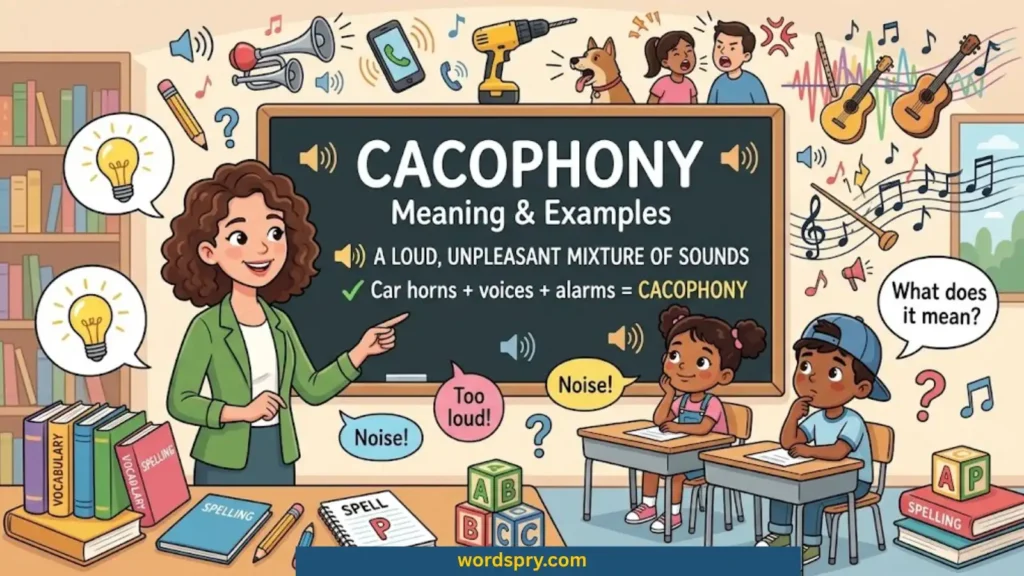
Have you ever walked into a busy street and heard car horns, people shouting, dogs barking, and machines running at the same time? That unpleasant mix of sounds is a cacophony.
The word cacophony is often searched by students, writers, and English learners because it sounds unusual and has a formal tone. Many people also want to know whether it means simply “noise” or something more specific. The answer is simple: cacophony means a mixture of loud, harsh, or unpleasant sounds. It can also describe a confusing or chaotic mixture of things.
For example, a crowded market may create a cacophony of voices, while heavy traffic can produce a cacophony of horns and engines. The word is also common in literature, news reports, essays, and formal writing.
RELATED: No Cuts No Buts No Coconuts: Meaning, Origin and Examples
Cacophony Meaning – Quick Answer
Cacophony is a noun that means a loud, unpleasant, harsh, or confused mixture of sounds.
In simple English:
Cacophony = a lot of unpleasant sounds happening together.
For example:
- The busy street was filled with a cacophony of car horns.
- We heard a cacophony of voices outside the room.
- The construction site created a cacophony of drills and machines.
- The children produced a cheerful but noisy cacophony.
The word can also describe a chaotic mixture that is not literally a sound. Merriam-Webster notes that cacophony can describe an “incongruous or chaotic mixture,” such as a mixture of colors or smells.
Cacophony Pronunciation
The pronunciation differs slightly between British and American English:
- British English: /kəˈkɒf.ə.ni/
- American English: /kəˈkɑː.fə.ni/
Cambridge lists both pronunciations and defines the word as an unpleasant mixture of loud sounds.
Cacophony Synonyms
Common synonyms include:
- noise
- racket
- din
- clamor
- roar
- commotion
- uproar
- hubbub
- dissonance
- discord
However, cacophony often suggests that several sounds are mixed together in a harsh or unpleasant way.
The Origin of Cacophony
The word cacophony has a long history. It entered English in the mid-17th century.
Merriam-Webster gives its first known use as about 1656. The word came into English through French and New Latin and ultimately goes back to Greek.
The Greek roots are especially useful for understanding the meaning.
Cacophony comes from Greek:
- kakos = bad
- phōnē = sound or voice
Together, the basic idea is “bad sound” or “bad-sounding.” Oxford also traces the word to Greek kakophōnia, from kakos meaning “bad” and phōnē meaning “sound.”
This history also explains related English words.
For example:
- euphony refers to pleasing or harmonious sound.
- cacophony refers to harsh or unpleasant sound.
- symphony relates to sounds together in harmony.
- polyphony refers to multiple independent sounds or melodies.
Therefore, the ending -phony is connected with sound or voice.
Why Does Cacophony Look Unusual?
The spelling may look difficult because English borrowed the word from other languages instead of creating it from ordinary English words.
The word passed through French and New Latin before reaching English, while its deeper origin is Greek.
This is why learners may find the spelling and pronunciation less predictable than simpler words such as noise or sound.
British English vs American English Spelling
There is good news for English learners: British English and American English spell the word the same way.
The correct spelling is:
cacophony
There is no standard British spelling such as cacophonie or an American alternative such as cacofony.
The main difference is pronunciation, not spelling.
| Feature | British English | American English |
|---|---|---|
| Correct spelling | cacophony | cacophony |
| Pronunciation | /kəˈkɒf.ə.ni/ | /kəˈkɑː.fə.ni/ |
| Meaning | Unpleasant mixture of sounds | Unpleasant mixture of sounds |
| Plural | cacophonies | cacophonies |
| Adjective | cacophonous | cacophonous |
| Main difference | Pronunciation | Pronunciation |
Cambridge gives different British and American pronunciations but the same spelling and meaning.
Cacophony Variations Side by Side
| Word | Correct? | Meaning |
|---|---|---|
| cacophony | ✅ Yes | Harsh or unpleasant mixture of sounds |
| cacophonies | ✅ Yes | Plural form |
| cacophonous | ✅ Yes | Having an unpleasant sound |
| cacofony | ❌ No | Common misspelling |
| cacaphony | ❌ No | Common misspelling |
| cacophonie | ❌ No in standard English | French form, not standard English spelling |
The most important point is simple: use cacophony in both American and British English.
Which Spelling Should You Use?
You should use cacophony regardless of whether your audience uses American or British English.
For American English
Use:
cacophony
Example:
The city streets were filled with a cacophony of horns.
For British English
Use:
cacophony
Example:
The station was filled with a cacophony of voices.
For Commonwealth English
Countries such as Canada, Australia, and other Commonwealth countries also use cacophony.
Therefore, you do not need to change the spelling based on your target audience.
If you are writing for an international audience, cacophony is the safest and standard form.
The only thing that may change is pronunciation.
Common Mistakes with Cacophony
Because cacophony is not a simple word, learners often misspell or misuse it.
1. Writing “cacofony”
❌ The street was filled with a cacofony of sounds.
✅ The street was filled with a cacophony of sounds.
The letter ph is important.
2. Writing “cacaphony”
❌ We heard a loud cacaphony outside.
✅ We heard a loud cacophony outside.
Remember the spelling:
c-a-c-o-p-h-o-n-y
3. Using Cacophony for Any Sound
Not every sound is a cacophony.
For example:
The soft sound of rain was relaxing.
This is not normally a cacophony.
However:
The storm created a cacophony of thunder, wind, and breaking branches.
Here, the word works because several loud and unpleasant sounds combine.
4. Confusing Cacophony with Euphony
These words have opposite ideas.
Cacophony = unpleasant or harsh sound.
Euphony = pleasant or harmonious sound.
For example:
The factory created a cacophony of machines.
But:
The singer’s voice had a beautiful euphony.
5. Using the Word When “Noise” Is Better
Cacophony is a more formal word than noise.
In a simple conversation, you might say:
There was too much noise outside.
In formal or descriptive writing, you could say:
The street was filled with a cacophony of voices and traffic.
Both are correct, but the second creates a stronger image.
Cacophony in Everyday Examples
The word cacophony appears in many types of writing. It is especially useful when a writer wants to create a strong picture of sound.
Cacophony in Emails
You might use it in a professional email when describing a noisy environment.
The office was filled with a cacophony of phone calls and conversations, so I moved to a quieter room.
For a casual email, however, noise may sound more natural.
Cacophony in News Writing
News writers often use the word to describe busy public spaces.
A cacophony of sirens and shouting filled the streets after the accident.
It can also describe many competing opinions:
The announcement created a cacophony of reactions online.
This second use shows how the word can move beyond literal sound.
Cacophony on Social Media
People may use the word humorously or dramatically:
Monday morning traffic is a complete cacophony. 😩
Or:
My house is a cacophony of barking dogs and laughing children today.
The word can make an ordinary sentence more vivid.
Cacophony in Formal Writing
The word works well in essays, reports, and academic writing when used carefully.
The urban environment produces a constant cacophony of traffic, construction, and human activity.
It is especially useful in descriptive writing because it helps readers imagine the scene.
Cacophony in Literature
Writers use cacophony to create tension, confusion, or sensory detail.
For example:
The battlefield erupted into a cacophony of shouting, gunfire, and explosions.
The word immediately suggests disorder and harsh sound.
Cacophony – Google Trends & Usage Data
Search interest for individual words can change over time, and Google Trends does not provide the same type of fixed dictionary definition or worldwide popularity score as a dictionary.
For cacophony, usage is strongly connected with English learning, vocabulary study, literature, music, writing, and language searches. Dictionary resources continue to show the word in active modern use, including examples from news and other contemporary writing. Merriam-Webster’s current dictionary examples also show cacophony being used for both literal sounds and broader chaotic mixtures.
The word is also used across different English-speaking contexts. Cambridge provides examples involving animal sounds, voices, public disagreement, music, and other noisy situations.
Where Is Cacophony Commonly Used?
| Context | Typical Use |
|---|---|
| English learning | Vocabulary and word meaning |
| Literature | Describing harsh sounds |
| Music | Describing discordant sound |
| News | Describing busy or chaotic scenes |
| Essays | Strong descriptive language |
| Social media | Dramatic or humorous descriptions |
| Formal writing | Describing noise or disorder |
The word is not normally used in everyday speech as often as noise, loud, or racket. Instead, it appears more often in descriptive, formal, literary, and educational contexts.
Cacophony vs Noise: What’s the Difference?
Although cacophony and noise are related, they are not perfect synonyms.
Noise is a broad word. It can mean almost any unwanted or unpleasant sound.
Cacophony is more specific. It usually suggests a confused mixture of loud, harsh, or unpleasant sounds.
Compare these examples:
The noise from the television was annoying.
This sentence describes one general source of unwanted sound.
A cacophony of televisions, conversations, and traffic filled the room.
This sentence describes many sounds mixed together.
Therefore, cacophony gives the reader a stronger sense of disorder.
Cacophony vs Euphony
These words are useful opposites.
| Word | Meaning | Example |
|---|---|---|
| Cacophony | Harsh or unpleasant sound | A cacophony of horns |
| Euphony | Pleasant or harmonious sound | The euphony of birdsong |
| Noise | General unwanted sound | Traffic noise |
| Dissonance | Lack of harmony | Musical dissonance |
Knowing this difference can improve your vocabulary and descriptive writing.
FAQs About Cacophony Meaning
1. What does cacophony mean?
Cacophony means a loud, harsh, unpleasant, or confused mixture of sounds.
2. Is cacophony a positive or negative word?
It is usually negative because it describes unpleasant or harsh sounds. However, writers may use it creatively to describe a lively or chaotic mixture.
3. How do you pronounce cacophony?
In American English, it is commonly pronounced approximately kuh-KAH-fuh-nee. British pronunciation is slightly different. Cambridge lists /kəˈkɒf.ə.ni/ for British English and /kəˈkɑː.fə.ni/ for American English.
4. What is the plural of cacophony?
The plural is cacophonies.
Example:
Several cacophonies could be heard from the different streets.
5. What is the adjective form of cacophony?
The adjective is cacophonous.
Example:
The cacophonous noise made it difficult to concentrate.
6. What is the opposite of cacophony?
A useful opposite is euphony, which refers to pleasant or harmonious sound.
7. Is cacophony a formal word?
Yes. Cacophony is more formal and literary than everyday words such as noise or loudness. It is especially useful in essays, literature, journalism, and descriptive writing.
Conclusion
The cacophony meaning is simple once you break the word down: it means a loud, harsh, unpleasant, or confused mixture of sounds. The word can also describe a chaotic mixture more generally.
The correct spelling is always cacophony in standard English. American and British English do not use different spellings, although their pronunciations differ slightly. The word comes from Greek roots meaning “bad sound” and entered English around the mid-17th century.
Use cacophony when you want to describe several unpleasant sounds happening together. For simple everyday situations, noise may be more natural. However, cacophony adds stronger detail and works especially well in essays, news reports, literature, and descriptive writing.
Remember the spelling: cacophony, not cacofony or cacaphony. Once you understand its meaning and use, this unusual word becomes easy to recognize and use correctly.

Hi, I’m Henry Collins, the educator behind Wordspry.com
I’m dedicated to helping English learners build confidence through easy grammar explanations, writing tips, and everyday language learning resources.