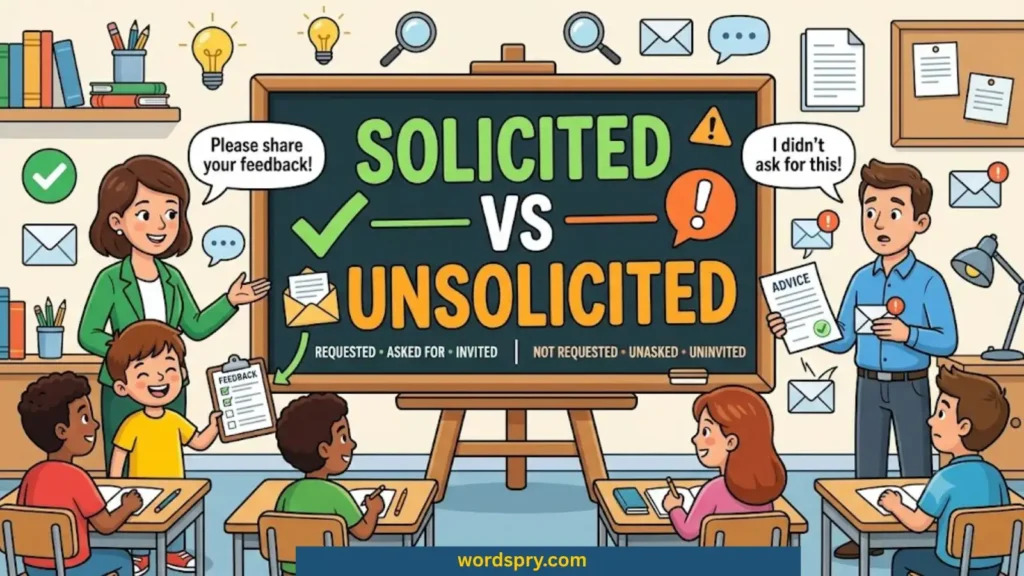
Have you ever received an email you never asked for or been invited to share your opinion? That simple situation explains the difference between solicited vs unsolicited.
These two words often appear in emails, job applications, business communication, legal writing, surveys, and everyday conversations. Although they look similar, they describe opposite situations. Solicited means something was requested, invited, or asked for. Unsolicited means something arrived without being requested.
Understanding this difference can help you choose the right word and avoid awkward mistakes. It can also make your writing sound more professional.
In this guide, we’ll explain the meaning, spelling, origin, usage, examples, and differences between these two commonly confused words.
RELATED: Hierarchical vs Hierarchal: Which Word Should You Use?
Solicited vs Unsolicited: Quick Answer
Solicited means requested or invited, while unsolicited means not requested or invited.
For example, if a company asks customers to submit feedback, that feedback is solicited feedback. If someone sends the company feedback without being asked, it is unsolicited feedback.
| Word | Meaning | Example |
|---|---|---|
| Solicited | Requested or invited | I submitted a solicited application. |
| Unsolicited | Not requested or invited | She received an unsolicited advertisement. |
The easiest way to remember the difference is simple: solicited = asked for, while unsolicited = not asked for.
Meaning of Solicited vs Unsolicited
The word solicited describes something that someone actively requested, invited, or encouraged. It can refer to opinions, applications, advice, offers, information, or services.
Example:
A teacher may request student feedback after a lesson. That feedback is solicited feedback because the teacher asked for it.
Unsolicited describes something provided without a request. An unexpected sales email, unwanted advice, or random business proposal can all qualify as unsolicited communication.
The words can describe information, skills, services, opinions, offers, and abstract qualities depending on the context.
Simple Examples
- The company requested solicited feedback from customers.
- He gave me unsolicited advice about my career.
- The editor accepted solicited submissions.
- She rejected an unsolicited offer.
Solicited advice meaning

Solicited advice means advice that someone asks for or requests from another person. In simple terms, it is guidance given because the person wanted to hear your opinion or suggestion.
Example: She asked her teacher for solicited advice about choosing a career.
Why People Misspell Solicited vs Unsolicited
People sometimes struggle with these words because English contains many confusing spelling patterns. However, solicited and unsolicited themselves do not use double “s.”
The correct spellings are:
- Solicited
- Unsolicited
Some writers accidentally add or remove letters when typing quickly. English also contains words with double letters, such as address, success, and necessary, which can make spelling patterns harder to remember.
For example:
- Correct: solicited
- Incorrect:
solicitted - Correct: unsolicited
- Incorrect:
unsollicited
The best approach involves remembering the base word solicit and adding the correct ending.
Origin of Solicited vs Unsolicited
Both words come from the verb solicit, which has roots in Latin. The English word developed from the Latin sollicitare, meaning to disturb, stir up, urge, or appeal to someone.
Over time, solicit developed several meanings, including asking for something, seeking support, requesting business, or attempting to obtain something.
Solicited became the past-tense and participial form of solicit. The prefix un- creates the opposite meaning, producing unsolicited.
So the basic structure is easy to understand:
solicit → solicited → unsolicited
This history explains why the two words share almost the same spelling while carrying opposite meanings.
British English vs American English

There is no spelling difference between British and American English for these words. Writers in both varieties use solicited and unsolicited.
Unlike words such as colour/color or centre/center, these terms keep the same spelling across major English varieties.
| English Variety | Solicited | Unsolicited |
|---|---|---|
| American English | solicited | unsolicited |
| British English | solicited | unsolicited |
| Canadian English | solicited | unsolicited |
| Australian English | solicited | unsolicited |
Therefore, you do not need to choose a regional spelling. Focus instead on choosing the correct word for the situation.
When to Use Solicited vs Unsolicited
You can use these words in many types of writing, from formal documents to casual conversations. The key question is whether someone asked for the thing.
Essays and Assignments
Students can describe requested opinions, research, or feedback as solicited responses.
The professor collected solicited feedback from students.
Emails
Businesses often receive both solicited and unsolicited emails.
We welcome solicited business proposals.
Work Reports
Employees may describe customer opinions as solicited feedback when the company specifically requested them.
The report summarizes solicited customer responses.
Legal Documents
Legal writing frequently uses these terms when discussing offers, communications, requests, or services.
The attorney reviewed the unsolicited communication.
Casual Writing
You can also use the words in everyday conversations.
I didn’t ask for that unsolicited advice!
Common Mistakes
One common mistake involves adding an unnecessary letter to solicited. The correct form comes from solicit, not sollicit.
Another mistake occurs when writers spell unsolicited incorrectly by changing the middle letters.
| Incorrect | Correct |
|---|---|
| sollicitated | solicited |
| solicitted | solicited |
| unsollicited | unsolicited |
| unsolicitted | unsolicited |
Typing quickly can cause these errors, especially when the words appear inside longer sentences. Reading your writing aloud and checking unfamiliar words can help.
Tips:
Remember that solicited does not contain double “s.” The double-s rule applies to other English words, not this pair.
Everyday Examples of Solicited vs Unsolicited
These words appear frequently in modern communication.
Emails
A company may request applications through a job advertisement. Those applications are solicited applications.
An unexpected promotional message may qualify as an unsolicited email.
Social Media
If someone asks followers to share opinions, the responses are solicited opinions.
A stranger suddenly criticizing someone’s appearance may provide unsolicited advice.
Professional Writing
A business can request proposals from selected companies. Those proposals are solicited proposals.
A company may also receive an unsolicited proposal from a business it never contacted.
School Assignments
A teacher might request student feedback about a course. That feedback is solicited.
A student who gives an opinion without being asked may offer unsolicited feedback.
Usage Comparison Table
The context determines which word fits best. Use solicited when someone requested something and unsolicited when nobody requested it.
| Context | Correct Sentence | Incorrect Meaning |
|---|---|---|
| Objects | The company requested a solicited sample. | The sample was unsolicited if they requested it. |
| Skills | The manager requested solicited expertise from the consultant. | Calling requested expertise unsolicited changes the meaning. |
| Legal terms | The court reviewed the unsolicited communication. | Calling it solicited suggests someone requested it. |
| Daily speech | He gave me unsolicited advice. | Calling it solicited means you asked for it. |
| Business | We accepted a solicited proposal. | An unsolicited proposal was not requested. |
The central idea remains the same: requested = solicited, while unrequested = unsolicited.
Solicited vs Unsolicited Feedback
Feedback provides one of the clearest examples of this distinction.
Solicited feedback comes after someone asks for your opinion. For example, a manager might ask employees to complete a workplace survey.
Unsolicited feedback comes without a request. Someone might offer criticism about your presentation even though you never asked for their opinion.
Neither word automatically means good or bad. Solicited feedback can be positive or negative, and unsolicited feedback can also be useful or unhelpful.
The difference concerns whether someone requested the feedback.
Solicited vs Unsolicited Advice
Advice works in much the same way.
If you ask your friend, “What should I do?” and they respond, you received solicited advice.
If your friend suddenly tells you how to organize your life without being asked, you received unsolicited advice.
The second situation often sounds slightly negative because people may not appreciate advice they never requested. Still, unsolicited simply means unrequested; it does not automatically mean harmful.
Solicited vs Unsolicited Applications
The distinction also matters in employment.
“A solicited application usually refers to an application submitted in response to a specific job opening, advertisement, or invitation.”
“An unsolicited application arrives when the employer has not specifically advertised or requested an application from that person.”
For example:
Maria applied for the advertised position.
Her application is solicited because the company invited applications.
If Maria sends her résumé to a company without responding to an advertised opening, her application may be considered unsolicited.
How to Remember the Difference
Use this simple memory trick:
Solicited = someone solicited it.
In other words, someone asked for it.
Unsolicited = unasked.
The prefix un- often creates an opposite meaning in English:
- wanted → unwanted
- requested → unrequested
- invited → uninvited
- solicited → unsolicited
Also remember the spelling of the base word:
solicit → solicited
Do not insert an extra s into the word.
FAQs About Solicited vs Unsolicited
What does solicited mean?
Solicited means requested, invited, or deliberately sought. For example, a company may request customer feedback, making that feedback solicited.
What does unsolicited mean?
Unsolicited means something was provided without being requested or invited. Unsolicited advice and unsolicited emails are common examples.
Is solicited positive or negative?
Not necessarily. Solicited only explains that someone requested something. The requested information can be helpful, harmful, positive, or negative.
Is unsolicited always negative?
No. Unsolicited simply means unrequested. An unsolicited idea may be useful even though nobody asked for it.
How do I remember the spelling?
Remember the base word solicit. The correct form is solicited, not solicitted or sollicitated. The word does not contain double “s.”
What is an example of unsolicited advice?
If someone tells you how to fix your career, appearance, or habits without you asking, that person is giving unsolicited advice.
Are solicited and unsolicited opposites?
Yes. In most contexts, they express opposite ideas. Solicited means requested, while unsolicited means not requested.
Conclusion
Understanding solicited vs unsolicited becomes easy once you focus on one question: Did someone ask for it?
If the answer is yes, use solicited. If nobody requested it, use unsolicited. This simple rule works for feedback, advice, applications, proposals, emails, opinions, and many other forms of communication.
Remember that both words have the same spelling in British and American English. Also, avoid adding an unnecessary double “s” to solicited. Although English contains many double-letter words such as address and success, this particular word does not.
When writing professionally, check whether the communication was requested before choosing your word. That small detail can make your sentence much clearer and more accurate.

Hi, I’m Henry Collins, the educator behind Wordspry.com
I’m dedicated to helping English learners build confidence through easy grammar explanations, writing tips, and everyday language learning resources.