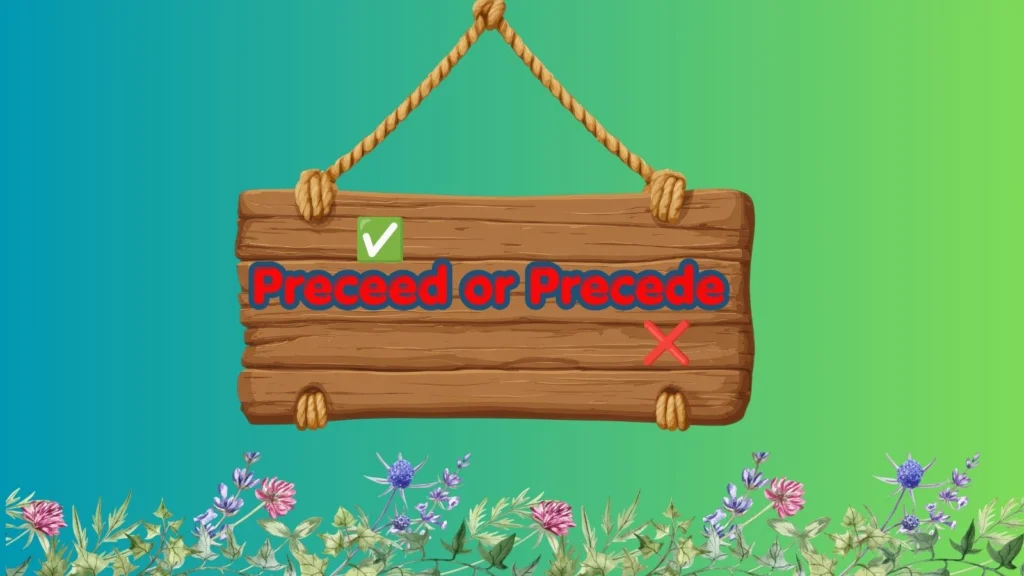
“Precede” is the correct English spelling, while “Preceed” is a common misspelling.
Imagine you’re writing an important email and type, “The introduction will preceed the conclusion.” Your spell checker highlights the word, leaving you wondering what went wrong. This is a mistake many English learners—and even native speakers—make because the spelling doesn’t match how the word sounds.
You’ll learn the difference between preceed or precede, discover why people confuse them, and master the correct spelling with easy examples and practical grammar tips.
Table of Contents
- Quick Answer
- What Does “Precede” Mean?
- Is “Preceed” a Real Word?
- Definitions with Examples
- Origin and History
- British English vs American English
- Which One Should You Use?
- Common Mistakes
- Everyday Examples
- Usage Trends and Popularity
- Comparison Table
- Special Rules and Memory Tips
- FAQs
- Conclusion
⚡ Preceed or Precede: Quick Answer
| Word | Correct? | Meaning |
|---|---|---|
| Precede | ✅ Yes | To come before something in time, order, or position |
| Preceed | ❌ No | Incorrect spelling of “precede” |
Quick Rule
Always write precede.
Never write preceed.
What Does “Precede” Mean?
The verb precede means to come before something or someone in time, order, or position.
Examples
- The introduction precedes the first chapter.
- Spring precedes summer.
- A warning message preceded the announcement.
- Dessert should not precede the main course.
Learn More: Realize vs Realise: What Is the Difference and Which Spelling Should You Use?
Is “Preceed” a Real Word?
No.
Preceed is not an English word. It is simply a spelling mistake.
Many people accidentally add an extra “e” because they remember the phrase “i before e” or confuse it with words like “proceed.”
Incorrect Examples
❌ The meeting will preceed lunch.
❌ This chapter preceeds the conclusion.
Correct Examples
✅ The meeting will precede lunch.
✅ This chapter precedes the conclusion.
Definitions with Examples
Precede
Meaning:
To happen, appear, or come before something else.
Correct Examples
- A short speech preceded the award ceremony.
- Heavy rain preceded the storm.
- His reputation preceded him.
- The title page precedes the table of contents.
Incorrect Examples
❌ Heavy rain preceeded the storm.
❌ His reputation preceeded him.
Origin and History
The word precede comes from the Latin word praecedere, meaning “to go before.”
It entered English through Old French during the Middle Ages. Over time, its spelling remained almost unchanged, making precede the standard form in both modern British and American English.
The incorrect spelling preceed likely became popular because English spelling rules can sometimes seem inconsistent.
British English vs American English
Unlike many English words, precede has exactly the same spelling in both British and American English.
| British English | American English |
|---|---|
| precede | precede |
Tip:
“There are no regional spelling differences.”
Which One Should You Use?
Always choose precede.
Use “precede” when talking about:
- Events that happen first
- Items that come before others
- The order of information
- Time sequences
- Physical position
Examples
- The summary precedes the report.
- Breakfast usually precedes work.
- Registration precedes admission.
- Practice should precede performance.
Easy Memory Trick
Think of the word previous.
Both previous and precede relate to something that comes before.
Neither uses “ee.”
Common Mistakes
Mistake 1
❌ Preceed
✅ Precede
Mistake 2
❌ Preceeded
✅ Preceded
Mistake 3
❌ Preceeding
✅ Preceding
Mistake 4
❌ The ceremony will preceed dinner.
✅ The ceremony will precede dinner.
Everyday Examples
Emails
- Please read the instructions that precede this section.
Social Media
- The teaser video preceded the official trailer.
News
- Strong winds preceded the heavy rainfall.
Classroom
- Chapter 2 precedes Chapter 3.
Daily Life
- Wash your hands before meals that precede family gatherings.
- Stretching should precede exercise.
Usage Trends and Popularity
The correct spelling precede appears in:
- Books
- Newspapers
- Academic writing
- Business documents
- Legal papers
- Government publications
Meanwhile, preceed appears almost entirely because of typing or spelling errors.
Spell-checking software usually flags preceed immediately.
Comparison Table
| Feature | Precede | Preceed |
|---|---|---|
| Correct spelling | ✅ Yes | ❌ No |
| English dictionary | ✅ Yes | ❌ No |
| Used in formal writing | ✅ Yes | ❌ Never |
| Means “to come before” | ✅ Yes | ❌ No |
| Accepted in British English | ✅ Yes | ❌ No |
| Accepted in American English | ✅ Yes | ❌ No |
Special Rules and Important Uses
1. Remember the Spelling
The correct pattern is:
P-R-E-C-E-D-E
Not:
P-R-E-C-E-E-D
2. Different Forms
| Form | Example |
|---|---|
| precede | They precede us. |
| preceded | The rain preceded the flood. |
| preceding | Read the preceding paragraph. |
| precedence | Safety takes precedence over speed. |
3. Don’t Confuse It with “Proceed”
Many writers confuse these words.
- Precede = come before
- Proceed = continue or move forward
Example:
- The opening speech precedes dinner.
- After dinner, we proceed to the awards.
FAQs
Is “preceed” correct?
No. Preceed is an incorrect spelling.
Which is correct: preceed or precede?
Precede is always correct.
Why do people spell “precede” as “preceed”?
People often confuse it with words like proceed or mistakenly apply the “i before e” spelling rule.
Is “precede” used in British English?
Yes. British and American English both use precede.
What is the opposite of “precede”?
Common opposites include:
- follow
- come after
- succeed
Is “preceding” spelled with one or two e’s?
The correct spelling is preceding, with one “e” after the c.
How can I remember the correct spelling?
Remember this phrase:
“Previous things precede later things.”
Both words begin with pre- and contain only one “e” after the c.
Conclusion
When comparing preceed or precede, the answer is straightforward.
Precede is the only correct spelling. It means to come before in time, order, or position.
Preceed is simply a common spelling mistake and should never appear in formal or informal writing.
If you remember that precede and previous both relate to things that come first, you’ll avoid this error every time. Practice using the word in everyday sentences, and the correct spelling will soon become second nature.

Hi, I’m Mason Clark, the writer behind Wordspry!
My goal is to make grammar learning easier with straightforward explanations, useful examples, and engaging English lessons that help you grow every day.