Have you ever paused while typing because you couldn’t remember whether it’s necessary or neccessary? You’re not alone. This is one of the most commonly misspelled words in English. The confusion comes from its unusual pattern of double letters. Fortunately, there’s a simple rule that makes it easy to remember.
RELATED: Pricy or Pricey: Which Spelling Is Correct in Modern English?
Quick Answer
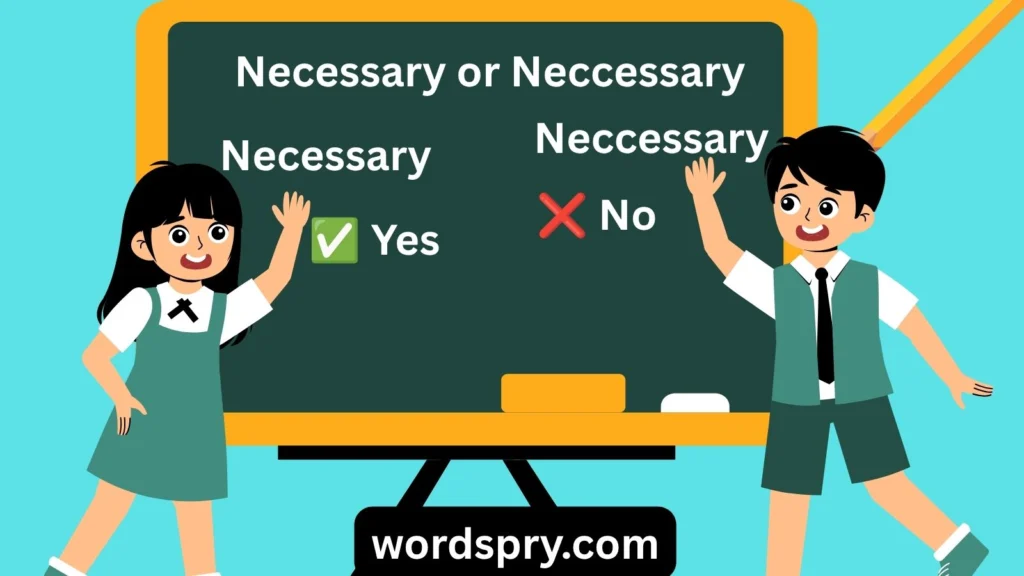
The correct spelling is necessary ✅. The spelling neccessary ❌ is incorrect and should never be used in formal or informal English.
- ✅ Necessary = Correct spelling
- ❌ Neccessary = Incorrect spelling
A simple memory trick is:
Necessary has one “c” and two “s” letters.
Meaning of Necessary or Neccessary
The word necessary means something that is needed, required, essential, or unavoidable. It can describe objects, skills, permissions, qualities, or actions that are important for achieving a goal.
Examples:
- Water is necessary for life.
- Good communication is a necessary skill at work.
- Wearing a helmet is necessary for safety.
- The manager gave the necessary approval before the project started.
Notice that necessary can describe both physical things and abstract ideas like responsibility, planning, or teamwork. The spelling neccessary has no meaning because it is simply a misspelling.
Why People Misspell Necessary
Many English learners accidentally write neccessary because English contains many words with double letters.
Examples include:
- address
- success
- committee
- accommodate
Since success contains a double c, people often assume necessary follows the same pattern. However, necessary only has one “c” but two “s” letters.
Other common reasons include:
- Fast typing
- Autocorrect errors
- Memorizing pronunciation instead of spelling
- Confusing similar-looking words
Fortunately, once you remember the letter pattern, the mistake becomes much less common.
Origin of Necessary
The word necessary comes from the Latin word necessarius, meaning “unavoidable,” “needed,” or “essential.”
Word History
| Language | Word |
|---|---|
| Latin | necessarius |
| Old French | necessaire |
| Middle English | necessary |
| Modern English | necessary |
The spelling has remained remarkably stable for centuries, although many learners still confuse the number of double letters.
British vs American English
Unlike words such as colour and color, the spelling of necessary is exactly the same in both British and American English.
| British English | Necessary ✅ |
| American English | Necessary ✅ |
| Canadian English | Necessary ✅ |
| Australian English | Necessary ✅ |
No English-speaking country spells it neccessary.
When to Use Necessary
Use necessary whenever you describe something that is required, essential, or important.
It fits naturally in:
- Essays
- School assignments
- Emails
- Business reports
- Legal documents
- Academic writing
- Everyday conversations
Examples:
- It is necessary to submit your application today.
- The lawyer prepared the necessary documents.
- Teamwork is necessary for success.
- Safety equipment is necessary on construction sites.
Common Mistakes
Most spelling errors happen because writers place the double letters incorrectly.
| Incorrect | Correct |
|---|---|
| Neccessary | Necessary |
| Necesary | Necessary |
| Necessery | Necessary |
| Neccesary | Necessary |
Why These Mistakes Happen
- Adding an extra c
- Forgetting the second s
- Typing too quickly
- Relying on pronunciation instead of spelling
Memory Trick
Remember this sentence:
One Collar, Two Socks
- One C
- Two S letters
This trick helps thousands of English learners remember necessary correctly.
Everyday Examples
Emails
- Please send the necessary documents before Friday.
Social Media
- Taking breaks is necessary for mental health.
Professional Writing
- The company completed all necessary safety inspections.
School Assignments
- Students must include all necessary references.
Usage Comparison Table
| Situation | Correct | Incorrect |
|---|---|---|
| Object | This tool is necessary. | This tool is neccessary. |
| Skill | Patience is necessary. | Patience is neccessary. |
| Legal Document | All necessary signatures are included. | All neccessary signatures are included. |
| Daily Conversation | It isn’t necessary today. | It isn’t neccessary today. |
| Work Report | We completed the necessary checks. | We completed the neccessary checks. |
How to Remember the Correct Spelling
A few simple tricks can make the spelling stick forever.
- Think One C, Two S’s
- Remember the phrase One Collar, Two Socks
- Practice writing the word in full instead of relying on spell check.
- Read books regularly to reinforce correct spelling.
- Break the word into parts:
Nec + ess + ary
The middle section contains double s, not double c.
FAQs
Q1.Is necessary or neccessary correct?
Necessary is correct. Neccessary is always incorrect.
Why do people spell necessary incorrectly?
Because the word contains unusual double letters, many writers mistakenly add an extra c.
Is necessary spelled differently in British English?
No. Both British and American English use necessary.
What is the easiest way to remember necessary?
Remember One C, Two S’s or the phrase One Collar, Two Socks.
Is neccessary a real English word?
No. It is simply a spelling mistake.
Can spell check detect neccessary?
Most modern spell checkers automatically suggest necessary.
Is necessary a noun or adjective?
Necessary is primarily an adjective that describes something essential or required.
Conclusion
The confusion between necessary and neccessary is extremely common, but the answer is simple. Necessary is the only correct spelling, while neccessary is always incorrect. The mistake usually happens because English contains many words with double letters, causing writers to add an extra c by habit.
Whenever you write essays, emails, business reports, legal documents, or social media posts, use necessary with one “c” and two “s”. A quick memory trick like “One Collar, Two Socks” makes the spelling much easier to remember. With a little practice, you’ll never hesitate over this word again.

Hi, I’m Henry Collins, the educator behind Wordspry.com
I’m dedicated to helping English learners build confidence through easy grammar explanations, writing tips, and everyday language learning resources.