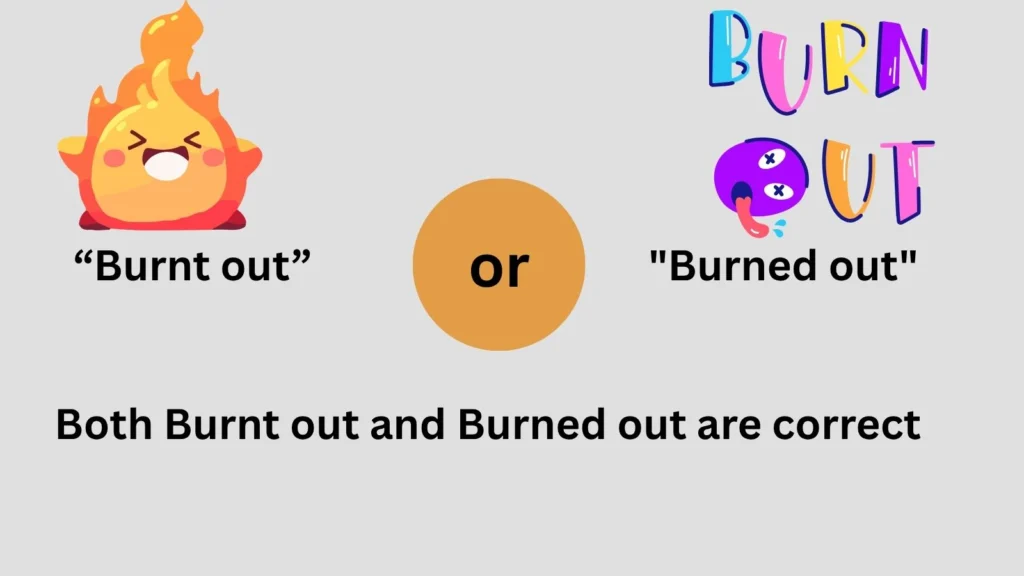
Have you ever wondered whether you should write “burnt out” or “burned out”? Many English learners, writers, and professionals face this spelling question. Both forms appear online, in books, and in everyday conversations, which can make the choice confusing.
The good news is that both burnt out and burned out are correct. However, their usage depends largely on the type of English you use. In some countries, one spelling is preferred over the other. Understanding the difference helps you write more clearly and professionally.
See Also: Ingage vs Engage: Which Word Is Correct and When Should You Use It?
Burnt Out or Burned Out – Quick Answer
Both burnt out and burned out mean the same thing.
They describe:
- Being extremely tired or exhausted.
- Something that has stopped working because it has been overused.
- A person experiencing mental or emotional exhaustion.
Examples
Burned out (American English)
- After working 80 hours a week, Sarah felt burned out.
- The light bulb burned out yesterday.
Burnt out (British English)
- After months of stress, he felt burnt out.
- The engine was completely burnt out.
Quick Rule:
- Burned out = Preferred in American English.
- Burnt out = Preferred in British English.
The Origin of Burnt Out or Burned Out
The words burned and burnt come from the verb burn.
In Old English, many verbs had irregular past forms. Over time, English evolved, and different regions adopted different spellings and verb forms.
Historically:
- Burnt became common in Britain.
- Burned became more common in North America.
Both forms have existed for hundreds of years. Neither is newer nor more correct than the other.
The phrase “burned out” originally referred to something destroyed by fire. Later, it developed a figurative meaning. Today, it often describes physical, emotional, or workplace exhaustion.
For example:
- A building can be burned out.
The same applies to burnt out.
British English vs American English Spelling
The main difference is regional preference.
| Feature | American English | British English |
|---|---|---|
| Preferred Form | Burned Out | Burnt Out |
| Past Tense of Burn | Burned | Burnt/Burned |
| Common in Business Writing | Burned Out | Burnt Out |
| Common in Newspapers | Burned Out | Burnt Out |
| Meaning | Same | Same |
Examples
American English
- I am feeling burned out after the project.
- The motor burned out.
British English
- I am feeling burnt out after the project.
- The motor burnt out.
Which Spelling Should You Use?
The best choice depends on your audience.
Use “Burned Out” If:
- You write for American readers.
- Your company follows U.S. style guides.
- You create content for U.S. websites.
Use “Burnt Out” If:
- You write for UK readers.
- Your audience is in Australia, New Zealand, or South Africa.
- You follow British English conventions.
For a Global Audience
Either spelling works.
However, consistency is important. Choose one form and use it throughout your document.
Common Mistakes with Burnt Out or Burned Out
Here are mistakes people often make.
| Incorrect Usage | Correct Usage |
|---|---|
| I am burn out. | I am burned out. |
| I feel burn’t out. | I feel burnt out. |
| The bulb burn out yesterday. | The bulb burned out yesterday. |
| He is burn out from work. | He is burned out from work. |
| She feels burnted out. | She feels burnt out. |
Common Error #1
❌ I am burn out.
✅ I am burned out.
Common Error #2
❌ The machine burn out.
✅ The machine burned out.
Common Error #3
❌ Burn’t out
✅ Burnt out
The spelling burn’t is incorrect.
Burnt Out or Burned Out in Everyday Examples
In Emails
American English
I have been feeling burned out after several weeks of overtime.
British English
I have been feeling burnt out after several weeks of overtime.
In News Articles
- Healthcare workers reported feeling burned out during the crisis.
- Teachers across the country said they felt burnt out.
On Social Media
- I’m completely burned out after finals week.
- Feeling burnt out and need a break.
In Formal Writing
- Employee burnout can occur when workers feel burned out for long periods.
- Staff members may become burnt out due to excessive workload.
Burnt Out or Burned Out – Google Trends & Usage Data
Search patterns show clear regional preferences.
| Country | More Popular Form |
|---|---|
| United States | Burned Out |
| Canada | Burned Out |
| United Kingdom | Burnt Out |
| Australia | Burnt Out |
| New Zealand | Burnt Out |
Usage Context
Burned Out is commonly used in:
- American business writing
- U.S. news websites
- Academic papers in the United States
Burnt Out is commonly used in:
- British publications
- UK newspapers
- Commonwealth English writing
Burnt Out vs Burned Out Comparison Table
| Feature | Burnt Out | Burned Out |
|---|---|---|
| Meaning | Exhausted or overused | Exhausted or overused |
| Grammar | Correct | Correct |
| British English | Preferred | Acceptable |
| American English | Less Common | Preferred |
| Formal Writing | Common in UK | Common in US |
| Informal Writing | Common | Common |
| Global Understanding | Yes | Yes |
FAQs
Is burnt out grammatically correct?
Yes. Burnt out is grammatically correct and commonly used in British English.
Is burned out grammatically correct?
Yes. Burned out is grammatically correct and preferred in American English.
Do burnt out and burned out mean the same thing?
Yes. Both phrases have the same meaning.
Which spelling is more common?
Globally, burned out appears slightly more often because of American English influence.
Can I use burnt out in formal writing?
Yes. It is acceptable in formal British English writing.
Is burnt out old-fashioned?
No. It remains widely used throughout the United Kingdom and other Commonwealth countries.
Which spelling should international businesses use?
Choose the version that matches your audience and stay consistent throughout your content.
Conclusion
The debate between burnt out and burned out is not about right versus wrong. Both spellings are correct and carry the same meaning. The real difference lies in regional English preferences. American English generally favors burned out, while British English and many Commonwealth countries prefer burnt out.
Whether you are describing emotional exhaustion, workplace stress, a damaged machine, or a failed light bulb, either version communicates the same idea. The key is understanding your audience. If your readers are primarily in the United States, burned out is usually the better choice. If your audience is in the United Kingdom, Australia, or New Zealand, burnt out will feel more natural.
For global communication, consistency matters more than the specific spelling you choose. Pick one version and use it throughout your document. By following this simple rule, your writing will appear professional, polished, and easy to understand.

Hi, I’m William Parker, the creator behind Wordspry.com
I enjoy breaking down complex grammar rules into clear and practical lessons that help learners write and speak English more effectively.