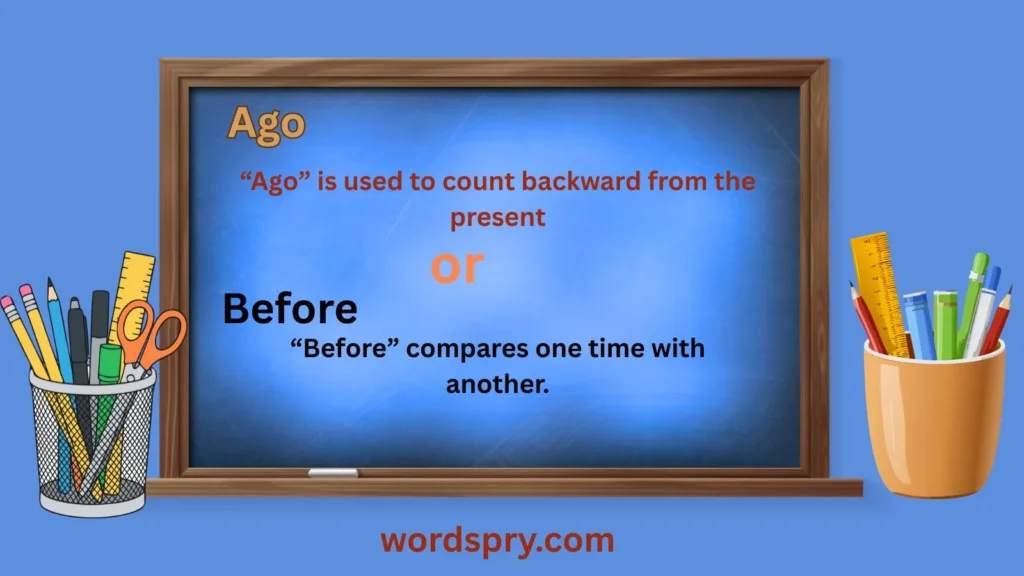
The quick answer is simple: “ago” is used to count backward from the present, while “before” compares one time with another.
For example:
- “I met her two years ago.” ✅
- “I met her two years before the wedding.” ✅
Many English learners confuse ago or before because both words relate to time. They often appear in conversations, stories, emails, and even news reports. However, their grammar rules are different.
Understanding the difference helps your English sound more natural and accurate. In this guide, you’ll learn the meanings, rules, examples, mistakes, and practical tips for using both words correctly.
See also: Blatantly vs Bluntly – Which Word Should You Really Use?
Table of Contents
- Quick Answer
- What Does “Ago” Mean?
- What Does “Before” Mean?
- Ago vs Before: Main Difference
- Correct and Incorrect Examples
- Origin and History
- British vs American Usage
- Which One Should You Use?
- Common Mistakes
- Everyday Examples
- Usage Trends and Popularity
- Comparison Table
- Special Grammar Rules
- FAQs
- Conclusion
⚡ Ago or Before: Quick Answer
| Word | Main Use | Example |
|---|---|---|
| Ago | Counts backward from now | “She left an hour ago.” |
| Before | Shows an earlier time than another event | “She left before dinner.” |
Simple Rule
- Use ago with the present moment
- Use before with another event or time
What Does “Ago” Mean?
The word ago refers to a time counted backward from the present.
It tells how long ago something happened.
Structure
Time + ago
Examples
- I called him five minutes ago.
- They moved here three years ago.
- We ate lunch an hour ago.
Incorrect Examples
- I called him five minutes before. ❌
- They moved here three years before. ❌
Those sentences sound incomplete because “before” usually needs another event or reference point.
Important Tip
“Ago” is commonly used with the past simple tense.
Examples
- She arrived two days ago.
- We finished the project last week.
What Does “Before” Mean?
The word before means earlier than a particular time, action, or event.
Unlike “ago,” it does not always connect directly to the present.
Examples
- Wash your hands before eating.
- I had seen that movie before.
- She arrived before sunset.
Structure
Before + noun / event / clause
Correct Usage
- Before class started
- Before dinner
- Before he arrived
Incorrect Usage
- I met him two years before. ❌
- She called me ten minutes before. ❌
These examples feel unfinished because the comparison point is missing.
Ago vs Before: Main Difference
The biggest difference between ago or before is the reference point.
“Ago”
- Refers back from now
- Focuses on the present moment
“Before”
- Refers to an earlier point compared with another time
- Focuses on relationships between events
Compare These Sentences
- I visited London two years ago.
→ Counting back from today - I visited London two years before the pandemic.
→ Comparing one event with another
Correct and Incorrect Examples
Using “Ago”
✅ Correct:
- He left ten minutes ago.
- We spoke a month ago.
❌ Incorrect:
- He left ten minutes before.
- We spoke a month before.
Using “Before”
✅ Correct:
- Finish your homework before bedtime.
- She had met him before the meeting.
❌ Incorrect:
- Finish your homework ago bedtime.
- She had met him ago the meeting.
Origin and History
The Word “Ago”
“Ago” comes from old English expressions meaning “gone by” or “passed.” Over time, it became linked with measuring time backward from the present.
The Word “Before”
“Before” has ancient Germanic roots. It originally meant “in front of” or “earlier than.” Today, it still carries the idea of something happening earlier.
|RELATED: Choir vs Chorus: What’s the Difference and Which Word Should You Use?
British English vs American English
There is very little difference between British and American English when using ago or before.
Both forms follow the same grammar rules.
Common in Both Styles
- Two days ago
- Before lunch
- Before the meeting
However, British speakers sometimes use slightly more formal sentence structures in writing.
Example
- British: “I had seen it before.”
- American: “I saw it before.”
The meaning stays nearly identical.
Which One Should You Use?
Use this simple guide when deciding between ago or before.
Use “Ago” When:
- Talking about time from now
- Mentioning a finished action
- Using the past simple tense
Examples
- I woke up an hour ago.
- She graduated two years ago.
Use “Before” When:
- Comparing two events
- Showing sequence
- Talking about earlier actions
Examples
- Call me before you leave.
- I had heard that story before.
Quick Memory Trick
- Ago = from now
- Before = earlier than something
Common Mistakes
Many learners mix these words because both describe past time.
Mistake 1
❌ I met him three years before.
✅ I met him three years ago.
Reason: No comparison point exists.
Mistake 2
❌ She washed her hands ago dinner.
✅ She washed her hands before dinner.
Reason: “Ago” cannot introduce an event.
Mistake 3
❌ We arrived before two hours.
✅ We arrived two hours ago.
Reason: “Before” is not used for counting backward from now.
Everyday Examples
Emails
- I sent the report two days ago.
- Please review it before tomorrow.
Social Media
- I posted that picture weeks ago.
- Think before commenting online.
News
- The storm began hours ago.
- Officials warned people before the flood.
Classroom
- We studied this chapter before the exam.
- The teacher explained it again yesterday.
Daily Life
- I cooked dinner an hour ago.
- Lock the door before leaving.
Usage Trends and Popularity
Both words are extremely common in English.
“Ago”
Most popular in:
- Conversations
- News reporting
- Daily storytelling
“Before”
Most popular in:
- Instructions
- Academic writing
- Sequencing events
English learners search ago or before frequently because the difference seems small at first. Yet one tiny grammar mistake can change sentence clarity.
Comparison Table
| Feature | Ago | Before |
|---|---|---|
| Refers to present time | Yes | Not always |
| Compares events | No | Yes |
| Common tense | Past simple | Many tenses |
| Needs another event | No | Usually yes |
| Example | “A week ago” | “Before dinner” |
Special Grammar Rules and Important Uses
1. “Ago” Usually Comes After Time Expressions
✅ Correct:
- Two years ago
- A minute ago
❌ Incorrect:
- Ago two years
2. “Before” Can Work as Different Parts of Speech
It can be:
- A preposition
- A conjunction
- An adverb
Examples
- Before lunch (preposition)
- Before you go (conjunction)
- I had seen it before (adverb)
3. “Ago” Cannot Start a Clause Naturally
❌ Ago I met him.
✅ I met him years ago.
4. “Before” Can Talk About Future Time
- Finish the work before Friday.
- Call me before you arrive.
“Ago” cannot be used this way.
FAQs
Is “ago” the same as “before”?
No. “Ago” counts backward from the present, while “before” compares one event with another.
Can I say “two years before”?
Yes, but only if another event is mentioned.
Example:
- “Two years before the wedding.”
Why is “three days before” sometimes wrong?
It becomes incomplete without a comparison point.
Incorrect:
- “I arrived three days before.”
Correct:
- “I arrived three days before the ceremony.”
Which tense is used with “ago”?
“Ago” usually works with the past simple tense.
Example:
- “She called yesterday.”
Can “before” refer to the future?
Yes.
Example:
- “Finish your homework before dinner.”
Is “ago” formal or informal?
It works in both formal and informal English.
Do native speakers confuse ago or before?
Rarely. Native speakers naturally follow the grammar pattern through regular usage.
Conclusion
Understanding ago or before becomes much easier once you know the reference point.
Use ago when counting backward from the present. Use before when comparing events or times.
Here’s the simple rule again:
- Ago = from now
- Before = earlier than another event
Practice with real-life examples every day. Over time, choosing the correct word will feel automatic and natural.

Hi, I’m William Parker, the creator behind Wordspry.com
I enjoy breaking down complex grammar rules into clear and practical lessons that help learners write and speak English more effectively.