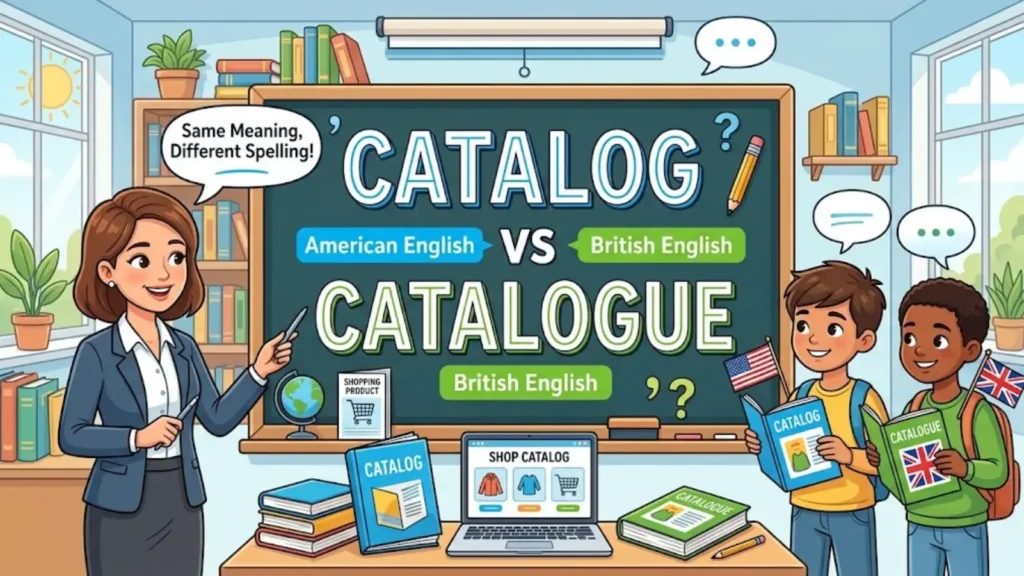
When comparing catalog vs catalogue, both spellings are correct. The main difference comes down to regional spelling preferences: catalog is standard in American English, while catalogue is more common in British English.
For example, an American online store might publish a product catalog, while a British retailer might call the same document a product catalogue. Both phrases describe a list of products, often with pictures, descriptions, and prices.
So, which spelling should you choose for your blog, school assignment, business document, or website? The answer depends on your audience and the type of English you want to use.
Although the two words have the same meaning, choosing one spelling and using it consistently makes your writing look more professional. Let’s explore their definitions, history, regional differences, common mistakes, and everyday uses.
Table of Contents
- Quick Answer: Catalog vs Catalogue
- What Does Catalog Mean?
- What Does Catalogue Mean?
- Origin and History
- British English vs American English
- Which One Should You Use?
- Common Mistakes
- Everyday Examples
- Usage Trends and Popularity
- Catalog vs Catalogue Comparison Table
- Special Rules and Important Uses
- Frequently Asked Questions
- Conclusion
Quick Answer: Catalog vs Catalogue
Catalog and catalogue are two correct spellings of the same word. Both refer to an organized list of items, products, books, services, or other information.
- Catalog: Preferred in American English.
- Catalogue: Preferred in British English and commonly used in other varieties that follow British spelling conventions.
Example: The American company printed a new product catalog, while the British company published a new product catalogue.
Neither spelling is universally more correct. Choose the version that suits your audience, and use it consistently.
What Does Catalog Mean?
A catalog is an organized list of items, products, services, or information. It may appear in print or online, helping people find and compare different options.
The word is especially common in American English. Businesses, schools, libraries, and online retailers use catalogs for different purposes.
Examples of Catalog in Sentences
- The furniture store released its new catalog this spring.
- Students can check the course catalog before registering for classes.
- I searched the library catalog for books about history.
- The company added its latest products to the online catalog.
In each example, catalog refers to an organized collection of information.
What Is a Catalog Used For?
A catalog can serve several purposes:
- Shopping: Displays products, prices, and descriptions.
- Education: Lists courses, requirements, and academic programs.
- Libraries: Helps readers locate books and other resources.
- Business: Organizes services, inventory, and product information.
- Digital platforms: Presents searchable lists of products, files, or content.
In American English, catalog is the usual spelling in these contexts.
What Does Catalogue Mean?
A catalogue has exactly the same meaning as catalog. It describes an organized collection or list of items, products, services, or information.
The spelling catalogue is preferred in British English. It is also widely used in places and institutions that follow British spelling conventions.
Examples of Catalogue in Sentences
- The shop delivered its new furniture catalogue to customers.
- The university published a catalogue of available courses.
- She found the book in the library catalogue.
- The museum prepared a catalogue of its latest exhibition.
These sentences mean the same as their American English equivalents. Only the spelling changes.
What Is a Catalogue Used For?
A catalogue commonly appears in:
- Retail brochures showing products and prices.
- University documents listing courses and qualifications.
- Museum publications describing artworks and collections.
- Library systems that organize books and other materials.
- Online stores that display available products.
The longer spelling does not make the word more formal or more accurate. It simply reflects a different spelling convention.
Is “catalogue” ever acceptable in American English?
Yes. American writers may use catalogue in official titles, museum publications, or organizations that follow British spelling. However, catalog remains the usual choice for general American writing.
Origin and History
The word catalogue comes through French from the Latin catalogus, which refers to a list or register. Its history reflects the long-standing need to organize information, from written records to modern digital databases.
Over time, English developed two common spellings: catalogue and catalog. The shorter form became especially established in American English, while British English retained the longer form as its standard spelling.
The difference is similar to other regional spelling variations, including color and colour or center and centre.
Today, both spellings remain correct. Neither represents a newer meaning, and neither automatically indicates a different kind of list.
British English vs American English
The main difference between catalog and catalogue is regional preference. American English generally favors the shorter spelling, while British English traditionally uses the longer one.
American English
Catalog
Example: Browse our online catalog.
British English
Catalogue
Example: Browse our online catalogue.
The same pattern appears in verb forms:
| American English | British English |
|---|---|
| catalog | catalogue |
| catalogs | catalogues |
| cataloged | catalogued |
| cataloging | cataloguing |
These are standard regional forms. However, organizations and technical systems may follow their own conventions, so check the relevant style guide when necessary.
Which One Should You Use?
Choosing between catalog and catalogue is simple once you know your audience.
1. Use “Catalog” for American English
Choose catalog when writing for American readers. It works well in blog posts, product descriptions, school documents, and business communication.
Examples:
- Our online catalog features hundreds of products.
- Check the university catalog for admission requirements.
- The librarian updated the digital catalog.
2. Use “Catalogue” for British English
Choose catalogue when following British spelling conventions.
Examples:
- Our online catalogue features hundreds of products.
- Check the university catalogue for admission requirements.
- The librarian updated the digital catalogue.
3. Follow Your Brand’s Style Guide
If your company or publication has an established spelling style, follow it. This matters especially when writing product descriptions, marketing materials, and international website content.
4. Keep Your Spelling Consistent
Avoid switching between catalog and catalogue without a clear reason.
For example, if your American website uses product catalog on one page, use that spelling throughout the site. Consistency makes your writing easier to read and helps maintain a professional style.
Common Mistakes
Even though both spellings are correct, writers sometimes use them inconsistently or misunderstand their regional differences.
Mistake 1: Calling “Catalogue” Incorrect
Incorrect claim: “Catalogue is a misspelling of catalog.”
Correct explanation: Both forms are accepted English spellings. The preferred choice depends on the variety of English.
Mistake 2: Mixing American and British Forms
Inconsistent example:
“Our new product catalog is available online. Download the latest catalogue today.”
Consistent American version:
“Our new product catalog is available online. Download the latest catalog today.”
Consistent British version:
“Our new product catalogue is available online. Download the latest catalogue today.”
Mistake 3: Forgetting the Verb Forms
The spelling difference also affects the past tense and present participle.
- American: The librarian cataloged the books.
- British: The librarian catalogued the books.
- American: We are cataloging new products.
- British: We are cataloguing new products.
Both sets are correct within their respective spelling conventions.
Mistake 4: Assuming the Longer Form Is More Formal
The word catalogue is not automatically more formal than catalog. Both are suitable for formal writing, provided they match the chosen English variety.
Everyday Examples
Here are practical examples showing how these spellings appear in everyday communication.
In Emails
American English:
Hello Team,
The updated product catalog is now available on our website. Please review the latest listings before sending quotations to customers.
Best regards,
The Sales Team
British English:
Hello Team,
The updated product catalogue is now available on our website. Please review the latest listings before sending quotations to customers.
Best regards,
The Sales Team
On Social Media
- American: Our new summer catalog is here! Explore the latest styles.
- British: Our new summer catalogue is here! Explore the latest styles.
In News Articles
- American: The retailer released its holiday catalog ahead of the shopping season.
- British: The retailer released its holiday catalogue ahead of the shopping season.
The Classroom
- American: Students can find the required reading list in the course catalog.
- British: Students can find the required reading list in the course catalogue.
In Daily Life
- American: I ordered a sofa after checking the furniture catalog.
- British: I ordered a sofa after checking the furniture catalogue.
These examples demonstrate that the meaning stays the same. Only the preferred spelling changes.
Usage Trends and Popularity
The popularity of catalog and catalogue varies by country and writing context.
- United States: Catalog is the dominant spelling in general usage.
- United Kingdom: Catalogue remains the traditional and preferred spelling.
- Australia and New Zealand: Catalogue is commonly preferred under British-influenced spelling conventions.
- Canada: Both forms appear, and usage can vary by context and organization.
Sapling+1
In digital publishing, product listings, library databases, and online stores, the spelling often reflects the organization’s preferred English style.
For a blog targeting American readers, catalog is usually the better choice. For British readers, catalogue is generally more suitable.
One important note: popularity figures from individual language websites may rely on particular datasets. They should not be treated as universal measurements of every English speaker’s writing.
Catalog vs Catalogue Comparison Table
| Feature | Catalog | Catalogue |
|---|---|---|
| Preferred variety | American English | British English |
| Meaning | An organized list or collection | An organized list or collection |
| Used as a noun | Yes | Yes |
| Used as a verb | Yes | Yes |
| Plural noun | Catalogs | Catalogues |
| Past tense | Cataloged | Catalogued |
| Present participle | Cataloging | Cataloguing |
| Product example | Product catalog | Product catalogue |
| Library example | Library catalog | Library catalogue |
| Correct spelling | Yes | Yes |
The simplest rule is to choose catalog for American English and catalogue for British English.
Special Rules and Important Uses
Although the two spellings usually mean the same thing, a few details are worth remembering.
1. Both Words Can Be Nouns
A catalog or catalogue can describe a physical publication, a digital list, or an organized collection of information.
Examples:
- The store printed a new catalog.
- The museum published an exhibition catalogue.
- The library maintains an online catalog.
2. Both Words Can Be Verbs
As verbs, both spellings mean to list, record, or organize items systematically.
Examples:
- The team will catalog the new inventory.
- The researchers will catalogue the historical documents.
3. “A Catalogue of Errors” Is Also Correct
Both forms can describe a series or collection of events, problems, or qualities.
For example:
- The report described a catalog of mistakes.
- The report described a catalogue of mistakes.
The intended meaning is a list or series of mistakes. In British English, catalogue is the usual choice.
4. Preserve Official Names and Titles
If a university, company, museum, or publication uses one spelling in its official name, preserve that spelling. Do not change a proper name merely to match your preferred regional style.
5. Pronunciation Is Generally Similar
In ordinary speech, the two forms are generally pronounced alike within the same English variety. The main distinction is written spelling, not meaning.
Frequently Asked Questions
1. Is catalog or catalogue correct?
Both are correct. Catalog is the standard American spelling, while catalogue is preferred in British English.
2. Is catalog American or British English?
Catalog is primarily American English. It appears in product catalogs, library catalogs, course catalogs, and other organized lists.
3. Is catalogue British or American English?
Catalogue is the traditional British English spelling. Although it also appears in American writing, catalog is generally preferred in the United States.
4. Do catalog and catalogue mean the same thing?
Yes. Both words describe an organized list or collection of items, such as books, products, services, or artworks. The difference is mainly regional spelling.
5. What is the plural of catalog?
The standard American plural is catalogs. In British English, the usual plural is catalogues.
Examples:
- American: The company printed three catalogs.
- British: The company printed three catalogues.
6. Is it cataloging or cataloguing?
Both spellings are correct. American English usually uses cataloging, while British English generally uses cataloguing.
Example: The librarian is cataloging new books.
British version: The librarian is cataloguing new books.
7. Should I use catalog or catalogue for SEO?
Choose the spelling that matches your target audience. If your blog primarily targets the United States, use catalog. If it targets the United Kingdom, use catalogue. Write naturally, and avoid repeating both spellings unnecessarily just to target search engines.
Conclusion
The difference between catalog vs catalogue is simple: both words are correct, and both have the same basic meaning. The main distinction is regional spelling.
Use catalog when writing in American English. Choose catalogue when following British English conventions.
Remember that this difference also affects related forms, including cataloging/cataloguing and cataloged/catalogued. If you are writing for a particular audience, follow its spelling conventions and remain consistent throughout your article.
The next time you write about a product list, library collection, or online store, consider your readers before choosing a spelling. That small decision can make your writing clearer and more professional.

Hi, I’m Henry Collins, the educator behind Wordspry.com
I’m dedicated to helping English learners build confidence through easy grammar explanations, writing tips, and everyday language learning resources.