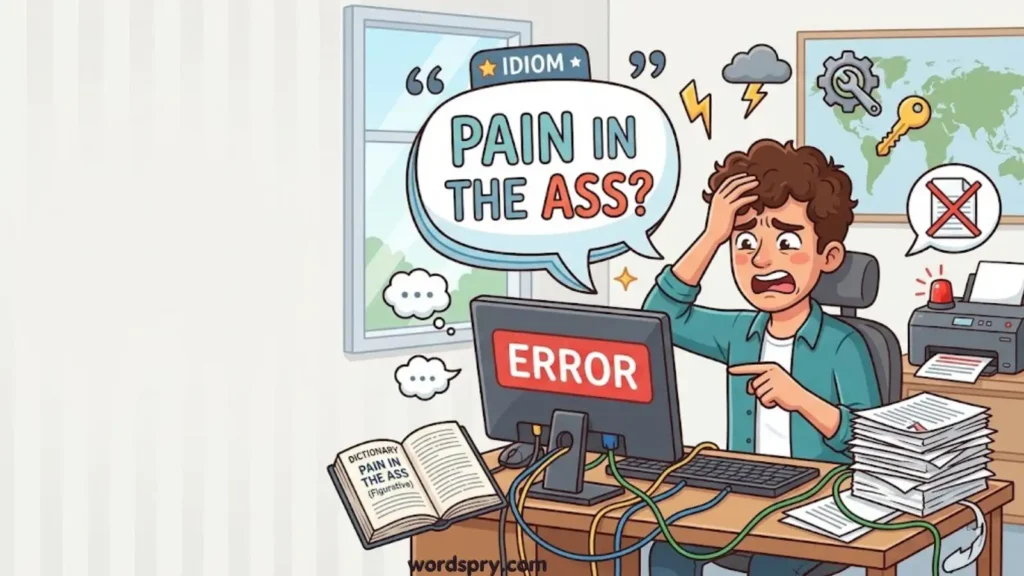
You have probably heard someone say, “That paperwork is a pain in the ass,” or “My old computer became a real pain in the ass.” The phrase can sound funny, rude, or even confusing if you hear it for the first time.
So, what does pain in the ass really mean? Does it literally describe physical pain, or does it express something completely different?
In everyday American English, pain in the ass is a common informal idiom for a person, situation, task, or thing that causes annoyance, frustration, inconvenience, or trouble. The phrase uses exaggerated language to show how irritating something feels.
You may encounter it in movies, television shows, books, social media posts, comedy, casual conversations, and online discussions. It also appears in creative writing because its strong emotional tone can make dialogue sound natural.
This guide explains the pain in the ass meaning, its origin, tone, synonyms, examples, cultural context, and correct usage. You will also learn when to use this expression—and when a more polite alternative works better.
Read: No Cuts No Buts No Coconuts: Meaning, Origin and Examples
Quick Answer
Pain in the ass is an informal idiom meaning someone or something that causes irritation, inconvenience, frustration, or trouble. It does not usually describe literal physical pain. The phrase has a humorous but vulgar tone and works best in casual conversations, informal writing, comedy, and realistic dialogue.
Table of Contents
- Meaning at a Glance
- What Does Pain in the Ass Mean?
- Why Do People Search for Pain in the Ass?
- The Deeper Meaning of Pain in the Ass
- Background and Origin
- Contexts Where Pain in the Ass Is Used
- Usage Across Different Platforms
- Examples in Everyday Life
- When Should You Use Pain in the Ass?
- When Should You Avoid Using It?
- Common Misconceptions
- Common Mistakes
- Similar Phrases and Alternatives
- How to Use Pain in the Ass in a Sentence
- Pain in the Ass in Different Languages and Cultures
- Pain in the Ass in Online Conversations
- Popularity and Trends Over Time
- Featured Snippet Summary
- Trusted References
- Frequently Asked Questions
- Conclusion
Meaning at a Glance
| Aspect | Explanation |
|---|---|
| Literal Meaning | Physical discomfort involving the buttocks, although this is rarely the intended meaning |
| Figurative Meaning | A person, task, object, or situation that causes annoyance or trouble |
| Emotional Meaning | Frustration, irritation, impatience, or exasperation |
| Common Usage | Casual conversations and informal writing |
| Tone | Informal, blunt, humorous, and mildly vulgar |
| Related Topics | Idioms, slang, frustration, annoyance, colloquial English, informal language |
What Does Pain in the Ass Mean?
The pain in the ass meaning is usually figurative rather than literal.
When someone calls a person or situation a pain in the ass, they mean that it creates unnecessary difficulty, irritation, inconvenience, or frustration.
For example:
“My printer is a pain in the ass.”
The speaker does not mean that the printer physically hurts them. Instead, the printer keeps causing problems.
The expression can describe several things:
- A difficult person
- An annoying task
- A troublesome machine
- An inconvenient situation
- A frustrating problem
- Something that repeatedly causes trouble
Literal Meaning
Taken literally, “pain in the ass” could describe actual physical discomfort in the buttocks. However, ordinary speakers usually use the expression as an idiom.
Figurative Meaning
The figurative meaning focuses on annoyance and inconvenience.
For example:
“Getting all these documents signed is a pain in the ass.”
Here, the paperwork has become frustrating and time-consuming.
Emotional Meaning
The expression often carries emotional force. It tells listeners that the speaker feels more than mild annoyance.
Compare:
“This task is annoying.”
with:
“This task is a pain in the ass.”
The second sentence sounds stronger, more emotional, and much more informal.
Why Do People Search for Pain in the Ass?
People search for this phrase for several reasons.
Some learners encounter it while watching an American movie or television program. Others see it in a social media comment, book, song title, meme, or online conversation.
Common searches include:
- Pain in the ass meaning
- What does pain in the ass mean?
- Pain in the ass definition
- Pain in the ass synonym
- Is pain in the ass a bad word?
- Is pain in the ass an idiom?
- How do you use pain in the ass in a sentence?
- Pain in the ass meaning in Urdu
- Pain in the ass meaning in Hindi
The phrase also attracts attention because English learners may understand each individual word but still miss the overall figurative meaning.
The Deeper Meaning of Pain in the Ass
Unlike an artistic metaphor, this expression does not usually hide a complex symbolic message. Its power comes from exaggeration, emotion, and vivid imagery.
The phrase connects an unpleasant experience with a part of the body associated with discomfort when someone sits for too long. That image makes the idea of persistent irritation easy to understand.
Frustration
The expression often communicates frustration after repeated problems.
“That software update has been a pain in the ass all week.”
Inconvenience
It can describe something that makes a simple task unnecessarily difficult.
“Finding a parking space downtown is a pain in the ass.”
Humor
Friends may use the expression jokingly without expressing serious anger.
“My little brother is such a pain in the ass, but I love him.”
Context determines whether the phrase sounds hostile, humorous, affectionate, or simply annoyed.
Character and Voice
Writers often use the expression to make dialogue sound realistic. A character who regularly uses informal American slang may naturally say it.
In fiction, language becomes part of characterization. Word choice can reveal personality, attitude, social setting, and emotional expression.
Background and Origin
The exact first use of pain in the ass as an idiom is difficult to identify with certainty. Like many colloquial expressions, it developed through everyday spoken English rather than from a single clearly documented creator.
The expression belongs to a broader family of English phrases that use pain figuratively to describe an annoying person or troublesome situation.
English speakers have long used physical discomfort as a metaphor for emotional or practical difficulty. Expressions involving bodily discomfort often make abstract experiences easier to picture.
The American form pain in the ass became especially familiar through informal American speech, entertainment, comedy, movies, television, and popular culture.
A related British expression is pain in the arse, which uses the British spelling and pronunciation of “arse.”
The expression remains popular because it is short, vivid, emotionally strong, and easy to understand from context.
Contexts Where Pain in the Ass Is Used
Art and Painting
The phrase does not have a special technical meaning in art history or painting.
However, an artist could use it in a painting title, installation, poster, or conceptual artwork to express frustration or humor.
For example:
“A Pain in the Ass: The Artist’s Struggle With Bureaucracy”
Here, the phrase becomes part of the artwork’s creative expression rather than an art term.
Photography
Photographers might use the expression in an informal caption describing an inconvenient shoot.
“Carrying this equipment up five flights of stairs was a pain in the ass.”
The phrase creates a conversational tone.
Literature
Authors frequently use colloquial expressions in dialogue.
A fictional character might say:
“That neighbor is a pain in the ass.”
This wording can make the character’s speech feel authentic.
Movies and Documentaries
Screenwriters may use the expression when they want dialogue to sound casual, blunt, comedic, or emotionally intense.
Because the phrase is vulgar, filmmakers often reserve it for characters and scenes where informal language fits.
Personal Development
A person discussing productivity might describe an annoying habit as a “pain in the ass,” although more professional content usually uses phrases such as major obstacle or persistent problem.
Business and Branding
Businesses should use caution with this phrase. A humorous brand targeting a casual audience may deliberately use provocative language, but a conservative company may damage its professional image by using vulgar expressions.
Education
Teachers can discuss the phrase when teaching:
- Idioms
- Slang
- Colloquial English
- Register
- American English
- Figurative language
- Cultural communication
However, students should understand that it is informal and mildly vulgar.
Social Media
Social media users commonly use the expression to describe frustrating experiences.
For example:
“Waiting three hours for customer support is a pain in the ass.”
The casual tone fits many personal posts and comments.
Usage Across Different Platforms
| Platform | Typical Usage | Example |
|---|---|---|
| Casual captions | “Moving apartments is a pain in the ass.” | |
| TikTok | Humor and storytelling | “This trend is a pain in the ass to recreate.” |
| Less common | Usually appears in quotes or humorous graphics | |
| Personal complaints | “Traffic was a pain in the ass today.” | |
| Generally avoided | A professional alternative works better | |
| YouTube | Casual speech | Creators may use it in informal videos |
| Blogs | Conversational writing | “Why website migrations can be a pain in the ass” |
Examples in Everyday Life
The phrase can describe almost any frustrating experience.
Daily Conversation
“My car has been a pain in the ass lately.”
Artwork
“The exhibition explores the everyday pains of modern life, with a deliberately humorous title.”
Classroom Discussion
A teacher might explain:
“Pain in the ass is an informal idiom for something annoying.”
Business Presentation
A speaker should usually replace it with:
“This process creates several challenges.”
Social Media Caption
“Moving all my furniture was a pain in the ass!”
Speech
In a casual speech, a speaker might use it to create humor. In a formal speech, a more neutral expression would usually sound better.
Blog Title
A casual blog could use:
“Why Website Maintenance Can Be a Pain in the Ass”
This title immediately signals an informal, humorous tone.
When Should You Use Pain in the Ass?
Use the expression when the situation allows informal and somewhat vulgar language.
Good situations include:
- Casual conversations
- Conversations with close friends
- Comedy
- Informal blogs
- Creative writing
- Character dialogue
- Social media
- Informal storytelling
- Humorous content
Before using it, consider your audience. A phrase that makes friends laugh may sound inappropriate in a job interview.
When Should You Avoid Using It?
Avoid the expression when you need formal, respectful, or highly professional language.
It generally does not belong in:
- Legal documents
- Scientific papers
- Academic research
- Formal contracts
- Official reports
- Medical documentation
- Professional correspondence
- Job applications
- Formal business proposals
Instead of:
“The new procedure is a pain in the ass.”
write:
“The new procedure creates several practical difficulties.”
The second version communicates the same basic idea without vulgar language.
Common Misconceptions About Pain in the Ass
Misconception 1: It Always Means Physical Pain
Not usually.
In everyday English, the expression generally describes annoyance, inconvenience, or frustration, not actual bodily pain.
Misconception 2: It Always Insults a Person
No.
You can describe an object, task, process, or situation as a pain in the ass.
“This software is a pain in the ass.”
Misconception 3: It Is Always Extremely Offensive
The phrase is certainly vulgar, but its perceived offensiveness depends on context, audience, and culture.
Friends may use it casually, while the same words could sound inappropriate in a workplace.
Misconception 4: It Has a Special Artistic Meaning
It does not have a standard technical meaning in art.
Artists may use it creatively, but the ordinary idiomatic meaning remains something or someone annoying.
Common Mistakes When Using Pain in the Ass
Using It in Formal Writing
The biggest mistake involves choosing an overly casual expression for a formal audience.
Use frustrating, difficult, or problematic instead when appropriate.
Assuming It Describes Only People
The phrase can describe people, objects, tasks, and situations.
Ignoring Tone
The phrase contains a reference to a body part and therefore sounds vulgar.
Always consider your audience.
Overusing It
Repeating the expression can make writing sound immature or forced.
Strong language works better when you use it selectively.
Confusing It With Literal Language
Most speakers understand the phrase figuratively. Do not interpret it literally unless the surrounding context clearly indicates physical pain.
Similar Phrases & Alternatives
| Phrase | Meaning | Best Used When |
|---|---|---|
| Pain in the neck | Annoying person or thing | Informal but less vulgar |
| Nuisance | Something irritating or troublesome | Neutral and professional |
| Annoyance | Something that causes irritation | General writing |
| Headache | A troublesome problem | Casual and professional contexts |
| Bother | Something that causes inconvenience | Everyday conversation |
| Troublemaker | A person who causes problems | Describing people |
| Inconvenience | Something that creates difficulty | Formal writing |
| Frustration | Something that causes irritation | Professional and general writing |
Pain in the Ass vs. Pain in the Neck
These expressions have almost the same figurative meaning.
However, pain in the neck sounds less vulgar and works in more situations.
“My neighbor is a pain in the neck.”
This sentence feels more polite than:
“My neighbor is a pain in the ass.”
How to Use Pain in the Ass in a Sentence
Professional Writing
It is better to use a formal alternative:
“The approval process has become a significant inconvenience.”
Creative Writing
“Getting through that locked door was a pain in the ass.”
Social Media Caption
“Packing for a two-week trip is such a pain in the ass!”
Inspirational Quote
A motivational writer might use the phrase humorously:
“Growth can be a pain in the ass, but staying stuck can be worse.”
Everyday Conversation
“That old printer is a pain in the ass.”
Talking About a Person
“He can be a real pain in the ass sometimes.”
This can sound insulting, although friends may also use it jokingly.
Pain in the Ass in Different Languages & Cultures
Idioms rarely translate word-for-word successfully. Different languages often use their own images to communicate the same idea of annoyance or trouble.
| Language | General Interpretation |
|---|---|
| Spanish | Expressions such as ser un dolor de cabeza can describe someone or something troublesome |
| French | être pénible or similar expressions can communicate annoyance |
| Arabic | Expressions involving a “headache” or troublesome person can convey a similar idea |
| Hindi | सिरदर्द (sir dard), meaning “headache,” can describe something troublesome |
| Urdu | سر درد (sar dard), meaning “headache,” often conveys a similar figurative idea |
| Tamil | Expressions involving trouble or irritation can communicate the same general concept |
| Malayalam | Local expressions for annoyance or inconvenience often replace the English idiom |
| Marathi | डोकेदुखी (dokyadukhi), meaning “headache,” can describe a troublesome situation |
The important point is that translation depends on meaning, tone, and culture, not just individual words.
A literal translation can sound strange or much stronger in another language. Translators therefore often choose a culturally familiar idiom instead.
Pain in the Ass in Online Conversations & Social Media
Online communication has made informal language more visible than ever.
People use the phrase in comments, memes, videos, posts, and personal stories to express frustration quickly.
Users may use it in humorous captions:
“Cleaning this entire house was a pain in the ass.”
TikTok
Creators may use it while telling funny stories about difficult experiences.
The phrase can appear in personal complaints about traffic, technology, travel, or customer service.
Informal online communities often use blunt language to describe frustrating products, experiences, or situations.
YouTube
Creators may use it naturally when speaking without a formal script.
Creative Communities
Writers and artists sometimes use the phrase humorously to describe creative struggles.
For example:
“Getting the lighting right was a pain in the ass.”
The expression can make a post feel personal and conversational.
Popularity & Trends Over Time
The phrase has remained part of informal English for decades, although its visibility changes with media and communication trends.
| Period | Trend |
|---|---|
| Before 2010 | Common in spoken English, books, comedy, movies, and television |
| 2010–2015 | Social media increased exposure to casual American slang |
| 2016–2020 | Memes, video platforms, and online communities expanded informal usage |
| 2021–Present | The phrase remains common in casual speech, social media, entertainment, and digital content |
Its continued popularity comes from its directness. People often prefer a vivid phrase when they want to communicate strong frustration quickly.
Featured Snippet Summary
Pain in the ass is an informal American English idiom for a person, thing, task, or situation that causes annoyance, inconvenience, or frustration. It usually has a humorous but vulgar tone. The phrase works best in casual conversation, informal writing, entertainment, social media, and realistic fictional dialogue.
Trusted References
For dictionary-level information about idioms, informal language, and usage, useful references include:
- Cambridge Dictionary
- Merriam-Webster
- Oxford Learner’s Dictionaries
- Dictionary.com
These sources can help readers verify definitions, pronunciation, usage labels, and related vocabulary.
Frequently Asked Questions (FAQs)
What does pain in the ass mean?
Pain in the ass means a person, thing, task, or situation that causes annoyance, inconvenience, trouble, or frustration. It usually has a figurative meaning rather than a literal one.
Is pain in the ass an idiom?
Yes. Pain in the ass is an informal idiomatic expression. Its overall meaning cannot be understood simply by interpreting each word literally.
Is pain in the ass a bad word?
It contains vulgar language, so it may be considered inappropriate in formal settings. However, many English speakers use it casually among friends and in informal entertainment.
Is pain in the ass a metaphor?
It uses figurative language based on physical discomfort to describe emotional or practical irritation. More specifically, it functions as an idiomatic expression rather than a simple literal metaphor.
Where did pain in the ass originate?
The exact first use is uncertain. The expression developed within informal English and belongs to a broader tradition of describing troublesome people or situations through physical discomfort.
Can businesses use pain in the ass?
Businesses can use it when their brand voice intentionally targets a casual or humorous audience. However, professional companies should consider whether the phrase fits their customers, industry, and brand image.
What is a polite alternative to pain in the ass?
Good alternatives include pain in the neck, nuisance, inconvenience, headache, frustrating problem, and troublesome situation.
Can pain in the ass describe an object?
Yes. You can describe an object, machine, task, process, person, or situation as a pain in the ass.
For example:
“This old laptop is a pain in the ass.”
Conclusion
The pain in the ass meaning is simple once you understand its figurative use. In most everyday situations, the phrase describes someone or something that causes irritation, inconvenience, frustration, or trouble.
Although the expression contains a literal reference to physical discomfort, speakers generally use it as an informal idiom. Its strong wording gives it a humorous, blunt, and sometimes insulting tone.
You may hear it in movies, television programs, books, social media posts, online communities, comedy, and casual conversations. Writers can also use it in dialogue to create a realistic voice or show a character’s frustration.
However, context matters. The phrase works naturally with friends and in casual content, but it usually does not belong in formal reports, academic papers, contracts, or professional correspondence.
If you want a softer alternative, try pain in the neck, nuisance, headache, or inconvenience.
Language becomes more powerful when you understand not only what words mean, but also when, where, and why people use them.

Hi, I’m Mason Clark, the writer behind Wordspry!
My goal is to make grammar learning easier with straightforward explanations, useful examples, and engaging English lessons that help you grow every day.