
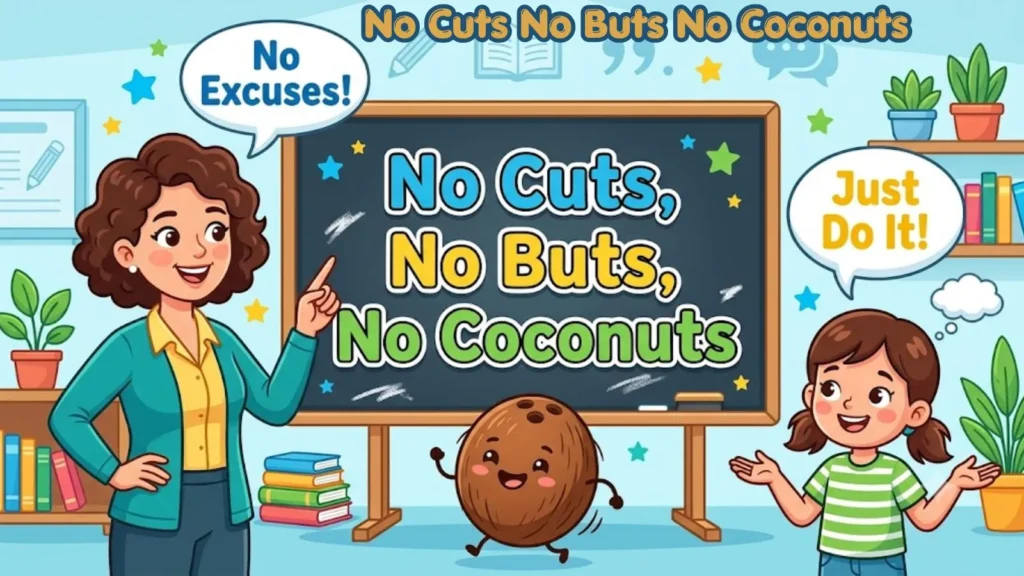
Have you ever heard someone say “No Cuts No Buts No Coconuts” and wondered what it means? Although it sounds funny, this playful expression has become a memorable way to tell someone to stop making excuses. This guide explains the meaning of No Cuts No Buts No Coconuts, where it came from, when to use it, and common misunderstandings about the phrase.
RELATED: Casi Algo Meaning: Full Guide to Love, Feelings, and Relationships
Quick Answer
No Cuts: “No excuses”
No Buts: “No Complaints“
and No Coconuts: “No arguments“
No Cuts No Buts No Coconuts is a humorous phrase that means “No excuses, no arguments, and no delays.” People use it to tell someone to accept a decision without complaining or making excuses.
Example:
“You’re helping clean the garage today—no cuts no buts no coconuts!“
In simple terms, the phrase means: The discussion is over. Just do it.
Meaning of Phrase
The phrase No Cuts No Buts No Coconuts is an informal expression used to stop excuses or objections. No cuts suggests no shortcuts or avoiding responsibility. And No buts means don’t argue or make excuses. No coconuts is a playful rhyme that adds humor rather than literal meaning.
Unlike many English expressions, it does not describe ownership, control, skills, or legal rights. Instead, it expresses determination and finality.
Examples:
- “No Cuts No Buts No Coconuts, it’s time to leave.”
- “Finish your homework—no cuts no buts no coconuts.”
No Cuts No Buts No Coconuts Idiom Meaning
The No Cuts No Buts No Coconuts idiom means no excuses, no arguments, and no complaints. People use it playfully to end a discussion or insist that someone follows instructions. Although humorous, the phrase clearly tells others to stop negotiating and simply accept the decision or complete the task.
No Cuts, No Buts, No Coconuts Meaning Urban Dictionary
According to No Cuts, No Buts, No Coconuts meaning Urban Dictionary discussions, the phrase means “no excuses” or “no arguing back.” Users describe it as a playful expression used by parents, teachers, and friends when they want someone to accept a decision without further debate or complaints.
Idiom
The No Cuts No Buts No Coconuts idiom is an informal English saying rather than a formal proverb. It relies on rhyme instead of literal meaning, making it easy to remember. People commonly use it in friendly conversations, classrooms, and family settings to end unnecessary excuses.
No Cuts, No Buts, No Coconuts Wreck-It Ralph
Many people associate No Cuts, No Buts, No Coconuts Wreck-It Ralph with the Disney film because of its playful tone. However, the phrase existed before the movie and is not an original quote from Wreck-It Ralph. The film simply helped some viewers discover similar humorous expressions.
No Cuts, No Buts Meaning
The shorter expression No Cuts, No Buts carries the same basic idea as the full phrase. It tells someone not to make excuses, take shortcuts, or argue with instructions. Speakers often add “No Coconuts” simply because it creates a funny rhyme that makes the saying more memorable.
No Cuts, No Buts, No Coconuts Big Bang Theory
Some fans search for No Cuts, No But, No Coconuts Big Bang Theory because they remember hearing similar humorous dialogue. While the phrase fits the show’s playful style, it is not widely recognized as one of its famous catchphrases. Instead, it remains a popular informal expression used beyond television.
Why People Misspell Phrase
Although the phrase is simple, people often misspell or mishear it because it rhymes.
Common mistakes include:
- No Cuts No But No Coconuts
- No Cuts No Butts No Coconuts
- No Cuts No Buts No Coconut
- No Cuts No Buts No Coco Nuts
English contains many words with double letters, such as address, success, and committee, which often confuse writers. However, No Cut No Buts No Coconuts contains only standard spellings.
Remember:
- ✅ No Cuts No Buts No Coconuts
- ❌ No Cuts No Butts No Coconut
Origin of No Cuts No But No Coconuts
The exact origin of No Cuts No Buts No Coconut is unknown, but it is believed to have developed in British playgrounds and schools during the late twentieth century.
The phrase follows a common English tradition of creating humorous rhymes to make sayings memorable.
Word Origins
| Word | Origin |
|---|---|
| No | Old English nā |
| Cut | Middle English cutten (uncertain origin) |
| But | Old English butan, meaning “except” |
| Coconut | Portuguese coco, meaning “head” or “face,” later combined with nut |
Unlike many English words, the complete phrase does not come from Latin. Instead, it is a modern rhyming expression created for emphasis.
British vs American English
The spelling of No Cuts No Buts No Coconut remains the same in both British and American English.
| British English | American English |
|---|---|
| No Cuts No Buts No Coconuts | No Cuts No But No Coconuts |
The pronunciation may vary slightly depending on the accent, but the wording does not change.
When to Use Phrase
Use No Cuts No Buts No Coconuts only in informal situations.
Suitable places include:
- Friends and family conversations
- Classroom discussions
- Social media posts
- Casual emails
- Friendly text messages
Avoid using it in:
- Legal documents
- Business contracts
- Academic essays
- Formal work reports
- Professional presentations
Although people may jokingly use it in workplace conversations, it is generally too informal for official writing.
Common Mistakes
Here are mistakes people commonly make.
| Incorrect | Correct |
|---|---|
| No Cuts No But No Coconuts | No Cuts No Buts No Coconuts |
| No Cuts No Butts No Coconuts | No Cuts No Buts No Coconuts |
| No Cuts No Buts No Coconut | No Cuts No Buts No Coconuts |
| No Cut No Buts No Coconuts | No Cuts No Buts No Coconuts |
Typing quickly often causes missing letters or extra letters. Always double-check the phrase before publishing.
Everyday Examples
Here are common situations where people use No Cuts No Buts No Coconut.
Please submit the report by Friday—no cut no buts no coconuts.
Social Media
Monday workout starts at 7 AM. No Cuts No But No Coconuts!
Professional Conversation
We have a deadline today, so no cuts no buts no coconut.
School Assignment
Finish your science project tonight—no cuts no buts no coconuts.
Usage Comparison Table
| Situation | Correct Usage | Incorrect Usage |
|---|---|---|
| Daily speech | No Cut No Buts No Coconuts, let’s go. | No Cuts No But Coconuts |
| Friendly email | Finish it today—No Cuts No Buts No Coconut. | Finish it today—No Butts No Coconuts |
| Social media | Weekend cleaning—No Cuts No Buts No Coconuts! | Weekend cleaning—No Coconut |
| School | Complete your homework—No Cuts No But No Coconuts. | Complete your homework—No Cuts No But |
| Legal writing | Avoid this phrase. | Using the phrase in contracts |
Tips to Remember No Cuts No Buts No Coconuts
- Think of the rhyme.
- Remember all three parts belong together.
- Never remove buts.
- Keep coconuts plural.
- Say it aloud a few times to remember it naturally.
The rhythm makes it easy to recall.
Common Questions and Answers
What does No Cuts No Buts No Coconuts mean?
It means no excuses, no arguments, and no complaints.
Is No Cuts No Buts No Coconuts a real English idiom?
Yes. It is an informal, humorous expression used mainly in casual speech.
Can I use it in professional writing?
Generally no. It is too informal for business reports, legal documents, and academic papers.
Is the spelling different in British and American English?
No. The spelling stays exactly the same.
Why does the phrase include “coconuts”?
“Coconuts” is included because it rhymes with “buts.” It adds humor rather than meaning.
How can I remember the phrase?
Think of the sequence:
Cuts → Buts → Coconuts
The rhyme makes it easy to remember.
Is it suitable for children?
Yes. Teachers and parents sometimes use it playfully to encourage children to stop making excuses.
Conclusion
No Cuts No Buts No Coconuts is a lighthearted English expression that means stop making excuses and accept the situation. While its final word has no literal connection to the message, the rhyme makes the saying memorable and fun. The spelling is the same in British and American English, and it works best in conversations, social media, classrooms, and friendly emails.
Remember to write the phrase exactly as No Cuts No Buts No Coconuts without adding or removing words. Since it is informal, avoid using it in legal documents, academic essays, or professional reports. Once you learn the rhythm, you’ll never forget it.

Hi, I’m Mason Clark, the writer behind Wordspry!
My goal is to make grammar learning easier with straightforward explanations, useful examples, and engaging English lessons that help you grow every day.

Pingback: Phenomena or Phenomenon: What Is the Difference? - wordspry.com
Pingback: Nostalgic Meaning, Spelling, Origin, and How to Use It Correctly - wordspry.com