Have you ever faced a problem where every possible solution creates another problem? You might need a job to gain experience, but employers refuse to hire you without experience. No matter what you do, you cannot move forward. This frustrating situation is called a Catch-22.
The expression is common in everyday English, books, conversations, and professional writing. However, many English learners are unsure about its exact meaning. Some people use it to describe any difficult situation, while others use it only for problems involving impossible rules or conflicting conditions.
Understanding the meaning of Catch-22 can help you recognize this expression and use it correctly. It describes a situation in which two or more conditions depend on each other in a way that prevents a solution. Therefore, a person becomes trapped in a problem with no easy way out.
See also: No Cuts No Buts No Coconuts: Meaning, Origin and Examples
What Does Catch-22 Mean?
Catch-22 is a noun that describes a difficult or frustrating situation in which a person cannot solve a problem because the conditions required for a solution conflict with each other.
In simple words, it means being stuck between two rules or requirements that prevent you from moving forward.
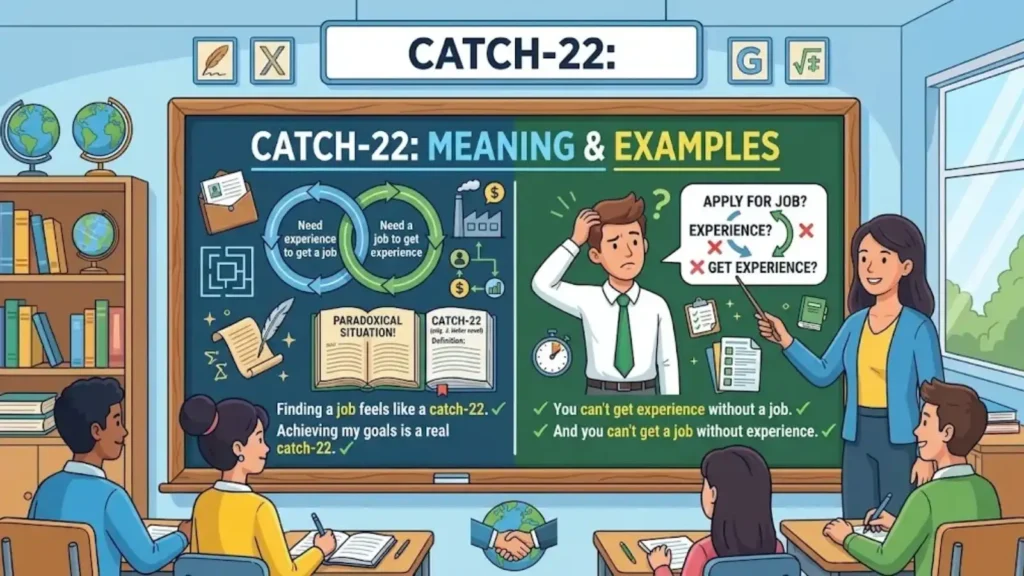
For example, imagine that you want to get your first job. However, every employer requires previous work experience. You cannot gain experience without getting a job, but you cannot get a job without experience.
This situation is a Catch-22 because both conditions block each other.
Simple Examples of Catch-22
Here are some everyday examples to make the expression easier to understand:
- You need money to start a business, but you need a business to earn money.
- A company requires experience before hiring you, but you need employment to gain experience.
- You cannot rent an apartment without proof of income, but you need an apartment to move closer to your new workplace.
- You need a good credit history to get a loan, but you need a loan to build a credit history.
- A student needs time to study, but a demanding part-time job leaves no time for studying.
Each example involves conditions that make progress difficult or impossible.
The Origin of Catch-22
The expression Catch-22 comes from the famous novel Catch-22, written by American author Joseph Heller and published in 1961.
The story takes place during World War II and follows American airmen serving in the military. Its main character, Captain John Yossarian, wants to avoid dangerous bombing missions because he fears for his life.
However, a strange military rule creates an impossible situation.
According to the fictional rule, a pilot could be excused from dangerous missions if he was considered mentally unfit to fly. However, asking to be excused showed that the pilot understood the danger and was thinking rationally. Therefore, the request itself was treated as evidence that he was mentally fit to continue flying.
As a result, the pilot could not escape the missions by asking for help. The rule trapped him regardless of what he chose to do.
This paradox became known as Catch-22. Over time, people began using the expression outside the novel to describe similar situations involving contradictory rules, impossible conditions, or no-win choices.
Today, it is a familiar English expression used in everyday conversations, journalism, education, and business writing.
Catch-22: Core Meaning and Explanation
The central idea behind a Catch-22 is that a person cannot solve a problem because the solution depends on something that the problem itself prevents.
In other words, one condition blocks another, creating a cycle that is difficult to escape.
How Does a Catch-22 Situation Work?
Consider this simple example:
A young person wants to apply for a professional job. However, the employer requires two years of experience. The person cannot gain those two years without getting a job in the first place.
The situation works like this:
- The person wants to get a job.
- The employer requires previous experience.
- The person needs a job to gain experience.
- Without experience, the employer refuses to hire the person.
Therefore, the person remains stuck.
This is more than an ordinary difficulty. It is a problem in which the requirements prevent the person from reaching the desired result.
Catch-22 vs. an Ordinary Problem
Not every difficult situation is a Catch-22.
For example, losing your phone is an unpleasant problem. However, it is not necessarily a Catch-22 because you can search for it, contact someone, or replace it.
By contrast, needing work experience to get a job while needing a job to gain experience creates a circular problem.
The important difference is that a Catch-22 involves conflicting or dependent conditions that block a solution.
✓ Correct Ways to Use Catch-22
The expression is usually written as Catch-22 or catch-22. It functions as a noun and can describe a no-win situation, a paradox, or a problem created by contradictory conditions.
Here are some correct examples:
- Getting a job without experience is a real Catch-22.
- We are facing a Catch-22 because we need funding to start the project, but investors want to see the project running first.
- The company’s rules created a catch-22 for new employees.
- It is a Catch-22: I need more time to earn money, but I need money to save time.
- The application process puts students in a difficult Catch-22.
Notice that the expression can appear at the beginning, middle, or end of a sentence.
You can also use it in the phrase Catch-22 situation.
Example: New graduates often face a Catch-22 situation when applying for their first jobs.
✗ Incorrect or Misleading Ways to Use Catch-22
Although Catch-22 is a flexible expression, it should not describe every problem or inconvenience.
Consider these examples:
Incorrect or misleading: I forgot my umbrella, so getting wet was a Catch-22.
Better: I forgot my umbrella, so I got wet.
Why? Forgetting an umbrella is an ordinary mistake. It does not involve conflicting conditions that prevent a solution.
Another example:
Incorrect or misleading: My computer is slow. This is a Catch-22.
Better: My computer is slow, so I need to find a way to improve its performance.
Why? A slow computer is a problem, but it is not automatically a Catch-22. The expression would make sense if two conflicting requirements prevented you from fixing it.
Remember, a Catch-22 involves a no-win situation or a circular condition, not simply something unpleasant.
Catch-22 vs. Similar Expressions
Several English expressions describe difficult situations. However, they do not always have exactly the same meaning.
| Expression | Meaning | Example |
|---|---|---|
| Catch-22 | Conflicting conditions prevent a solution. | You need experience to get a job but need a job to gain experience. |
| Dilemma | A difficult choice between options. | I must choose between two important opportunities. |
| No-win situation | Every available choice leads to an unfavorable result. | Either decision could upset someone. |
| Vicious circle | A cycle in which one problem creates or worsens another. | Debt creates stress, and stress makes it harder to manage money. |
| Double bind | A situation involving conflicting demands or expectations. | Your manager asks you to work faster but also demands perfect results. |
These expressions are related, but they are not always interchangeable.
For example, a dilemma may involve two difficult choices without any circular rules. Meanwhile, a Catch-22 usually involves conditions that make a solution impossible or extremely difficult.
How to Use Catch-22 in Real Life
Understanding an expression is easier when you see how people use it in different situations. Here are practical examples from everyday life, education, blogging, and business.
1. Everyday Conversations
People often use Catch-22 when discussing frustrating personal situations.
Examples:
- “I cannot save money because my salary is too low, but I cannot find a better job without more training. It’s a Catch-22.”
- “We need a bigger house because our family is growing, but we cannot afford one without selling our current house. What a Catch-22!”
- “I need a quiet place to work, but I cannot afford an office. That is my Catch-22.”
These examples show how the expression makes a complicated problem easier to explain.
2. Education and Student Life
Students can also experience Catch-22 situations.
Examples:
- A student needs practical experience for an internship, but the internship is supposed to provide that experience.
- A student needs a scholarship to attend college, but the scholarship application requires proof of enrollment.
- A graduate needs professional references, but has never worked in a professional position.
In these situations, students may struggle because one requirement depends on another.
3. Blogging and Content Writing
Bloggers and writers can use Catch-22 to describe problems involving content creation, website growth, and online publishing.
Examples:
- A new website needs visitors to attract advertisers, but it needs advertising income to support its growth.
- A blogger needs quality content to attract readers, but needs reader feedback to understand what content works best.
- A new website struggles to build trust because it has few visitors, while attracting visitors often requires an established reputation.
These examples demonstrate how the expression can explain challenges in digital publishing.
However, writers should use the expression carefully. Not every marketing challenge is a Catch-22. The situation should involve conflicting or dependent conditions.
Common Mistakes to Avoid
English learners sometimes misunderstand the expression or use it in the wrong context. Here are five mistakes to watch for.
1. Using It for Every Difficult Situation
Incorrect or misleading: I missed the bus. What a Catch-22!
Better: I missed the bus, so I had to wait for the next one.
A missed bus is an inconvenience, not necessarily a Catch-22.
2. Confusing It With a Dilemma
A dilemma involves a difficult choice. A Catch-22 involves conditions that prevent a solution.
For example, choosing between two job offers is a dilemma. Needing a job to gain experience while needing experience to get a job is a Catch-22.
3. Forgetting the Hyphen
The standard spelling is Catch-22, with a hyphen. You may also see catch 22 without one in informal writing or search queries. However, use the hyphenated form in polished writing.
4. Writing It as Catch Twenty Two in Formal Text
The expression is normally written as Catch-22, rather than spelling out the number.
Use the established form when writing articles, reports, and professional messages.
5. Confusing It With a Simple Coincidence
A coincidence happens when events occur together unexpectedly. A Catch-22 involves a logical trap or conflicting requirements.
Therefore, do not use the expression simply because two unrelated things happen at the same time.
Frequently Asked Questions
1. What is the simple meaning of Catch-22?
Catch-22 means a frustrating situation in which conflicting rules or conditions prevent someone from finding a solution. It is often called a no-win situation.
2. Where did the expression Catch-22 come from?
The expression comes from Joseph Heller’s 1961 novel Catch-22. The story describes a fictional military rule that traps pilots in an impossible situation.
3. Is Catch-22 a positive or negative expression?
Catch-22 generally has a negative meaning. It describes a frustrating problem, an impossible situation, or conditions that prevent someone from achieving a goal.
4. Can Catch-22 be used in everyday conversation?
Yes. People use it in everyday conversations to explain situations involving contradictory requirements.
Example: “I need experience to get a job, but I need a job to gain experience. It’s a Catch-22.”
5. Is Catch-22 an idiom?
Yes. Catch-22 is commonly used as an idiomatic expression. Its modern meaning goes beyond the original fictional military rule in Joseph Heller’s novel.
6. What is another word for Catch-22?
Depending on the context, similar expressions include paradox, no-win situation, dilemma, vicious circle, and double bind. However, each expression has a slightly different meaning.
7. What is an example of a Catch-22 at work?
A company may require previous experience before hiring someone, but the applicant needs a job to gain that experience. This creates a Catch-22 for new workers.
8. Should Catch-22 have a hyphen?
Yes. Catch-22 is the standard written form. It is best to use the hyphen in formal articles, educational content, and professional communication.
9. Is Catch-22 the same as a vicious circle?
They are related but not identical. A vicious circle is a cycle in which problems continue to create or worsen each other. A Catch-22 usually involves conflicting conditions that prevent a person from solving a problem.
Conclusion
Understanding the meaning of Catch-22 helps you describe situations in which conflicting rules or conditions leave someone with no easy solution. The expression comes from Joseph Heller’s famous 1961 novel and has become a common part of modern English.
Remember that a Catch-22 is not simply an ordinary problem or an inconvenient experience. It involves a frustrating situation in which one requirement prevents you from meeting another. For example, needing work experience to get a job while needing a job to gain experience is a classic example.
Use this expression when describing a genuine no-win situation. With regular practice, you can recognize it easily and use it naturally in conversations, essays, emails, and professional writing.

Hi, I’m Victoria Lane, the voice behind Wordspry!
I’m passionate about helping students and readers master English grammar, vocabulary, and writing through simple, friendly, and easy-to-follow content.