Imagine a cell as a tiny living factory. It needs nutrients, fluids, particles, and other materials to survive. But how can a cell bring large materials inside when they cannot simply pass through its membrane?
This is where endocytosis comes in.
Many students search for “is endocytosis passive or active” because cell transport can be confusing. Passive transport does not require cellular energy, while active transport does. Terms such as diffusion, osmosis, facilitated diffusion, and endocytosis are often taught together, so it is easy to mix them up.
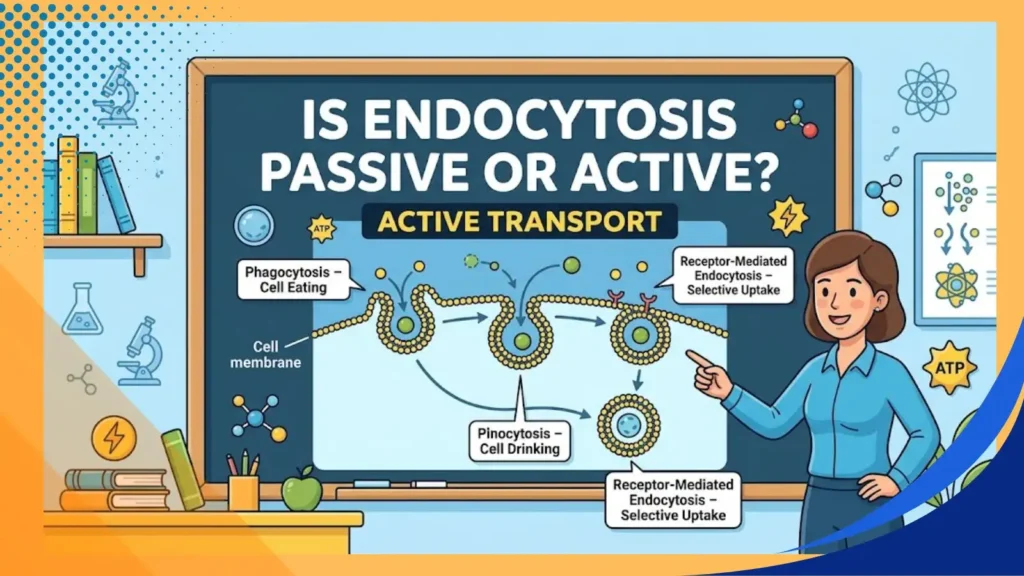
The simple answer is that endocytosis is an active transport process. The cell uses energy to change its membrane shape, surround material, and form a vesicle inside the cell. This allows the cell to take in large particles, fluids, macromolecules, and other materials. OpenStax identifies endocytosis as a type of active transport and explains that the plasma membrane folds inward before pinching off to form a vesicle.
Understanding this difference makes cell transport much easier. It also helps students answer biology exam questions with confidence.
Is Endocytosis Passive or Active – Quick Answer?
Endocytosis is active transport, not passive transport.
During endocytosis, the cell uses energy to bring material inside. The cell membrane bends inward and surrounds the material. It then pinches off and forms a small membrane-bound vesicle.
There are three common forms of endocytosis:
- Phagocytosis: The cell takes in large particles. It is often called “cell eating.”
- Pinocytosis: The cell takes in extracellular fluid and dissolved substances. It is often called “cell drinking.”
- Receptor-mediated endocytosis: Specific substances attach to receptors on the cell surface before entering the cell.
For example, some white blood cells use phagocytosis to engulf harmful microorganisms. Cells can also use receptor-mediated endocytosis to take up substances such as LDL particles.
Why Is Endocytosis Active?
Endocytosis requires cellular work to reshape the plasma membrane and move material into the cell. Therefore, it is classified as active transport.
By contrast, passive transport does not require cellular energy. Diffusion and osmosis are common examples of passive transport.
Quick rule:
Endocytosis = active transport
Diffusion = passive transport
The Origin of “Is Endocytosis Passive or Active”
The phrase “is endocytosis passive or active” is a modern biology question based on the classification of membrane transport.
The word endocytosis has Greek roots. The prefix endo- means “within” or “inside,” while kytos refers to a cell or container. The suffix -osis indicates a process or condition.
The term endocytosis was coined by Belgian cytologist Christian de Duve in 1963. It was created to describe cellular processes that bring material into a cell through membrane vesicles. The term also provides a useful counterpart to exocytosis, which moves material out of a cell.
The name itself offers a helpful memory trick:
- Endo = inside
- Exo = outside
- Endocytosis = bringing material inside
- Exocytosis = releasing material outside
There is no British-versus-American spelling conflict here. The scientific term is normally written endocytosis in both forms of English.
British English vs American English Spelling
Unlike words such as color/colour or center/centre, endocytosis does not have separate British and American spellings.
Both British and American scientific writing use:
endocytosis
The pronunciation can vary slightly between accents, but the spelling remains the same.
| Term | American English | British English | Meaning |
|---|---|---|---|
| Endocytosis | endocytosis | endocytosis | Bringing material into a cell |
| Exocytosis | exocytosis | exocytosis | Releasing material from a cell |
| Phagocytosis | phagocytosis | phagocytosis | Engulfing large particles |
| Pinocytosis | pinocytosis | pinocytosis | Taking in fluid and dissolved material |
| Receptor-mediated endocytosis | receptor-mediated endocytosis | receptor-mediated endocytosis | Selective cellular uptake |
So, if you are writing for a US, UK, Canadian, Australian, or international audience, endocytosis is the correct spelling.
Which Spelling Should You Use?
There is only one standard spelling to use:
endocytosis
If you are writing for an American audience, use endocytosis.
you are writing for a British or Commonwealth audience, use endocytosis.
If you are writing a scientific article for a global audience, use endocytosis.
The main difference is not spelling. Instead, scientific writers should focus on using the term correctly and explaining the transport process clearly.
For example:
Correct:
“Endocytosis is an active transport process.”
Incorrect:
“Endocytosis is a passive transport process.”
This distinction is more important than any regional spelling rule.
Common Mistakes with “Is Endocytosis Passive or Active”
Students often make a few simple mistakes when learning membrane transport.
Mistake 1: Calling Endocytosis Passive
Some students think that material enters the cell naturally, so the process must be passive.
Correction: Endocytosis is active transport because the cell performs work to engulf material and form a vesicle.
Mistake 2: Confusing Endocytosis With Diffusion
Diffusion moves particles from an area of higher concentration to an area of lower concentration without cellular energy.
Endocytosis is different. The cell surrounds material with its membrane and brings it inside in a vesicle.
Mistake 3: Thinking All Transport Uses ATP in the Same Way
Active transport is a broad category. Some active transport uses membrane pumps, while endocytosis uses membrane movement and vesicle formation.
Therefore, it is better to say that endocytosis requires cellular energy rather than treating it as identical to a sodium-potassium pump.
Mistake 4: Confusing Endocytosis With Exocytosis
Remember:
- Endocytosis → into the cell
- Exocytosis → out of the cell
These processes work in opposite directions.
Mistake 5: Thinking Endocytosis Has Only One Form
Endocytosis includes several pathways. The main forms commonly taught are phagocytosis, pinocytosis, and receptor-mediated endocytosis.
“Is Endocytosis Passive or Active” in Everyday Examples
Although endocytosis is a scientific term, it appears in many educational and scientific contexts.
In Emails
A biology teacher might write:
“Please review whether endocytosis is an active or passive transport process before tomorrow’s class.”
In News
A science article may discuss how a virus enters a host cell through endocytosis.
On Social Media
A student might post:
“Finally remembered it: endocytosis is active transport!”
In Formal Writing
A research paper may state:
“The cells internalized the material through receptor-mediated endocytosis.”
In Biology Exams
A common question is:
Is endocytosis passive or active?
A strong answer is:
Endocytosis is an active transport process because the cell uses energy to engulf extracellular material and form an intracellular vesicle.
This answer is short, accurate, and directly addresses the question.
Endocytosis vs Passive Transport
The easiest way to understand the difference is to compare the processes side by side.
| Feature | Endocytosis | Passive Transport |
|---|---|---|
| Transport type | Active | Passive |
| Cellular energy required | Yes | No |
| Uses membrane vesicles | Yes | No |
| Moves large particles | Yes | Usually no |
| Examples | Phagocytosis, pinocytosis | Diffusion, osmosis |
| Main action | Brings material into the cell | Moves substances across the membrane |
| Concentration gradient | Not the defining feature | Often moves down a gradient |
Passive transport includes diffusion, osmosis, and facilitated diffusion. These processes do not require the cell to spend metabolic energy.
Endocytosis is different because the membrane must actively change shape to surround and internalize material.
“Is Endocytosis Passive or Active” – Google Trends & Usage Data
The search phrase “is endocytosis passive or active” has a clear educational purpose. People usually search it when they need to understand or review membrane transport.
The phrase is especially useful for:
- High school biology
- College biology
- Anatomy and physiology
- Medical education
- Biology homework
- Exam preparation
- Cell biology study guides
Search interest can also vary with school and exam schedules. Students often use question-style searches when they need a direct answer, which explains why phrases such as “is endocytosis active or passive” are common.
The term endocytosis itself is strongly associated with biology, medicine, cell biology, and scientific education. Dictionary references list it as a physiology or cytology term, while scientific textbooks explain it as a form of active transport.
Google Trends can be useful for comparing search interest across countries and periods, but search-interest scores change over time. They should not be treated as fixed measures of scientific importance.
The strongest related search terms include:
- is endocytosis active or passive
- is endocytosis active transport
- is endocytosis passive transport
- why is endocytosis active transport
- does endocytosis require energy
- does endocytosis use ATP
- endocytosis vs diffusion
- phagocytosis active or passive
- pinocytosis active or passive
- receptor-mediated endocytosis
Comparison Table: Endocytosis and Related Transport Terms
| Process | Active or Passive? | Uses Energy? | Main Function |
|---|---|---|---|
| Endocytosis | Active | Yes | Brings material into the cell |
| Phagocytosis | Active | Yes | Engulfs large particles |
| Pinocytosis | Active | Yes | Takes in fluid and dissolved substances |
| Receptor-mediated endocytosis | Active | Yes | Selectively takes in specific substances |
| Exocytosis | Active | Yes | Releases material from the cell |
| Simple diffusion | Passive | No | Moves substances down a gradient |
| Osmosis | Passive | No | Moves water across a membrane |
| Facilitated diffusion | Passive | No | Moves substances through membrane proteins |
This comparison shows why endocytosis belongs in the active transport group. OpenStax specifically describes endocytosis as active transport and notes that it allows cells to take in large molecules, particles, and even whole cells.
FAQs About Is Endocytosis Passive or Active?
1. Is endocytosis active or passive?
Endocytosis is active transport. The cell uses energy to engulf extracellular material and form a vesicle inside the cell.
2. Does endocytosis require energy?
Yes. Endocytosis requires cellular energy because the cell must reshape its membrane and internalize material.
3. Is phagocytosis active or passive?
Phagocytosis is active. It is a type of endocytosis in which a cell engulfs large particles, such as microorganisms or cellular debris.
4. Is pinocytosis active or passive?
Pinocytosis is also active transport. The cell takes in extracellular fluid and dissolved substances by forming small vesicles.
5. Is receptor-mediated endocytosis active or passive?
Receptor-mediated endocytosis is active. Specific molecules bind to receptors on the cell membrane, and the membrane then forms a vesicle to bring them inside.
6. What is the difference between endocytosis and diffusion?
Endocytosis uses cellular energy and forms vesicles. Diffusion is passive and moves particles down a concentration gradient without cellular energy.
7. Is exocytosis active or passive?
Exocytosis is also an active transport process. It moves material out of the cell when an internal vesicle fuses with the plasma membrane.
Conclusion
So, is endocytosis passive or active? The answer is clear: endocytosis is active transport.
During endocytosis, the cell brings material inside by changing the shape of its plasma membrane. The membrane surrounds the material and pinches inward to form a vesicle. This process requires cellular energy.
The three major forms include phagocytosis, pinocytosis, and receptor-mediated endocytosis. Each form helps cells take in different types of material. Phagocytosis handles large particles, pinocytosis takes in fluid and dissolved substances, and receptor-mediated endocytosis allows selective uptake.
It is also important to remember that endocytosis has the same spelling in British and American English. There is no regional spelling choice to make.
For exams, remember one simple rule: endocytosis is active, while diffusion and osmosis are passive. Once you remember that difference, many cell-transport questions become much easier to answer.

Hi, I’m Henry Collins, the educator behind Wordspry.com
I’m dedicated to helping English learners build confidence through easy grammar explanations, writing tips, and everyday language learning resources.