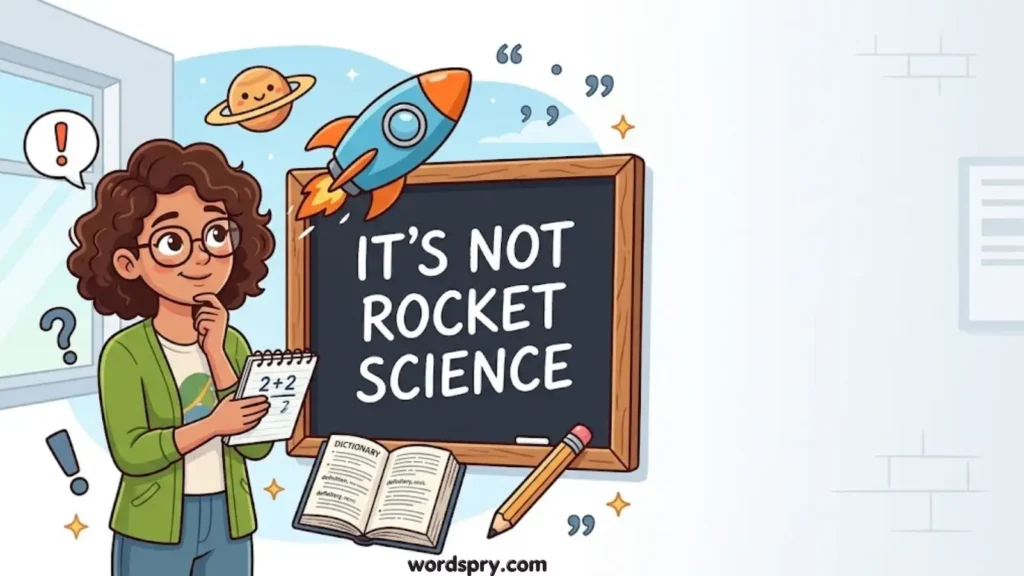
If someone says “It’s not rocket science,” they usually mean that something is not very difficult to understand or do. The phrase often reassures someone who feels worried about a task. It can also suggest that a person should be able to learn something with a little effort.
For example, a friend might say, “Just follow the instructions. It’s not rocket science.” The speaker does not mean anything about actual rockets. Instead, the phrase compares an ordinary task with the highly technical field of rocket science.
This common English idiom appears in conversations, emails, social media posts, workplaces, and everyday writing. However, its tone can change depending on the situation. It may sound encouraging in one context but slightly dismissive in another.
RELATED: Casi Algo Meaning: Full Guide to Love, Feelings, and Relationships
Quick Answer
“It’s not rocket science” means something is not extremely difficult or complicated. People use it to say that a task requires some basic knowledge or effort but does not demand advanced skills.
Example:
“You just need to enter your details and click submit. It’s not rocket science.”
The phrase is usually informal and conversational. It does not refer to ownership, control, physical objects, or a specific technical skill. Instead, it describes the difficulty of an activity or idea.
Meaning of “It’s Not Rocket Science”
The idiom means that something is relatively easy to understand, learn, or accomplish. “Rocket science” represents an activity that requires specialized knowledge, advanced skills, and careful calculation.
The phrase therefore creates a simple comparison: if a task is not rocketsscience, you probably do not need expert-level knowledge to complete it.
Examples:
- “Making toast is easy. It’s not rocket science.”
- “Follow the steps carefully. It’s not rocket science.”
Why Do People Misuse “It’s Not Rocket Science”?
Many mistakes happen because writers confuse literal and figurative meanings. The expression contains ordinary words, but the complete phrase works as an idiom.
People may also change the wording when typing quickly. Common versions such as “its not rocket science” leave out the apostrophe in it’s, which changes the grammatical form.
Remember:
- It’s = it is or it has
- Its = belonging to it
So, “It’s not rocket science” is correct because it means “It is not rocket science.”
Origin of “It’s Not Rocket Science”
The expression developed from the idea that rocket science represents highly advanced technical knowledge. Modern rocketry depends on physics, mathematics, engineering, and specialized scientific training.
The phrase became a popular way to describe something much simpler by comparison. Its exact first use is difficult to identify, but the expression became increasingly common in modern English during the 20th century.
The word rocket has a long history, while science comes through Latin scientia, meaning knowledge or understanding. The modern idiom combines these ideas to create a humorous comparison between complex science and an ordinary task.
Origin and Etymology of “It’s Not Rocket Science”
The idiom “It’s not rocket science” comes from the idea that rocket science represents something extremely complex and difficult to understand. Rocketry combines advanced mathematics, physics, engineering, and scientific knowledge, so people began using it as a humorous comparison for difficult subjects.
The expression is relatively modern. As rocket technology became more familiar during the 20th century, especially during the development of modern rockets and the space program, “rocket science” became a popular symbol of intellectual difficulty. Saying that something is “not rocket science” therefore means that the task is much easier than advanced rocket engineering.
British vs. American English
There is no spelling difference between British and American English for this expression. Both varieties use the same words and punctuation.
| Variety | Correct Form | Meaning |
|---|---|---|
| American English | It’s not rocket science. | Not very difficult |
| British English | It’s not rocket science. | Not very difficult |
| Canadian English | It’s not rocket science. | Not very difficult |
| Australian English | It’s not rocket science. | Not very difficult |
The difference appears mainly in pronunciation, context, or preferred expressions, not in the spelling of this idiom.
When to Use “It’s Not Rocket Science”
You can use the expression in casual conversations, emails, assignments, and workplace discussions when the tone allows informal language.
It works well when encouraging someone or explaining that a task is manageable. However, avoid it in highly formal legal documents, academic definitions, or serious professional reports unless the context specifically allows idiomatic language.
Suitable situations
- Casual conversations
- Friendly emails
- Social media
- Informal workplace communication
- Personal writing
- Some school assignments
Less suitable situations
- Contracts
- Legal documents
- Formal research papers
- Official policies
- Highly formal reports
Common Mistakes
One common mistake is writing “Its not rocket science.” The correct form is “It’s not rocket science” because it’s means it is.
Another mistake involves changing the phrase unnecessarily, such as “It isn’t rocket sciences.” The standard idiom uses rocket science as an uncountable expression.
| Incorrect | Correct |
|---|---|
| Its not rocket science. | It’s not rocket science. |
| It’s not rocket sciences. | It’s not rocket science. |
| Its not rocket sciences. | It’s not rocket science. |
Typing quickly can cause people to drop the apostrophe, add an unnecessary plural ending, or rearrange the words.
Everyday Examples
You can hear this idiom in many everyday situations. A teacher might use it to reassure students, while a coworker might use it to describe a simple computer task.
Email:
“Just complete the form and attach the file. It’s not rocket science.”
Social media:
“Cooking pasta is easy. It’s not rocket science!”
Professional writing:
“The process is straightforward and does not require specialized training.”
School assignment:
“The experiment looks complicated, but it’s not rocket science once you understand the steps.”
The final example works best in informal school writing rather than a highly academic essay.
Usage Comparison Table
| Context | Incorrect or Weak Use | Better Use |
|---|---|---|
| Daily speech | “Its not rocket science.” | “It’s not rocket science.” |
| Skill | “Learning this is rocket sciences.” | “Learning this isn’t rocket science.” |
| Professional | “The procedure is rocket science.” | “The procedure isn’t very complicated.” |
| Legal writing | “It’s not rocket science.” | “The procedure is relatively straightforward.” |
| Casual conversation | “It is not rocket science, you know.” | “It’s not rocket science.” |
The key point is that the phrase works naturally in informal contexts, while formal writing often benefits from a more precise alternative.
Is “It’s Not Rocket Science” Rude?
It can be, depending on how you say it. When used kindly, the phrase can reassure someone that they can handle a difficult-looking task.
However, saying it to someone who is genuinely struggling may sound dismissive or condescending. Your tone and relationship with the listener matter.
For example, “Don’t worry, we’ll figure it out. It’s not rockets science” sounds supportive. But “You should know this already. It’s not rockets science” may sound insulting.
Better Alternatives
Sometimes you need a more neutral expression. Instead of “It’s not rocket science,” you can say:
- It’s not very difficult.
- It’s fairly straightforward.
- It’s easy to learn.
- It’s manageable.
- It’s simple once you understand it.
- It doesn’t require advanced knowledge.
These alternatives work especially well in formal and professional writing.
FAQs About “It’s Not Rocket Science”
What does “It’s not rocket science” mean?
It means that something is not extremely difficult or complicated. The phrase compares an ordinary task with the advanced knowledge associated with rocket science.
Is “It’s not rocket science” an idiom?
Yes. “It’s not rockets science” is a common English idiom. Its figurative meaning is different from its literal meaning.
How do you remember the spelling?
Remember that “it’s” means “it is.” You can replace it with “it is”: “It is not rockets science.” If that replacement works, use it’s.
Is “Its not rocket science” correct?
No. “Its not rocket science” is incorrect because it needs the apostrophe in it’s, meaning “it is.”
Is the phrase formal or informal?
The expression is mainly informal. It works naturally in conversations, casual emails, social media, and friendly workplace communication.
Can I use it in an essay?
You can use it in a personal or informal essay, but formal academic writing usually benefits from a clearer phrase such as “the task is relatively straightforward.”
Can “It’s not rocket science” sound rude?
Yes. The phrase can sound dismissive if you use it toward someone who is struggling. Use a gentler alternative when you want to encourage someone respectfully.
Conclusion
“It’s not rocket science” is a popular English idiom that means something is not extremely difficult. It uses rocket science as a humorous symbol of advanced knowledge and compares it with a simpler task.
The correct spelling is always “It’s not rocket science,” in both British and American English. Pay particular attention to the apostrophe because it’s means “it is,” while its shows possession.
Use the expression naturally in casual conversations, friendly emails, social media, and informal writing. For legal documents, formal reports, and academic work, choose a more precise alternative such as “relatively straightforward.”
Most importantly, remember the complete expression rather than memorizing isolated words. Once you understand its meaning and tone, using “It’s not rocket science” becomes easy.

Hi, I’m Victoria Lane, the voice behind Wordspry!
I’m passionate about helping students and readers master English grammar, vocabulary, and writing through simple, friendly, and easy-to-follow content.