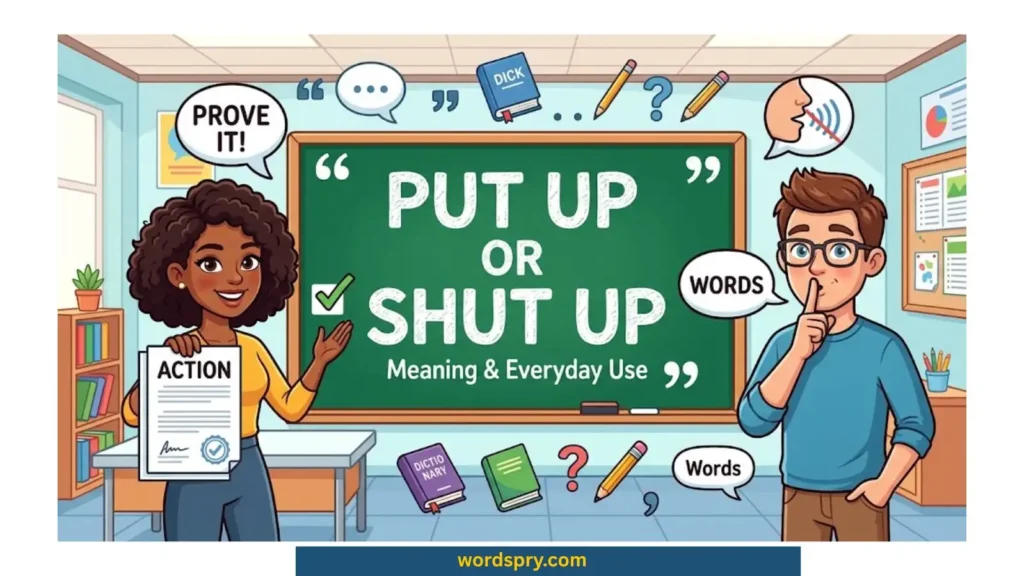
Quick answer: “Put up or shut up” means prove what you say or stop talking about it.
Imagine a friend says, “I can beat you at chess.” You smile and say, “Okay, put up or shut up.” You’re not asking them to remain silent or impolite indefinitely.. You are saying, “Show me that you can do it.” The phrase often appears when someone makes big claims but does not take action.
“Put up or shut up” is a common English idiom. It can sound funny among friends, but it can also sound harsh. The phrase combines two short commands. Put up means to provide something, usually money or effort, to support a claim or challenge. Shut up means to stop talking.
People search for put up or shut up because the phrase can seem confusing. “Put up” has many meanings in English. “Shut up” can also mean more than simply becoming quiet. Together, they form a fixed expression with a special meaning.
You may hear put up or shut up in sports, debates, social media, business, and daily talk. It often challenges someone to turn words into action.
✦ ─────────────── ✦
Pronunciation
American English
- Put up: /pʊt ʌp/
- Shut up: /ʃʌt ʌp/
- Put up or shut up: /pʊt ʌp ɔr ʃʌt ʌp/
British English
- Put up: /pʊt ʌp/
- Shut up: /ʃʌt ʌp/
- Put up or shut up: /pʊt ʌp ə ˈʃʌt ʌp/
The pronunciation is almost the same in American and British English. The main difference appears in the way speakers say or.
✦ ─────────────── ✦
Now, let’s look at each part and see why this short phrase carries such a strong message.
Difference Between “Put Up” and “Shut Up”
“Put up” and “shut up” have different meanings on their own. When joined together, they create an idiom.
1. “Put Up” Can Mean “Provide”
In this phrase, put up can mean to provide money, support, effort, or proof.
Examples:
- “If you think you can win, put up the money.”
- “He put up his own money for the project.”
Shut up, however, tells someone to stop talking.
Examples:
- “Please shut up for a moment.”
- “The children finally shut up.”
2. “Put Up” Connects Words With Action
“Put up” focuses on doing something.
It challenges a person to act instead of making claims.
Examples:
- “You say you can run faster. Put up a challenge.”
- “He says he can fix it, so let him put up the effort.”
“Shut up” focuses on stopping speech.
Examples:
- “She told him to shut up.”
- “The coach asked the players to shut up and listen.”
3. “Put Up” Can Show Confidence
The phrase can challenge someone to prove their confidence.
Examples:
- “You think you are the best? Put up or shut up.”
- “He says his team will win. Now he must put up.”
“Shut up” does not prove anything. It simply asks for silence.
Examples:
- “Shut up and listen.”
- “Everyone became quiet when the teacher arrived.”
4. “Put Up” May Involve Money
In older uses of the expression, put up can refer to placing money on a challenge or wager.
Examples:
- “If you believe that horse will win, put up some money.”
- “He was ready to put up $100 on the game.”
“Shut up” has no connection to money.
Examples:
- “He told his brother to shut up.”
- “The crowd would not shut up.”
5. “Put Up” Suggests Proof
Someone who makes a strong claim may need to support it.
Examples:
- “You say the plan works. Put up the results.”
- “She claims she can do it, so she needs to put up some proof.”
“Shut up” simply removes the words.
Examples:
- “If you have nothing useful to say, shut up.”
- “He finally shut up after the argument.”
6. “Put Up” Can Be Positive
The action behind “put up” can show courage, skill, or effort.
Examples:
- “Our team put up a strong fight.”
- “She put up an amazing performance.”
“Shut up” usually sounds negative when directed at another person.
Examples:
- “He rudely told his friend to shut up.”
- “The angry customer told everyone to shut up.”
7. “Shut Up” Can Also Show Surprise
In casual speech, shut up! does not always mean “be quiet.”
It can show shock or excitement.
Examples:
- “Shut up! You won the lottery?”
- “Shut up! That is amazing!”
This use depends heavily on tone.
8. “Put Up” Is Less Aggressive
“Put up” usually focuses on action.
Example:
- “Put up some evidence if you disagree.”
“Shut up” can sound much more direct.
Example:
- “Shut up and listen.”
Therefore, the full phrase can sound challenging or confrontational.
9. “Put Up” Can Stand Alone
English speakers use put up in many other expressions.
Examples:
- “We put up a tent.”
- “They put up a new sign.”
“Shut up” also works alone.
Examples:
- “Please shut up.”
- “The machine suddenly shut up.”
However, the second example is uncommon because shut up normally describes a person becoming silent.
10. Together, They Create a Challenge
The biggest difference appears when both expressions join together.
Put up means:
Show your ability, support your claim, or take action.
Shut up means:
Stop making claims if you will not act.
Examples:
- “You say you can win. Put up or shut up.”
- “He kept bragging about his skills, so his friend said, ‘Put up or shut up.’”
✦ ─────────────── ✦
Nature and Behaviour of “Put Up” and “Shut Up”
Nature of “Put Up”
“Put up” is a phrasal verb. Its meaning changes with context.
It can mean:
- provide something
- display something
- build something temporarily
- tolerate something
- offer resistance
- make a challenge
For example:
“They put up a tent.”
Here, it means set up.
But:
“She put up a strong argument.”
Here, it means presented or offered something.
Nature of “Shut Up”
“Shut up” is also a phrasal verb.
Its basic meaning is to become quiet or make someone quiet.
It can also express surprise in informal speech.
For example:
“Shut up! I cannot believe it!”
The meaning depends on tone and situation.
✦ ─────────────── ✦
Why People Get Confused About “Put Up or Shut Up”
People often confuse this phrase because both parts have several meanings.
The word put can appear in hundreds of English expressions. The word shut also appears in many phrases.
For example:
- put up a poster
- put up a fight
- put up money
- put up with noise
- shut up
- shut down
- shut off
- shut out
When you join put up and shut up, the phrase becomes an idiom.
It does not mean someone must literally put something somewhere and then become silent.
It means:
Stop making claims and prove your point through action.
✦ ─────────────── ✦
Comparison Table
| Feature | Put Up | Shut Up | Put Up or Shut Up |
|---|---|---|---|
| Type | Phrasal verb | Phrasal verb | Idiomatic expression |
| Basic meaning | Provide, raise, display, tolerate, or resist | Become or make quiet | Prove your claim or stop talking |
| Tone | Usually neutral | Often direct | Often challenging |
| Formality | Depends on context | Usually informal | Informal |
| Main idea | Action or support | Silence | Action over empty words |
| Common setting | Daily speech and writing | Casual speech | Arguments, sports, debates |
| Can be positive? | Yes | Sometimes | Sometimes |
| Can sound rude? | Sometimes | Yes | Yes |
| Literal meaning | Possible | Possible | Usually figurative |
| Example | “They put up a tent.” | “Please shut up.” | “Put up or shut up.” |
✦ ─────────────── ✦
The Origin of “Put Up or Shut Up”
The exact early history of put up or shut up is difficult to pin down to one person or one event.
The expression developed from older uses of put up, especially the idea of putting up money or support for a claim, challenge, or wager.
The phrase follows a simple pattern found in English:
Do something to support your words, or stop making the claim.
This idea became especially useful in competitive settings. Sports, gambling, politics, business, and public debate all create situations where people make claims and then need to prove them.
Over time, the phrase became a familiar informal idiom.
✦ ─────────────── ✦
British vs American English
The expression is understood in both British and American English.
There is no major spelling difference.
American English
Americans commonly use:
“Put up or shut up.”
Example:
“You say you can beat me. Put up or shut up.”
British English
British speakers also use:
“Put up or shut up.”
Example:
“If he thinks he can do better, he should put up or shut up.”
The phrase remains informal in both varieties.
The bigger difference comes from tone. In either country, saying shut up to someone can sound rude.
For polite situations, use softer language such as:
- “Please show us.”
- “Can you support your claim?”
- “Let your actions speak.”
- “Can you prove it?”
✦ ─────────────── ✦
Which One Should You Use?
Use put up or shut up when you are speaking casually and want to challenge a claim.
In American English
It is common in informal speech, sports, arguments, and online discussions.
In British English
It is also understood and used in informal conversation.
For global English
The phrase is widely understandable, but it may sound aggressive.
If you are writing for school, work, or a formal audience, choose a softer phrase.
Instead of:
“Put up or shut up.”
Try:
“Please support your claim with evidence.”
That sounds much more professional.
✦ ─────────────── ✦
Common Mistakes
Mistake 1: Taking It Literally
Wrong idea: Someone must physically put something up and then become quiet.
Correct meaning: Prove your claim or stop making it.
Mistake 2: Using It in Formal Writing
The phrase can sound rude.
Better:
“The writer should provide evidence for this claim.”
Mistake 3: Thinking “Shut Up” Always Means Silence
Sometimes shut up! expresses surprise.
Example:
“Shut up! You actually met the singer?”
Mistake 4: Confusing “Put Up” With “Put Up With”
These expressions differ.
“I put up a poster.”
means I displayed a poster.
“I put up with the noise.”
means I tolerated the noise.
Mistake 5: Forgetting the Informal Tone
“Put up or shut up” is not a polite request.
Use it carefully.
✦ ─────────────── ✦
Everyday Usage Examples
In Emails
This phrase is usually too strong for a professional email.
Instead of:
“Put up or shut up.”
Write:
“Please provide evidence to support your position.”
On Social Media
It can appear often in online debates.
“You keep saying the plan will fail. Put up or shut up.”
In Sports
It works naturally in competitive settings.
“He says he can score ten goals. Now it is time to put up or shut up.”
In News
News writers usually avoid the phrase in serious reporting unless they are quoting someone.
“The coach told his critics to stop talking and show their results.”
In Formal Writing
Use formal alternatives.
Instead of:
“Put up or shut up.”
Use:
“Claims should be supported by evidence.”
✦ ─────────────── ✦
Usage Trends
The phrase remains common in informal English.
It appears in:
- sports talk
- political debate
- online arguments
- business discussions
- comedy
- movies
- everyday conversation
Social media has also helped short idioms spread quickly.
However, the phrase can feel harsh. Many modern speakers choose softer versions when they want to avoid conflict.
For example:
“Let your actions speak.”
This carries a similar idea without the sharp tone.
✦ ─────────────── ✦
Metaphors and Similes
The phrase itself works like a metaphor for action versus empty talk.
Metaphor
“Actions are the real proof.”
This compares action with evidence.
Simile
“His promises were like smoke in the wind.”
This suggests that his words disappeared without producing results.
Related Example
“She talks like a champion, but now she needs to perform like one.”
The idea matches the message behind put up or shut up.
✦ ─────────────── ✦
Connotative Meaning
The phrase has a strong informal tone.
Positive Meaning
It can encourage action.
“You have a great idea. Now put it into practice.”
The message is motivating.
Negative Meaning
It can insult or challenge someone.
“You keep bragging. Put up or shut up.”
Here, the speaker sounds annoyed.
Neutral Meaning
In a friendly competition, it can sound playful.
“You think you can beat me? Put up or shut up!”
Friends may use it as a joke.
Tone matters a lot.
✦ ─────────────── ✦
Idioms and Proverbs
Several English expressions share the same basic idea.
“Actions speak louder than words”
This means actions show the truth better than promises.
Example:
“Do not worry about his promises. Actions speak louder than words.”
“Walk the talk”
This means doing what you say.
Example:
“She talks about fitness and walks the talk.”
“The proof is in the pudding”
This means the real value of something appears when you test it.
Example:
“The plan sounds good, but the proof is in the pudding.”
“Put your money where your mouth is”
This expression is very close to put up or shuts up.
It means you should support your words with action or money.
Example:
“You say the business will succeed. Put your money where your mouth is.”
✦ ─────────────── ✦
Literature and Movies
The idea behind put up or shut up appears often in literature because writers frequently explore the conflict between words and actions.
In satire, drama, and comedy, characters often make bold claims and later face pressure to prove themselves. This creates humor and conflict.
The phrase also fits naturally into sports films, crime stories, comedies, and competitive dramas.
Movies often use expressions like this during:
- challenges
- arguments
- competitions
- courtroom scenes
- locker-room talks
- confrontations
American films often use the expression to create a tough, direct tone. British films may use it with dry humor or sarcasm.
Because the phrase is informal, it works especially well in dialogue rather than formal narration.
✦ ─────────────── ✦
Why This Difference Matters
Understanding this phrase helps English learners understand real conversation.
A learner may know that put up means “raise” or “display.” They may also know that shuts up means “be quiet.”
But together, the words create a different message.
This is an important lesson about English idioms.
Words do not always keep their separate meanings when they appear together. Context matters.
Understanding the phrase also helps learners recognize tone. Someone saying put up or shuts up may not simply want silence. They may be challenging another person.
This difference matters in society too. People often need to separate claims from proof.
Words can sound impressive. Actions show whether those words have value.
✦ ─────────────── ✦
Usefulness in Daily Life
You can understand the phrase in many everyday situations.
At School
A student claims an answer is correct.
“Show your work and prove it.”
At Work
A worker says a new plan will improve sales.
“Let the results prove the idea.”
In Sports
A player says the team will win.
“Now they need to perform.”
Online
Someone makes a strong claim without evidence.
“Back up your argument with facts.”
With Friends
A friend boasts about a skill.
“Okay, show me what you can do.”
These softer versions often communicate the same idea without sounding rude.
✦ ─────────────── ✦
Situational Preference
Choose put up or shut up when you are speaking with close friends, discussing sports, joking around, or challenging someone in an informal setting. Avoid it when speaking to your boss, teacher, customer, or stranger because shut up can sound rude. In professional writing, use phrases such as support your claim, show the evidence, prove your point, or let the results speak for themselves. The phrase works best when the speaker wants a strong, direct tone. Your choice should depend on your relationship with the listener, the setting, and the level of respect the situation requires.
✦ ─────────────── ✦
FAQs
1. What does “put up or shut up” mean?
It means prove what you are saying through action, or stop making the claim.
2. Is “put up or shut up” rude?
It can be. The phrase has a strong and sometimes aggressive tone.
3. Is “put up or shut up” an idiom?
Yes. The complete expression is an informal English idiom.
4. What does “put up” mean in this phrase?
It means to support a claim through action, effort, money, proof, or performance.
5. What does “shut up” mean?
Its basic meaning is to become quiet or make someone quiet. In casual speech, it can also express surprise.
6. Is the phrase used in British English?
Yes. British speakers understand and use it, especially in informal situations.
7. What is a polite alternative?
You can say:
- “Please support your claim.”
- “Show us the evidence.”
- “Let your actions speak.”
- “Prove your point.”
✦ ─────────────── ✦
Conclusion
Put up or shut up is a short but powerful English idiom. It tells someone to stop making empty claims and prove their words through action. The phrase combines two phrasal verbs, but together they create a special meaning.
The expression is common in informal speech, sports, online discussions, arguments, and friendly challenges. It can sound funny among friends, but it can also sound rude or aggressive. That is why context matters.
The key lesson is simple: words make claims, but actions provide proof. If someone says they can do something, people may eventually expect results. This is why the phrase has remained useful in everyday English.
For formal situations, avoid the expression. Choose softer language such as support your claim, provide evidence, or let your actions speak.
Once you understand the meaning, tone, and context of put up or shut up, you can recognize it easily in conversations, social media, movies, and other forms of modern English.
✦ ─────────────── ✦

Hi, I’m Liam Harper, the voice behind Wordspry!
I’m here to make English grammar simple, clear, and easy to understand for learners of all levels. Through practical lessons and helpful guides, I aim to help you improve your writing and communication skills with confidence.