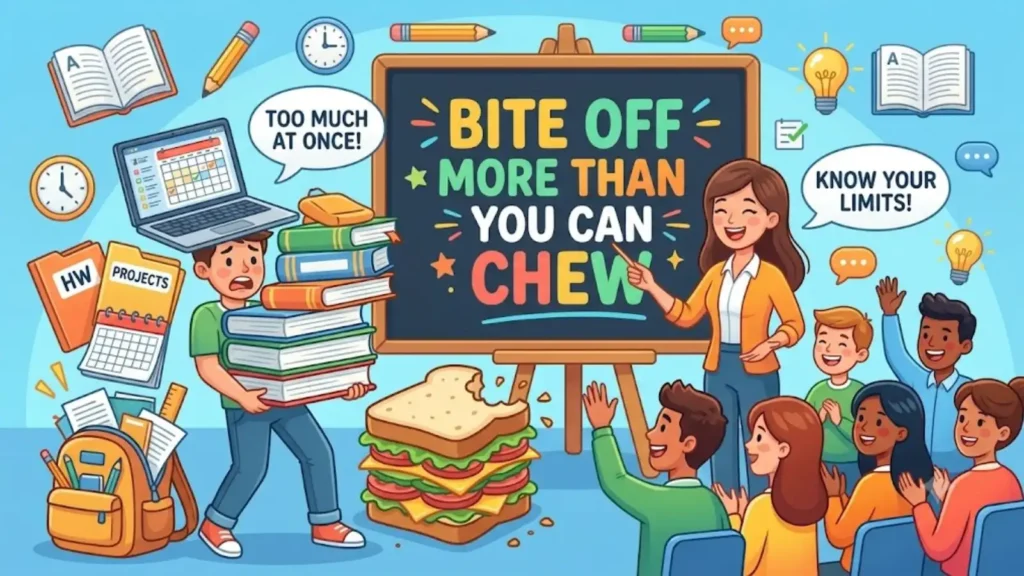
Have you ever accepted a huge project at work, signed up for too many classes, or promised to help everyone at once—only to realize you couldn’t keep up? If someone smiled and said, “You bit off more than you could chew,” they weren’t talking about food. They were using one of the most popular English idioms to describe taking on more responsibility than you can realistically handle.
You may have seen this expression in books, movies, motivational posts, classroom discussions, or everyday conversations. But what does it really mean? Is it always negative, or can it sometimes encourage personal growth?
In this guide, you’ll learn the meaning of “bite off more than you can chew,” where the idiom came from, why people use it, and how to use it correctly in speech and writing. You’ll also discover real-life examples, similar idioms, common mistakes, and practical tips that will help you use this expression naturally and confidently.
RELATED; No Cuts No Buts No Coconuts: Meaning, Origin and Examples
Quick Answer
“Bite off more than you can chew” means to take on more work, responsibility, or challenges than you can successfully manage. The idiom warns against overcommitting and reminds people to understand their limits before making promises or accepting difficult tasks.
Table of Contents
- Meaning at a Glance
- What Does “Bite Off More Than You Can Chew” Mean?
- Background & Origin
- Why People Use the Idiom
- Common Contexts
- Similar Idioms
- Common Mistakes
- How to Use It in Sentences
- FAQs
- Conclusion
Meaning at a Glance
| Aspect | Explanation |
|---|---|
| Literal Meaning | Taking a bite of food that is too large to chew comfortably. |
| Figurative Meaning | Accepting more work or responsibility than you can manage. |
| Emotional Meaning | Feeling overwhelmed, stressed, or overcommitted. |
| Common Usage | School, work, business, relationships, and everyday conversations. |
| Tone | Friendly advice, caution, or mild criticism. |
| Related Topics | Idioms, time management, productivity, decision-making, personal growth. |
What Does “Bite Off More Than You Can Chew” Mean?
The idiom “bite off more than you can chew” means taking on a task, commitment, or responsibility that is too difficult or too large to complete successfully. It reminds people to recognize their limits before making promises or accepting new challenges.
Literal Meaning
Imagine taking an enormous bite of food. If the bite is too big, you struggle to chew it properly. It becomes uncomfortable and difficult to swallow.
This simple image forms the basis of the idiom.
Figurative Meaning
In everyday English, the expression describes situations where someone overestimates their abilities or available time.
For example:
James: “I’m working two jobs while starting my own business.”
Friend: “Be careful—you might be biting off more than you can chew.”
The friend isn’t criticizing James. They’re warning him that he may become overwhelmed.
Emotional Meaning
The idiom often reflects feelings such as:
- Stress
- Pressure
- Anxiety
- Burnout
- Frustration
However, it can also encourage people to slow down, plan carefully, and set realistic goals.
Background & Origin
The exact origin of “bite off more than you can chew” isn’t known with complete certainty, but language experts agree that it has been part of English for centuries.
The phrase likely developed from everyday eating experiences. Everyone understands that taking an oversized bite makes chewing difficult or impossible. Over time, English speakers turned this familiar situation into a metaphor for accepting more responsibility than they could handle.
Written examples appeared in English during the late 1800s, and the idiom gradually became common in American and British English. Because the image is easy to understand, it has remained popular across generations.
Today, you’ll hear the phrase in workplaces, classrooms, sports, business meetings, television shows, podcasts, newspapers, and social media posts. Its simple imagery makes it memorable, while its message remains relevant in today’s busy world.
Why People Use the Idiom
People use this idiom because nearly everyone has experienced taking on too much at some point in life.
At Work
Employees may volunteer for too many projects and later struggle to meet deadlines.
Example:
“Our manager warned us not to bite off more than we could chew during the busy season.”
At School
Students often enroll in difficult courses while participating in sports and clubs.
Example:
“Taking six advanced classes was biting off more than she could chew.”
In Business
Entrepreneurs sometimes expand too quickly before building a stable foundation.
Example:
“The startup bit off more than it could chew by opening five new locations at once.”
In Personal Life
People may agree to too many commitments for family, friends, or community events.
Example:
“I promised to organize three events in one week. I definitely bit off more than I could chew.”
In Motivational Content
Life coaches and productivity experts use the idiom to encourage better planning and healthier work habits.
Rather than discouraging ambition, the phrase reminds people to balance confidence with realistic expectations.
Common Contexts Where the Idiom Is Used
Workplace
Managers often use this idiom when discussing workloads or project planning.
Example:
“Our team bit off more than we could chew by accepting every client request.”
Education
Teachers may advise students not to overload themselves with extracurricular activities and advanced coursework.
Example:
“He realized he had bitten off more than he could chew after joining four clubs.”
Sports
Athletes sometimes attempt training programs that exceed their current fitness level.
Example:
“The marathon training schedule was more than she could handle at first.”
Family Life
Parents frequently use the expression when children take on too many responsibilities.
Example:
“You don’t have to do everything yourself—you’ve bitten off more than you can chew.”
Social Media
The idiom appears in memes, productivity posts, and motivational videos discussing burnout and work-life balance.
Similar Idioms and Alternatives
Sometimes, another idiom may fit your message better. Here are several expressions with similar meanings.
| Idiom | Meaning | Best Used When |
|---|---|---|
| Take on too much | Accept more work than you can handle | Everyday conversations |
| Get in over your head | Become involved in a difficult situation | Work, finances, or personal life |
| Have too much on your plate | Already have many responsibilities | Discussing a busy schedule |
| Spread yourself too thin | Divide your time and energy among too many tasks | Productivity and time management |
| Overcommit yourself | Promise more than you can realistically do | Professional or formal writing |
| Burn the candle at both ends | Work excessively without enough rest | Talking about stress or burnout |
Although these expressions are similar, “bite off more than you can chew” is often the most vivid because it creates an easy-to-understand mental picture.
Common Mistakes When Using the Idiom
Even native English speakers sometimes misuse this idiom. Avoid these common mistakes.
Using It Literally
Unless you’re actually talking about food, the phrase should be understood figuratively.
❌ He bit off more than he could chew at dinner.
✅ He bit off more than he could chew by accepting three jobs.
Using It for Small Tasks
The idiom works best when someone has accepted a challenge that is significantly beyond their ability or available time.
Confusing It with Laziness
Someone who has bitten off more than they can chew isn’t necessarily lazy. They may simply be ambitious or overly optimistic.
Overusing the Idiom
Using the same idiom repeatedly can make your writing feel repetitive. Mix it with alternatives like “spread yourself too thin” or “get in over your head.”
How to Use “Bite Off More Than You Can Chew” in a Sentence
Here are examples in different situations.
Professional Writing
“Our company shouldn’t bite off more than it can chew by expanding before increasing production.”
Creative Writing
“Excited by every opportunity, Maya soon realized she had bitten off more than she could chew.”
Social Media Caption
“Reminder: Don’t bite off more than you can chew. Progress beats burnout every time.”
Inspirational Quote
“Dream big, but don’t bite off more than you can chew. Success grows one step at a time.”
Everyday Conversation
“I agreed to organize the party, coach the team, and finish my project. I definitely bit off more than I could chew.”
Featured Snippet Summary
“Bite off more than you can chew” is an English idiom that means taking on more work, responsibility, or challenges than you can successfully handle. It comes from the idea of taking a bite of food that is too large to chew. Today, it commonly describes situations involving overcommitment, stress, or unrealistic expectations.
Frequently Asked Questions (FAQs)
What does “bite off more than you can chew” mean?
It means accepting more work, responsibility, or challenges than you can realistically manage.
Is “bite off more than you can chew” an idiom?
Yes. It is a common English idiom used in both American and British English.
Is the idiom always negative?
Not always. It often serves as friendly advice or a warning rather than harsh criticism.
Where did the phrase originate?
The idiom comes from the simple idea that taking an oversized bite of food makes chewing difficult. It later became a metaphor for overcommitting.
Can I use this idiom in business writing?
Yes. It works well in articles, presentations, blogs, and workplace discussions. However, avoid it in legal or highly technical documents.
What is another way to say “bite off more than you can chew”?
Common alternatives include “get in over your head,” “spread yourself too thin,” “have too much on your plate,” and “take on too much.”
Conclusion
The idiom “bite off more than you can chew” reminds us that ambition is valuable, but balance is just as important. While its literal meaning involves taking a bite of food that is too large, its figurative meaning applies to everyday life whenever someone accepts more responsibilities than they can successfully manage.
Whether you’re a student, employee, business owner, or parent, this expression offers practical wisdom. It encourages thoughtful planning, realistic goal-setting, and knowing when to say “no” before stress becomes overwhelming. Instead of seeing the idiom as criticism, think of it as a reminder to work smarter rather than harder.
Learning expressions like this also helps you sound more natural in English conversations, writing, and presentations. The next time someone takes on an impossible workload, you’ll immediately recognize the situation—and you’ll know exactly which idiom fits perfectly.

Hi, I’m Henry Collins, the educator behind Wordspry.com
I’m dedicated to helping English learners build confidence through easy grammar explanations, writing tips, and everyday language learning resources.